Search

The Scotland Epistles Football Magazine

Scotland Football Fanzine

10325325_1717545008482870_8937950215301959132_n

(First posted on Facebook March 16th, 2016)

With Oliver Burke being called up to the Scotland squad he will be the first Nottingham Forest player to play for Scotland since Gareth Williams did so in 2002. However, they have provided one or two good Scotland players over the years but surprisingly there’s only been eight in total despite Brian Clough’s team of the late 80’s being filled with them.
The first Scotland player to play for Nottingham Forest was back in 1958 when Stewart Imlach won four caps. Stewart would take part in two or our World Cup Finals games that year playing in the 1-1 draw with Yugoslavia and the 2-1 defeat to France. Stewart’s son Gray Imlach wrote his biography in the book “My Father and Other Working Class Football Heroes”. The SFA in practice, prior to the late 60’s, only gave caps to players who represented Scotland in the Home Internationals but on the back of the publication of the book, a public campaign was started to recognise the players who played against other nations and in 2006 this was granted and caps were given retrospectively.
It would be 1970 before another Scot was capped as a Forest player and this time it would be Peter Cormack. Although, Jim Baxter would play for Forest for a couple of seasons from 1967-69, he was never capped for Scotland at this point.
Cormack had been capped four times in the 1960’s as a Hibs player and returned to the national side in 1970 coming on as a sub for John O’ Hare in a Euro Championship Qualifier as Scotland won 1-0 with the aforementioned O’Hare scoring. Peter would gain another four caps making a total of nine with his last appearance against the Netherlands in 1971 in a 2-1 defeat under Tommy Docherty. He would go on to make an impact on the Liverpool side of the early to mid-70’s; indeed he would make the squad for the 1974 World Cup but he would never be capped as a Liverpool player.
In his last match, Peter played alongside Archie Gemmill and John O’Hare, both of whom would be a big part of Brian Clough’s tenure at Forest.
After managing, Derby County, Clough had moved to Leeds for a disastrous time in charge for both him and Leeds and by 1975 had taken charge of Notts Forest. Among his first signings would be O’Hare and Jon McGovern both of whom would have big parts to play in Forest’s successes in the late 70’s with McGovern twice lifting the European Cup as captain. McGovern would never be capped and O’Hare who had been capped as a County player, would never feature again for Scotland after 1972.
However, Forest would have some players who would make a big impact on the Scotland team. Archie Gemmill would also move to Forest from Derby without a detour at Leeds unlike McGovern and O’Hare. Archie had been capped as a Derby player 22 times before moving to the City Ground and would only gain 11 in his time as a Forest player but included in that was his performance in Argentina.
Also, having played for Scotland before was Kenny Burns who had gained 8 caps as a Birmingham City player but he was to win a further twelve as a Forest man including not so memorable performances in Argentina.
And then there was Robbo, John Robertson, an enigma of a winger. A man who did not look like a football player but had a great ability to elude defenders with guile and pinpoint a cross. Robertson would win 26 caps in total at Forest and a final two with Derby County in 1983.
Also, around this time, in 1979 Frank Gray moved to Forest for a couple of years and gained 7 of his 32 caps back then.
There would be a twelve year cap until the next Forest player gained a Scotland cap and it would be Archie’s son Scot Gemmill who would play for Scotland from 1995 to 2003 winning 13 caps at Forest and a further 13 caps for Everton. Gareth Williams would make some of his 5 appearances alongside Scot in 2002 and that would be it until the arrival of Oliver Burke and maybe we’ll see another Forest player get among the caps.
10632688_1717545088482862_2457265197258422585_n
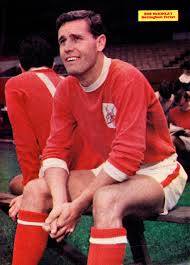
However, older Forest fans from the 1960’s would often describe Bob McKinlay as the best player never to be capped for Scotland. Bob played at Centre Half for Forest from 1951-1970 playing an incredible 685 games for the club, making him the player with most appearances for the City Ground club. A record which will never be beat one imagines.

David Stuart

Happy Birthday Ian Ferguson

10325772_1717294885174549_1195058324865445352_n

(First posted on Facebook March 15th, 2016)

Happy Birthday to Ian Ferguson who will be 49 today. Ian is one of those players that will split Scotland fans not necessarily for his Scotland performances of which there weren’t too many but for the club he was affiliated with, for so many years. St. Mirren fans will remember him fondly for scoring the winning goal in the 1987 Scottish Cup Final but most of us will think of him and his time with Rangers and therein lies how we as individuals think of him.
One thing that cannot be disputed is that Ian Ferguson was a winner similar to the way Scott Brown was in recent years; a do or die player for his team, the kind we are perhaps missing in the national team at this time.
Ian’s Scotland career is quite interesting as he was only capped nine times but he played in three World Cup campaigns but never featured in a Euro Qualifying game at any stage. Ian was first capped by Andy Roxburgh ( and this is a sentence I do not expect to write to often) three days before Christmas, in 1988 in Perugia, Italy to play the future World Cup hosts as part of their pre-World Cup preparation plan. Scotland lost 2-0 and Ferguson would be substituted for Gordon Durie of Chelsea in the 71st minute.
February, 1989 and Scotland were on World Cup duty in Limassol, Cyprus. This would be the game Scotland won 3-2 with Richard Gough providing two goals; the last being in the 96th minute. As for Ian, he was not picked to start but replaced an injured Stevie Nicol straight after Mo Johnston’s 9th minute opening goal.
Ferguson would play in Scotland’s next game, the memorable 2-0 win over France at Hampden a month later with Mo Johnston scoring both goals. Injury and luck often plays a part in a players’ International career for Ian tweaking a hamstring injury a few days before Scotland’s next game against Cyprus in April proved to be disastrous with the likes of Pat Nevin, Gordon Durie and others coming in to the side. Scotland would beat Cyprus and it would be four years before Ian played again.
Ian gained cap number four as part of Scotland’s lamentable campaign for USA ’94. He made a subs appearance against Malta at Ibrox coming on in 72 minutes for Gary McAllister. Scotland were already two up with Ally McCoist netting a double, which Pat Nevin would add to in the 84th minute for a 3-0 win.
Ferguson would then play the first 55 minutes against Estonia in June ’93 in another Qualifier up at Pittodrie before local favourite Scott Booth was brought on for Ian. Scotland won 3-1 with two goals from Pat Nevin and one from Brian McClair (a McClair goal, a collector’s item; the equivalent of ‘shiny’ in current football card parlance).
Not for Ferguson World Cup Qualifiers against Switzerland, Italy or Portugal, as once more he was trotted out; this time by Craig Brown in his first game in charge to face a minnow; Malta in Valetta. Billy McKinlay on his debut would open the scoring and Colin Hendry would add a second for 2-0 win for Scotland.
As others teams prepared for USA ’94, Scotland played friendlies away from home in Austria and the Netherlands in April and May ’94. Ian was given the second half in Vienna as Scotland won 2-1 with goals from John McGinlay and Billy McKinlay and 29 minutes in Utrecht a Scotland lost 3-1.
It would also seem as if that was it for Ian, however once more he was given an International recall; this time in 1997 as Scotland faced Estonia in Monaco. This was the rescheduled game, after the farce of the game that never was in Tallinn. Ian would come on, in the 63rd minute for Paul McStay as Scotland drew 0-0. However, with this poor result, the Scottish team was booed off the park. Ferguson was seen to give the ‘V’ sign to the fans and was not chosen again for Scotland.
So there you go, nine games for Scotland including six World Cup qualifiers for three different tournaments, 5 wins and 1 draw. Maybe we should have played him more. Anyway, Happy Birthday Ian down under where you are the coach at Northern Fury and all the best.

David Stuart

When All Roads Led to Leeds

1914557_1716662388571132_1354668236432355142_n

(First posted on Facebook March 14th, 2016)
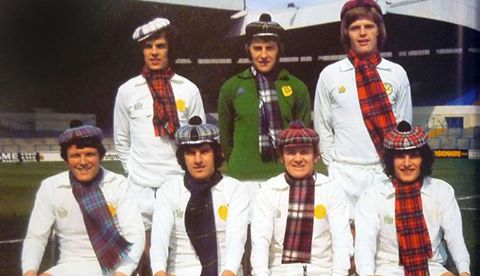
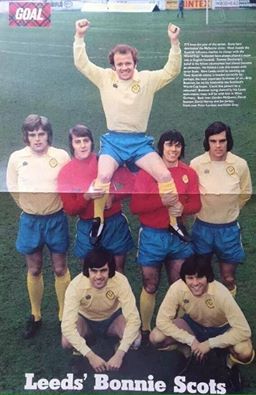
Gordon Strachan called up Liam Cooper of Leeds United to one of his Scotland squads last week and it was a reminder of the halcyon days when Leeds provided the backbone of any Scotland squad.
One of the surprising things about Scots being capped whilst playing for Leeds is that the first player to do so was Bobby Collins in 1965. When you think of all the players in the early years of football who practiced their craft down South it is strange that it took so long. Don Revie, ironically a future England manager would bring about an era of success for Leeds and ultimately Scotland, which would see Leeds provide five players for the 1974 World Cup Squad. One of his first signings was Bobby Collins. Bobby had been previously capped for Scotland 28 times first as a Celtic and then Everton player and had last been capped in 1959. His return to the International scene came in the same year he won the Football writers Player of the Year, although he would only win 3 more caps, he played alongside fellow Leeds and Scotland legend Billy Bremner when he made his debut in the dark blue of Scotland on 8th May 1965. Scotland drew 0-0 with Spain at Hampden. Billy would go on to win 54 caps in total.
The next Leeds player to become involved was not a Revie signing and is perhaps the least known of the Leeds Scotland players at this time. Full back Willie Bell had been at Leeds since 1960 joining from Queens Park, he would play over two hundred times for his club but only twice for his country. He played against Portugal in 1-0 defeat and a 1-1 draw with Brazil in June 1966.
Eddie Gray, perhaps the most skillful player of Revie’s era first played for Scotland on May 10th, 1969, sadly Scotland got beat 4-1 by rivals England at Hampden that day. Eddie would only win 12 caps for Scotland, which is rather surprising given his talent, however competition for a place on the wing was always competitive with Jimmy Johnstone, Charlie Cooke and Tommy Hutchison latterly among the contenders. Eddie was voted the third greatest Leeds player of all time with Billy Bremner and John Charles in taking 1st and 2nd place respectively. Eddie would be left out of the Scotland squad for the 1974 World Cup.
In Scotland’s last game of the 1960’s Peter Lorimer made his International bow coming on as a sub in the second half in 2-0 defeat to Austria in Vienna. Peter was well renowned for his thunderbolt of a shot as can be seen in the World Cup game against Zaire in 1974. Peter would play over 700 times for Leeds and 21 times for Scotland.
The final two players to make up the five for World Cup ’74 were Revie signings from Scottish clubs. Joe Jordan was bought from Morton for £15,000 in 1970 and would make his Scotland debut as a sub against England in May 19th, 1973, which we lost one nil. However, his fourth appearance in the blue of Scotland would be his most memorable, coming on for Kenny Dalglish at Hampden in September, 1973 to score the winning goal against Czechoslovakia to send us to the World Cup in 1974. Joe would win 52 caps altogether, scoring 11 goals along the way.
Gordon McQueen was a bargain buy from St. Mirren in 1972 for £30,000 made his Scotland debut against Belgium, on June 1st, 1974 a fortnight before our opening game of the World Cup. Scotland lost this World Cup warm up one 2-1. Gordon would win 30 caps in total.
By the time of the 1978 World Cup, Revie had left Leeds as had Jordan and McQueen to Manchester United, which meant there was no Leeds player in the squad for Argentina. Over the years there have been quite a few Leeds players representing Scotland including Frank Gray, Gordon Strachan, Gary McAllister and even in recent years Snodgrass, Bannan and McCormack but sadly the days of Leeds supplying the backbone of a Scotland squad have long gone.
In the picture we have Joe Jordan, Davie Stewart, Gordon McQueen, Eddie Gray, Peter Lorimer, Billy Bremner and Frank Gray.

David Harvey joins the others for this one.

12294683_1722447844659253_9163414554497815738_n
David Stuart

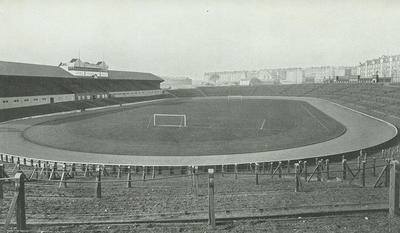
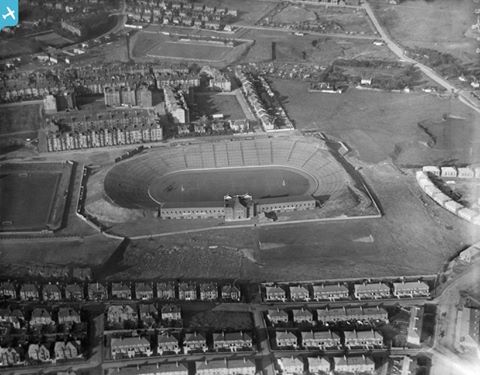
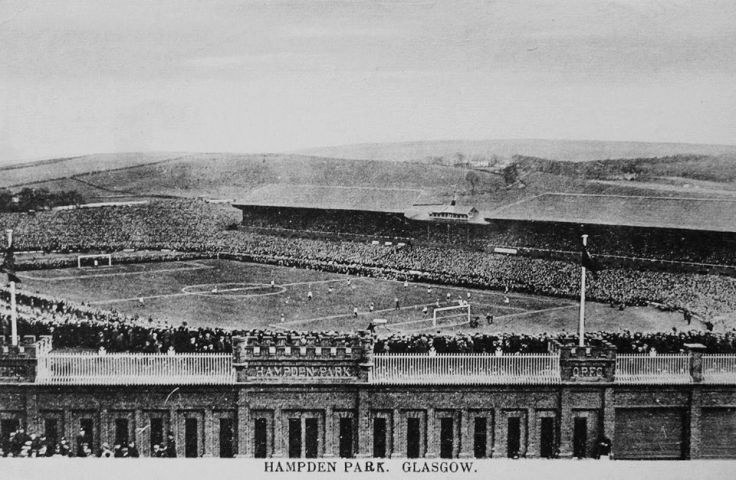
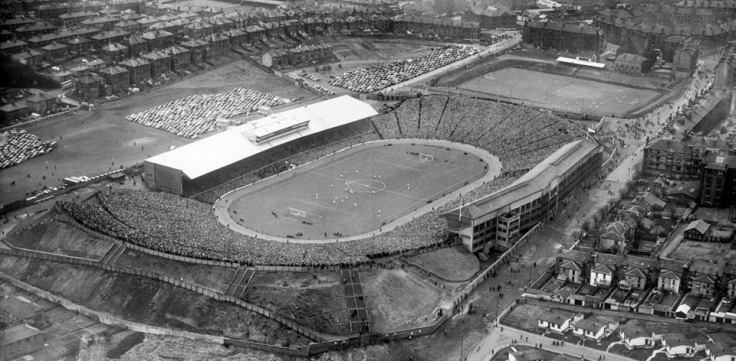
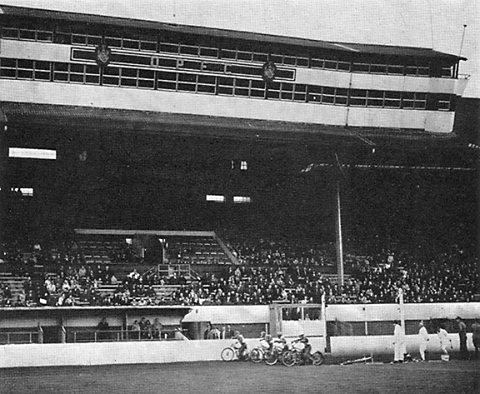
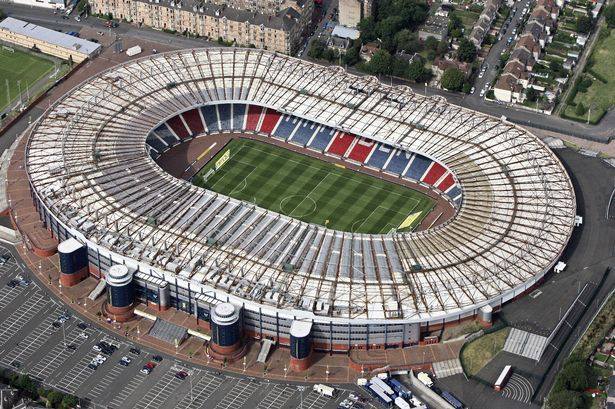
Images of Hampden

Posted various images of Hampden on Facebook around March 15th, 2016

1920’s (?)

12096165_1718841995019838_5288699467754993140_n

Hampden 1927

1044396_1717307781839926_8106388862686525335_n

1939790_982866551766602_1729176221705950917_n

1928

10600639_982781198441804_3156616805628537530_n

1930’s (?)

1915435_1718841835019854_9214989776716636958_n

1954 Scotland 2 England 4

10262204_1718841695019868_635459284168052307_n

1950’s maybe, with Speedway in action

10341415_1718841311686573_150743991546546141_n

Down in the Dumps early 1970’s (?)

944341_1718842175019820_8632921231183896923_n

The modern Lego Version

10593094_982866881766569_8368671583450484674_n

Sorry this is the modern Lego version

Happy Birthday to John Clark.

3846cbbd102089cbf1bb7128f3a8d911

(First posted on Facebook March 13th, 2016)

John will be 75 today. I think ‘Wikipedia’ got it right on his page as they suggested he was one of the more unheralded players from the Lisbon Lions, as the defensive partner to Billy McNeill. John gained four Scotland caps and all were won before Celtic won the European Cup and came in an 11 month period and remarkably under 3 different managers.
John Prentice took over from Jock Stein in 1966 after Scotland had failed to qualify for the World Cup for that year. Jock had always taken the job on a temporary basis and so Clyde boss John Prentice was then given the post.
Scotland had already lost the three games that Prentice had been in charge for and were facing Brazil at Hampden in June 1966 as they prepared for the World Cup. John was given his debut as was Peter Cormack, then of Hibs. Stevie Chalmers had scored for Scotland within a minute of the start but a Servilio equaliser in the 16th minute ensured it finished 1-1.
By the time of Scotland’s next game John Prentice had left to manage Dundee and in his place came Kilmarnock manager Malky MacDonald in a caretaker basis for Scotland’s opening games in the Home international series of 1966 – ’67. These were away to Wales in October and home to Northern Ireland in November. These games also doubled up a qualifiers for the European Nations Cup of 1968.
Scotland snatched a late draw in Wales at Ninian Park with Denis Law grabbing the goal in the 86th minute. Footage of this game was posted on the Facebook page about a fortnight ago, it is well worth watching and lasts about 45 minutes. John’s teammate Joe McBride made his Scotland debut in this game.
Next up, were the Irish at home, with another Celtic player making his debut; Bobby Lennox. Although Ireland would lead after nine minutes, first half goals form Bobby Murdoch and Lennox would seal the win.
Scotland’s next game saw Bobby Brown of St. Johnstone take up the managerial position on a permanent basis. He would not include John for his first game in charge, which was the 3-2 win at Wembley over England but would choose him for the following game.
There is some controversy over Brown’s team for the John’s final game which was against the USSR at Hampden. With both Celtic and Rangers both having qualified for European finals, Brown started with six Celts in his line up and augmented it with Willie Wallace at half time. Rangers had played the previous Wednesday to qualify for the European Cup Winners Cup Final, whilst Celtic had done so a fortnight before. However, with the Celtic final two weeks away and the Rangers one three weeks, Brown chose no Rangers players.
The game itself saw Scotland get beat 2-0 with Tommy Gemmell lobbing Ronnie Simpson 17 minutes into the game to give the Russians the lead.
So that was it for Clark, as Brown would favour other players over him during the rest of his tenure, however his place in Scottish football history is assured and he is still part of the Celtic backroom staff as he has been for many a year.
Happy Birthday John and all the best

David Stuar

1937067_1716143508623020_1950750894941434583_n (1)

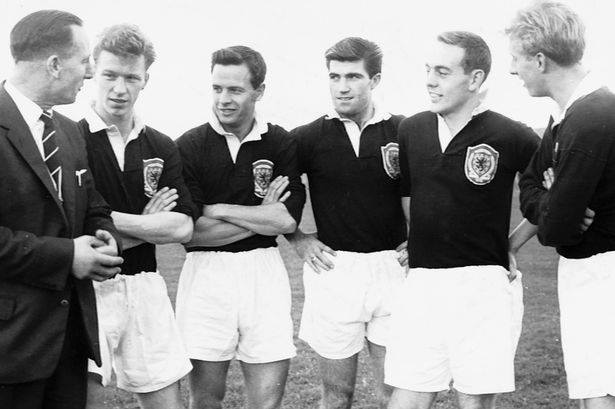
This is a cracking photo and has a rarity contained in it; a photo of Bertie Auld in a Scotland strip. While it is true that all the Lisbon Lions were capped by Scotland, Bertie was capped 8 years before Celtic’s European triumph. This was during his first stay at Celtic Park. Bertie was first picked by manager Andy Beattie to face the Netherlands in Amsterdam in May, 1959 also making his debut at full back was fellow Celt Eric Smith.
In looking up details of the match I came across the Evening Times Report and there was a couple of interesting things to note. Apparently Scotland had played a friendly against Jutland, the Danish peninsula, a few days before and it had been quite a rough and ready match with the Scots being the main culprits, perhaps this had put the Dutch on notice and so they were quite blatant in many a tackle. It was a tackle from behind on Auld in the 93rd minute that saw Bertie get his marching orders. It seems that the Dutch player was floored by our Bertie in retaliation and according to one of the reports the police had to stop Dutch fans from getting on the pitch to attack Auld.
However, Scotland did have a secret weapon that night; South African born John Hewie. Apparently, John spent the night translating as the Dutch shouted to each other, so some of their moves were anticipated. It must’ve helped as Scotland won 2-1 through goals from Bobby Collins and Graham Leggat.
Bertie became only the second player to be sent off representing Scotland and the only one so far to be sent off in his debut. However, Bertie was not cast aside and played a week later in Lisbon against Portugal. A game which Scotland would lose 1-0.
His final cap came in a Home International game against Wales at Hampden in November. John Charles would open the scoring for Wales after eight minutes with Graham Leggat equalising just after half-time and that is how it finished. It is also where Bertie’s Scotland career finished. Bertie was a bit of an outspoken player and it may well have been one of the reasons why he was not picked again; given the climate of “suits” that ran the SFA. Celtic too would move him on to Birmingham City in 1961, where he won a League Cup medal in 1963. By 1965 he was back at Celtic Park and ready to make his mark on football history
The photo seems to be taken just before the Wales game as this was the only time all five players were in the same team together. From left to right; Andy Beattie (Manager), John White, Graham Leggat, Bertie Auld, Ian St. John and Denis Law.
Remember we post a lot more stuff than Facebook sends to you, so keep clicking on the page to see what we’ve been up to.

David Stuart

Lazy Day at Scotland Epistles Office


Had a bit of a lazy day on 13th March and so posted a few images as follows;

1891296_1716321685271869_4340012177980384267_n
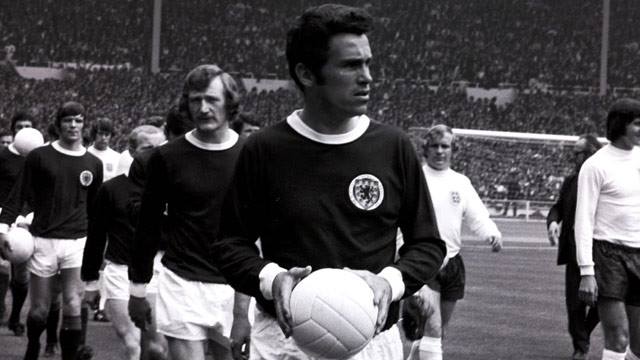
First up Billy McNeill and Bobby Moore lead out the teams at Wembley in 1965. The game ended 2-2 with Denis Law and Ian St. John scoring for Scotland. Behind McNeill is goalkeeper Bill Brown, Davie Wilson, Alex Hamilton, then possibly John Greig and perhaps Bobby Collins’ head peaking out behind him.


Next up once more a Scotland captain leading out his players at Wembley. This time it’s from 1971 and Bobby Moncur is the Scotland captain. Behind him is Davie Robb of Aberdeen, Jimmy Johnstone, Hugh Curran of Wolves and Frank McLintock of Arsenal. The result was 3-1 to England with Curran scoring for Scotland.

12814685_1716323001938404_4812821406148585607_n


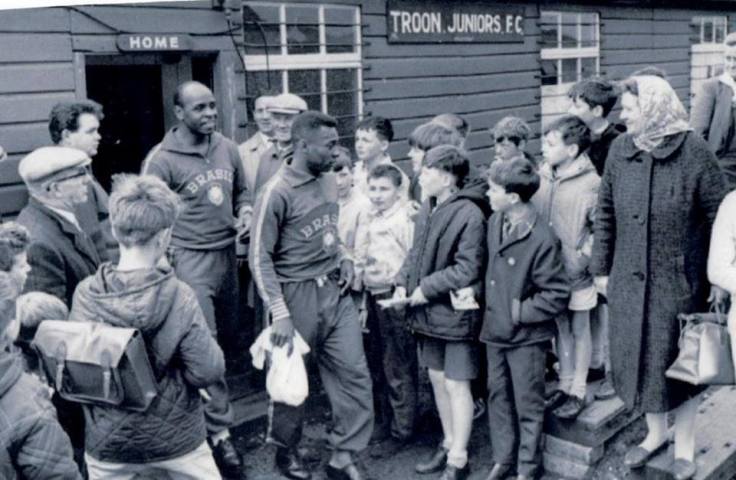
Back to 1966, Scotland v Brazil in a friendly. The Brazilians rather bizarrely get to train down at Troon Juniors. Here’s Pele just coming out the wee hut. I’m almost as fascinated with the what the kids are wearing, to see if I had similar as I am at Pele being there

1936031_1716324131938291_5042299937021096409_n

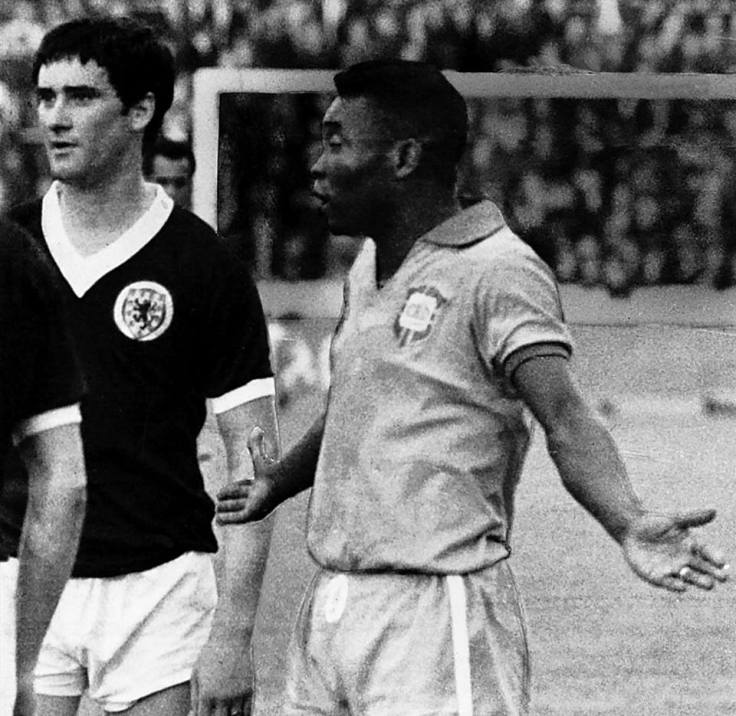
From the actual game, which ended up all square at 1-1 with Stevie Chalmers netting for Scotland, comes a photo of legends; Pele and Jim Baxter. Pele may have won the World Cup but oor Jim played keepie uppie with the English at Wembley, something Pele never achieved.
Although, if you look at the photo it seem a bit strange, so it may be photoshopped. Who knows?

12809549_1716324805271557_5179262350650672418_n


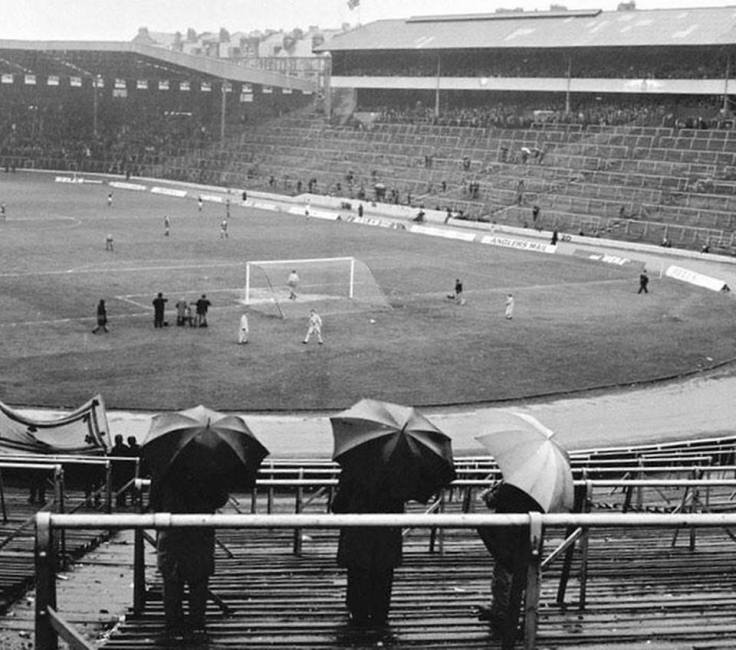
The Perfect Storm; The game lIve on TV and a heavy continuous downpour in Glasgow sees a crowd of 7,483 turn up for a Home International against Northern Ireland. Scotland draw 1-1 with Colin Stein scoring for Scotland. You might think it was a poor Scotland side on show but with the likes of Denis Law, Billy Bremner, Charlie Cooke, Tommy Gemmell and John Greig on show it was not; whilst playing for the Irish that day were the likes of George Best, Pat Jennings, Terry Neill, Derek Dougan etc.
Interesting to see the crush up at the North Stand

12814760_1716335398603831_8354572499474679886_n

Congratulations Denis Law

12821412_1716127821957922_4075101710790678422_n

(First published on Facebook , March 12th, 2016)

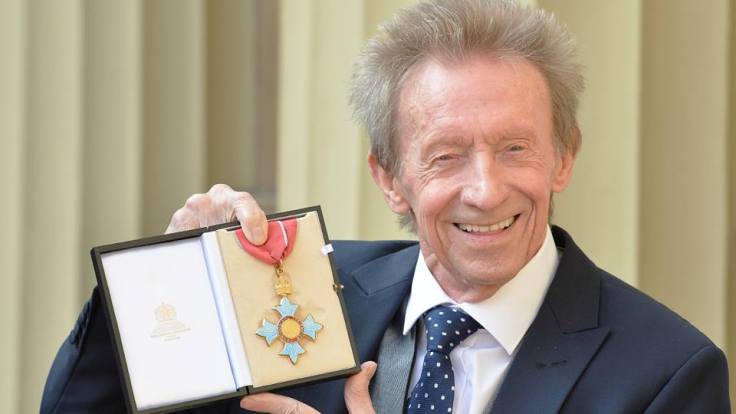
Congratulations to Denis Law on collecting his CBE yesterday but one has to ask why is it not a knighthood. Denis is a man that epitomised all that is great in football and will be the yardstick that most Scotland players will be measured again. His goalscoring records at club and International level speak for themselves and he also won Ballon d’Or in 1964.
Then again Jock Stein was never awarded a knighthood or others from Scottish football who deserved it, whilst the likes of Trevor Brooking has an MBE, CBE and a bloody knighthood.
Anyway, he’s better than a Lord after all he is a King.

Happy Birthday David Provan

10583886_1715801748657196_8423966656595824130_n

(First published on Facebook on March 11th, 2016)

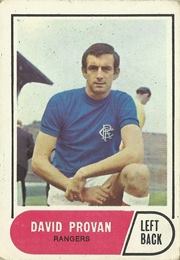
No, not the Permed Pundit but David Provan, the Rangers defender from the sixties who will be 75 today. In the 1960’s there was a clear lineage of full backs that went through the decade, starting with the likes of Duncan Mackay of Celtic and Eric Caldow of Rangers and moving to Alex Hamilton of Dundee, Eddie McCreadie of Chelsea and Tommy Gemmell of Celtic, so it was rare for others to get that chance to shine. David Provan was given that chance on five occasions.
David’s first cap came in October, 1963 under Ian McColl as Scotland faced Northern Ireland in a Home International in Belfast. Scotland lost 2-1 with Ian St. John netting for Scotland, Alex Hamilton of Dundee played full back on the right to David being on the left.
They would be paired up a month later as Scotland and Denis Law in particular ran riot at Hampden against Norway with Denis scoring four goals and Dave Mackay hitting a brace to win 6-1.
Jim Kennedy of Celtic was then given a run in the team for a few games until Eddie McCreadie made his debut in April, 1965 and generally made the left back spot himself.
However, one surmises that injury kept Eddie out of the team in November, 1965 when Scotland faced Italy at home in a vital World Cup Qualifier and so Jock Stein drafted in Provan for the left back position, making their debuts that night were Ronnie McKinnon of Rangers and Bobby Murdoch of Celtic. However, it would be another Rangers player, who would grab the headlines as John Greig scored the only goal in the 88th minute to keep Scotland’s World Cup hopes alive.
John Greig had often been used as a full back for Scotland but with the side depleted by injuries for the away game against Italy; Greig was pushed into midfield and with the right full back position vacant Stein chose Provan once more. In an attempt to confuse the Italians, Scotland started with Ron Yeats of Liverpool wearing the number nine but those crafty Italians got wise to the act, that he was really a centre half and managed to get three past him and the rest of the Scotland defence in Naples. Goodbye World Cup ’66.
David’s final game came in John Prentice’s flawed idea of a line up, when he played a team made of home based players for a friendly v Netherlands featuring no Celtic players; the team who had just won the league. Scotland got pumped 3-0 at Hampden.
David would leave Rangers in 1970 for Crystal Palace where he would play only one game before going on to Plymouth Argyle for five seasons before returning to Scotland and playing briefly for St. Mirren. He would go on to manage for Albion Rovers for years in the late eighties and indeed would lead them to the 1988-89 Second Division Championship.
(The football card in the picture is from the 1969/70 blue backed Scottish A&BC set and a great wee set it is).
Happy Birthday and all the best

Blog at WordPress.com.

Up ↑