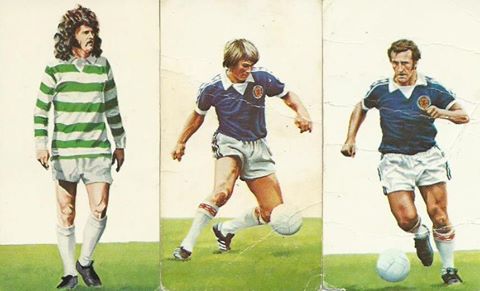
How come when you buy a mixed condition set of football cards on ebay it’s always the ones you really wanted are the creased ones? Mind you what about that Alfie Conn card; is it based on a portrait of King Charles II?
Golden Wonder Crisps released these sets in the 70’s. In 1977 it was the Soccer All Stars set of 24 with the likes of Conn, Kenny Dalglish,Derek Parlane, Martin Buchan among other Scots in the set.
For the Argentina set there were 36 cards with 6 Scots among them; Don Masson, Joe Jordan, Willie Johnston, Bruce Rioch and my two creased cards Dalglish and Danny McGrain.
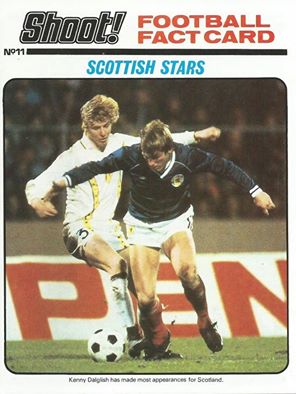
At the start of season 1983-’84, Shoot! Magazine released a set of Football Fact Cards. Card number 11 was Scottish Stars with a picture of Kenny Dalglish on the front and a set of Scotland International Facts for the period 1973-’84, which make for some interesting reading.
Top scorers for the period were; Kenny Dalglish with 26, then Joe Jordan with 11 and to show how shoddy our back up strikers were, three midfielders follow next on 7 each. Archie Gemmill, John Robertson and John Wark. These were followed by Andy Gray (6) and then Gordon McQueen and Don Masson on 5 each.
Dalglish also tops the most appearances with 80, then Danny McGrain with 57, Alan Rough with 51, Joe Jordan with 50, then a bit of a surprise Asa Hartford with 44, Archie Gemmill with 36 and then Graeme Souness with 35.
Capped with most clubs was Joe Jordan and Archie Gemmill with three each, nowadays the likes of Alan Hutton and Shaun Maloney have five each and there’s possibly somebody else with more.
Youngest capped player in the period was Andy Gray at 20 years and 2 weeks but the likes of Derek Johnstone and Derek Parlane had been capped at a younger age just prior to 1973. The oldest in the period was of course Denis Law who played at the age of 34 but he was capped much younger than Andy Gray way back in 1958.
Then, finally there was Fantastic Facts; the last time there was all home-based internationals team was in May, 1966 which was beaten 3-0 by the Netherlands at Hampden. However, in his first game in charge Jock Stein played a team of all Anglos, when Scotland beat Norway 3-2 in October, 1978.
A final King Kenny fact was that from May 6th, 1976 to February 25th, 1981; Dalglish appeared in 43 consecutive Internationals. Will we ever see his like again?
(Please click on our page there’s always something interesting to see).
(This article was first published on Facebook on February 10th, 2016)
Happy Birthday to Rambo. Yep, Sylvester Stallone is . . . nope sorry wrong guy, Alan McInally is 53 today. Alan was a big lumbering centre forward who took no prisoners on his way to goal often running through defences rather than at them. Despite a successful club career with the likes of Celtic, Aston Villa and Bayern Munich, he will not be remembered too fondly by Scotland fans for two reasons; Costa and Rica.
It was not until Alan had left Celtic and headed to Aston Villa that he was first given a cap by Andy Roxburgh in February 1989. He came on as a sub in the 68th minute for David Speedie against Cyprus in Limassol. You couldn’t really say it was like for like with Speedie standing at 5ft 7” and McInally at 6ft 1”. Scotland had equalised against Cyprus through Richard Gough, 15 minutes before and were desperate to get the winner. It would be Gough again, who would provide a moment of magic as he powered a header home in 96th minute to make it 3-2, a result that went a long way to seeing Scotland to Italia ’90 as would Mo Johnston’s double a few days later as they beat France 2-0 at Hampden.
However, McInally would have to wait a few games before being given his chance to shine. He was started up front against Chile at Hampden in a Rous Cup match in May ’89, alongside Speedie and would score his first Scotland goal four minutes into the game. Murdo MacLeod then playing in the Bundesliga with Dortmund scored early in the second half as Scotland won 2-0.
By the time of his 3rd Cap in September, McInally was also playing in the Bundesliga with Bayern Munich, where he had moved for a fee of just over £1m. Once more, he was a sub coming on late in the game for goalscorer Gordon Durie as Scotland lost 3-1 to Yugoslavia in Zagreb in a World Cup Qualifier.
A month later and Scotland were in the Parc des Princes in Paris, where they lost 3-0. Eric Cantona had scored France’s second goal shortly before McInally’s appearance in the 64th minute for Gordon Strachan. The game would end 3-0 but Scotland would qualify for Italia ’90 due to a point picked up at home against Norway in their final game.
World Cup warm-up time as Roxburgh shuffled his pack to see who would play in the World Cup. Alan was given his chance against Argentina in March, where Scotland beat the then World Champions with a goal from the unlikely of sources, Aberdeen full back Stewart McKimmie in only his third International would score in the first half to give Scotland a memorable 1-0 win. McInally was substituted in the second half to allow Brian McClair a chance to put forward his case for inclusion.
Cap 6 would see Alan come on for Mo Johnston in the 73rd minute in a friendly against Poland in May 1990. Mo had scored the opener but a horrendous own goal by Gary Gillespie in the 59th minute gifted the Poles a draw.
Next up was the mighty Malta and Scotland’s final warm up match and two goals for McInally in the Ta’Qali Stadium, made up Roxburgh’s mind to start McInally alongside Johnston as Scotland’s front pairing in our World Cup opener against Costa Rica. We all know it went pear shaped as these things often do it seems and McInally performed as badly as the rest of the team. With Scotland chasing the game after the shock of Costa Rica’s goal early in the second half, Roxburgh brought on McCoist alongside the other two front men but having taken off Jim Bett, Scotland sacrificed one of their more creative players and chances were few to equalise.
For most of us, this game lives on in infamy and McInally bears the brunt of our ire for the defeat and Roxburgh would choose to drop McInally in favour of Robert Fleck in the next game and indeed Alan never made it back into a Scotland shirt. Of course to me, one of the issues is why did we chose to play in that namby pamby T-shirt style top in our opening World Cup game and not the Blue of our first strip.
Knee injuries would soon see McInally’s career come to a premature end but for Scotland he goes on the list of Strikers who failed to match their club standards. Of course, Alan would go on to have a successful pundit career and along with Frank McAvennie is a perennial target for Only An Excuse, with a joke that’s played out long ago.
Happy Birthday Alan and all the best.
Billy was capped seven times for Scotland, all of his caps coming during his time as first choice goalie at Love St., former home of St. Mirren. Billy started out at Partick Thistle and was understudy to Alan Rough, which he would also be to a certain extent in his time with Scotland.
At Firhill, Billy was regularly rolled out for Glasgow Cup games, League Cup games but was only between the sticks for the Jags once on League business. He was thought of fairly highly at the time and indeed gained his first two Under 21 caps with Thistle. However, in 1978 St. Mirren came calling with £50,000 for him, which was accepted and was quite a remarkable price for a reserve from an unfashionable club at the time.
St. Mirren were a good team at the time with players such as Billy Stark, Frank McGarvey and Tony Fitzpatrick and Peter Weir all blossoming at the time. Within a couple of years and with eight more Under-21 caps under his belt, Billy was picked by Jock Stein to play for Scotland against Northern Ireland in Belfast in 16th May, 1980, which was the first game Scotland played there for ten years. Also making their debuts that day were yesterday’s birthday boy Gordon Strachan and fellow Buddie Peter Weir. Scotland lost one nil to a goal from Billy Hamilton.
Like other pretenders to Big Roughie’s crown, Billy would have to wait for his next cap which came in March 1981 at Hampden with Northern Ireland once more providing the opposition ; this time though the stakes were higher as this was a World Cup Qualifier and not the Home Internationals. Once more, Billy Hamilton would do the damage putting the Irish into the lead in the 70th minute but this time around John Wark managed an equaliser 5 minutes and the game ended 1-1.
On his 3rd cap Billy would once again face the Irish but this time it was Scotland who came away with the win at Hampden in May ’81 with goals from Ray Stewart and Steve Archibald.
14th October, 1981 a vital World Cup Qualifier against Northern Ireland at Belfast where a draw would see Scotland go through to Spain ’82. Of course, Billy didn’t play; Rough was back in for this one, as the Scots drew nil nil to reach the World Cup again. However, with Scotland through to the finals, Billy was back in goals for the last qualifier against Portugal in Lisbon, which the Scots lost 2-1 despite Paul Sturrock putting them into an early lead.
Scotland once more faced Northern Ireland in April 1982 and this time it was Arsenal’s George Wood who was picked to start this one as Billy found himself falling down the pecking order. As Scotland headed to Spain; Rough, Wood and an uncapped Jim Leighton were the goalkeeping trio picked by Jock Stein with Billy left behind at home.
After the World Cup, Rough lost his starting berth as Jock Stein forged ahead with Jim Leighton as his ready-made replacement and Leighton started in Scotland’s next four games. Once more and rather bizarrely Billy found himself back between the sticks to face Northern Ireland at home in the British Championships in game that also ended nil nil.
Cap 6, came during a Scottish tour of Canada with Billy starting in the opening game in Vancouver where Scotland beat their hosts 2-0 with goals from Gordon Strachan and Mark McGhee.
Billy’s final Scotland game would come in another dead rubber game as Scotland finished their abysmal 1984 Euro qualifiers with a 2-1 defeat in the East German city of Halle in November ‘83 with Eamonn Bannon of Dundee united scoring the only Scottish goal. Scotland’s next game was once more in Belfast but Billy was not selected for that one.
As for Billy he went on to have a good career with Dundee United, after leaving St. Mirren under a cloud and then had stints with Motherwell, Rangers and Dundee before quitting.
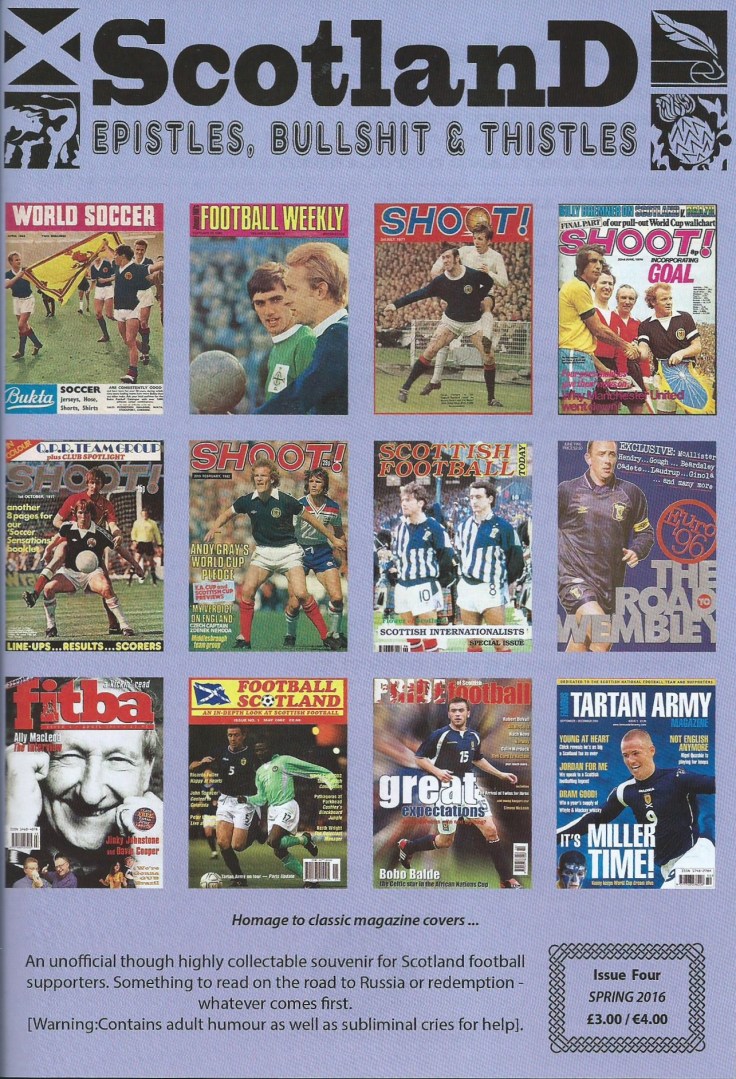
SCOTLAND EPISTLES # 4 NOW ON SALE Finally issue 4 is out and available to buy on eBay. As usual it’s full of articles and stories surrounding our love for the National team. Robert Marshall looks at Heroes and Villains which has nothing to do with the Beach Boys but more Scotland players and those special moments we have loved or loathed them for. Robert also delves into the myriad of books that have been written about Scotland; rating his top 8 (obviously the metric system has passed the man by). Alan Nelson gives his usual views on supporting; whether it be the tale of the long suffering wife or the whole travelling planning. Scott Cockburn looks back at Scotland’ s Under -21’s of 1997, the so called Golden Generation. Easton Thain writes of past Scotland and England games with a view to next seasons World Cup Qualifiers. On the International front, Scott Kelly gives us the lowdown on INTA or the International Tartan Army to you and me and indeed continuing on this theme; Italian Mauro Bonvicini and his adventures with the TA in Slovenia 2005 are given a page or two and if that’s not enough of an International flavour; Welshman Wayne Gough wades in with a Dragon-Hearted Epistle and viewing those World Qualifiers of ’78 and ’86 from a different angle. Finally some guy called David Stuart looks at Argentina ’78 and how Scotland peaked too soon (something his wife says he knows all about), then a statistical foray from Stein to Fletcher and all those times a player scored two but never reached the elusive hat-trick over the years and finally find out what was Andy’s B-plan. I’m sure you will enjoy it, so get on to Ebay, buy the mag and show us your support. As always though we ask can you like us on Facebook, Comment and Share the news that issue 4 is out and help keep the magazine and Facebook page going. For those who haven’t bought it before, we will be selling all four issues for £10 including postage for a limited period. Thank you
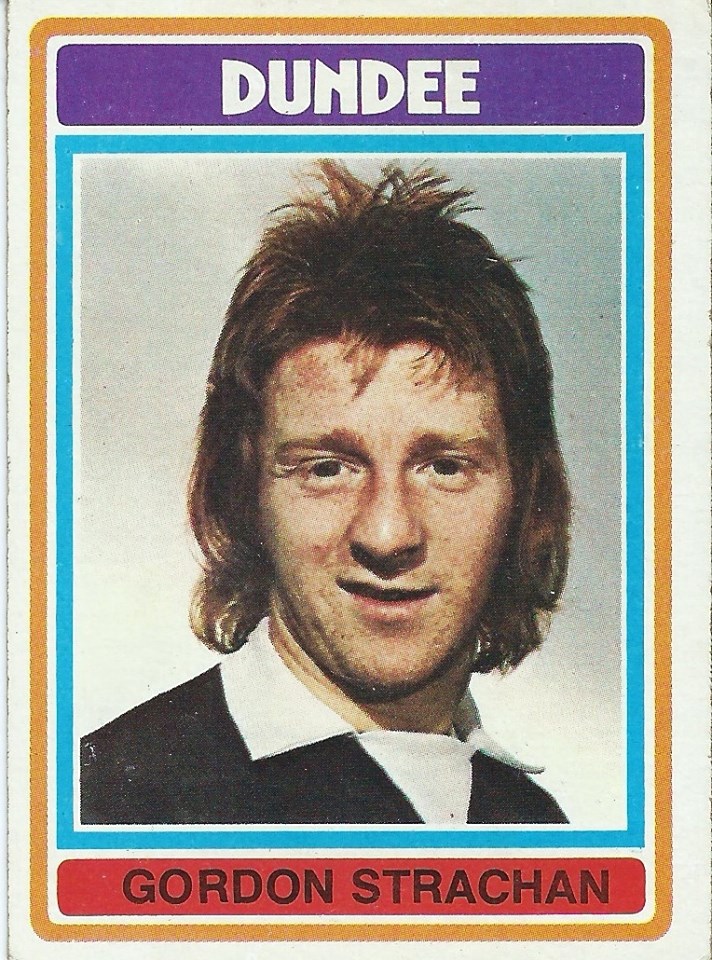
Last year for his birthday we posted a photo of Gordon’s first appearance in footballer cards of the 70’s. We think it’s too good not to post again. Happy Birthday Gordon.
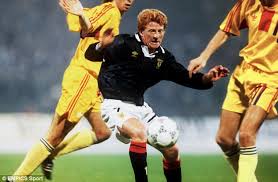
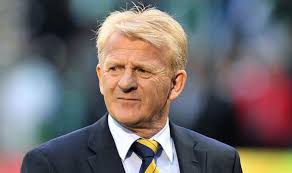
Happy Birthday Gordon Strachan who will be 59 today. Gordon gained 50 caps exactly for Scotland, scoring five goals in the process and has now been in charge of the team for almost half of that number.
His Scotland career did not get off the best of starts; first being capped against Northern Ireland in Belfast, in Scotland’s first return there in ten years, also making his debut that night was future team mate Peter Weir, who was then with St. Mirren. Scotland lost that game 1-0 and although they would beat Wales at Hampden 1-0, defeats to England, Poland and Hungary soon followed.
I had suggested recently that perhaps Gordon had saved Jock Stein’s Scotland career scoring the only goal in Sweden in the opening game of the 1982 World Cup qualifiers in Stockholm winning his seventh cap that night. Up until that point Jock had been in charge for 17 games and had only won 4; two against Norway and single goal victories over Northern Ireland and Wales.
However, there was still some stuttering along the way as Scotland made their way to qualification with Strachan missing most of the campaign with a stomach muscle tear. He made it back into the team for 0-0 draw with Northern Ireland in Belfast as Scotland qualified.
Although, he didn’t score Gordon was involved in most of the goals as Scotland beat New Zealand 5-2 in our opening game of 1982 World Cup in Malaga, Spain. Strachan was replaced by David Narey late in the game. Although, Gordon played in the 4-1 defeat to Brazil, he was substituted late in that game too, with Kenny Dalglish coming on for him in the 65th minute. Rather, strangely in the final match against Russia, he was replaced by full back Danny McGrain as Scotland chased the win, with the game sitting at 1-1. This would be Danny’s final Scotland game as Scotland drew 2-2.
The 1984 Euro Qualifiers started with a good 2-0 win over East Germany at home with goals from John Wark and Paul Sturrock, however quick defeats to Switzerland and Belgium away from home, followed by a home draw against Switzerland saw Scotland play catch up. An indifferent Home International series with a draw (NI), a win (Wales) and a defeat (guess who) was followed by a three game tour of Canada with Scotland winning all three games and Gordon scoring from the penalty spot in the first game.
A draw at home with Belgium and defeat in East Germany saw Scotland end up as bottom of their qualifying group.
Another poor British championship was followed by a two nil defeat to France in a friendly which was Gordon’s last game as an Aberdeen player, having won 28 caps up to this point. His first as a Manchester United player came as a sub against Spain as Scotland lost in a World Qualifier in Seville in February, 1985.
Although, he missed the home tie defeat against Wales, Gordon played in three games in a row 1985. First came, the 1-0 defeat of England at Hampden with Richard Gough scoring the only goal, to give Scotland the first Rous Cup. This was followed up by the vital win in Iceland as a goal in the last four minutes from Jim Bett, saw Scotland only needing a draw at Ninian Park, Cardiff to progress to the play offs for the 1986 World Cup in Mexico.
Davie Cooper would score a penalty with nine minutes remaining to equalise that would ultimately see Scotland through, but as we all know, this evening was tinged with tragedy as Jock Stein collapsed in the dugout and would die shortly after.
Gordon played in the first leg of the play off against Australia as Scotland won 2-0 with goals from Cooper and Frank McAvennie but did not travel for the second leg in December, 1985. It would be in March, ’86 when Gordon donned the Scotland shirt again in a friendly v Romania where he scored a peach of a goal in a 3-0 win.
As we all know, again Scotland failed to progress out the group stages in Mexico as they started with a 1-0 defeat to Denmark, which was followed by the 2-1 loss to West Germany in which perhaps came, Gordon’s most iconic moment as he pretended to leap the advertising hoarding after scoring the opening goal in the tie. In the final game, Gordon was hacked down by Batista in the very first minute, who was then sent off. Despite the man advantage for the next 89 minutes Scotland and Strachan failed to breach the Uruguayan defence and exited the World Cup.
Struggling to find form at Old Trafford, Gordon became a bit player on the International scene for Scotland for a while. He did play in two of the World Cup Qualifiers for Italia ’90 coming on as a sub as Scotland beat France 2-0 with goals from Mo Johnston and also in the return tie as France won 3-0 in Paris. These were Strachan’s first two games a Leeds United player but he would not be part of the squad for Italy.
However, Gordon and Scotland were not done as played an integral part in the team that qualified for the Euros in 1992, skippering Scotland on three occasions and also scoring with a penalty in a 2-0 win over San Marino. However, injury would see Strachan fail to make it to the Euros and his Scotland bow came in March, 1992 in front of a paltry 9,275 crowd at Hampden as Scotland played out 1-1 draw with Finland. Gordon captained the side that night for the fifth time.
Gordon has of course returned to the fold as manager in January, 2013 and although the disappointment of failing to qualify for this summer’s Euros is still fresh in our minds and heavy in our hearts, we all hope Gordon will prove to be the leader we all thought he could be and see us qualify for the World Cup in Russia, 2018.
Happy Birthday Gordon and all the best . . . for all our sakes.
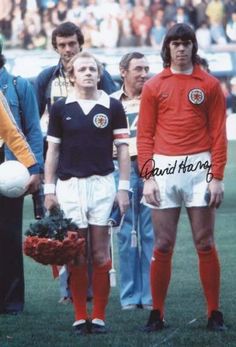
David with Club and Country Captain Billy Bremner.
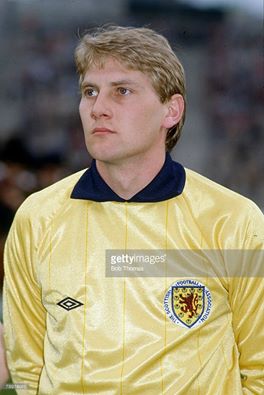
Happy Birthday to David Harvey, who turned 68 on February 7th. David waited a long time for his chance to become Leeds United first choice goalkeeper, having joined them in 1965. Gary Sprake was the man in place but Sprake began to make some high profile mistakes and David was given his place, first in the 1970 FA Cup final replay and then again in the 1972 Final, which Leeds won. After this, David was given the first team berth.
Although, Leeds born and bred, David qualified to play for Scotland through his father and in November, 1972, Tommy Docherty chose him to play in the World Cup Qualifier against Denmark at Hampden. Scotland won 2-0 with goals from Kenny Dalglish and Pater Lorimer; this would be Docherty’s last game in charge.
For his first few matches in charge, Willie Ormond went with Aberdeen’s Bobby Clark, then Peter McCloy of Rangers and also with Ally Hunter of Celtic. Following his mistake for the Czech goal in the vital World Cup Qualifier in September, ’73 and despite Scotland winning the game and thus qualifying for the ’74 World Cup, Hunter was dropped and in his place came David Harvey, who would more or less retain the No.1 spot through to the World Cup in Germany.
David started in goals for away Qualifier in Bratislava against the Czechs, which Scotland lost one nil in October ’74 and also played in a friendly against West Germany at Hampden that ended all square with Jim Holton, scoring the Scotland goal early on, only for Uli Hoeness to net the equaliser with a few minutes remaining.
Ormond opted for Thomson Allan of Dundee for the second friendly against Germany, which took place in Frankfurt in March 1974, however Harvey was back in goals as the Home International series began in the summer of ’74. Scotland lost the first game at Hampden with Tom Cassidy scoring the Northern Irish goal to give them the victory. Both Wales and then England came to Hampden within the following week and Scotland won both games 2-0.
Ormond would give Thomson Allan another shot in goals for one of the pre-World Cup warm up games; the 2-1 defeat of Norway in Oslo with Dalglish and Jordan netting the Scotland goals but when it came to the World Cup games there was never any doubt Harvey would start.
David had a good World Cup only conceding one goal against Yugoslavia but he contributed some good, vital saves in all the games including those against Zaire and Brazil. However, like the rest of team despite being able to hold their heads up high, David headed home after the group stages in disappointment.
After, the World Cup David played in Scotland’s first three games. A 3-0 friendly victory over East Germany, that was followed by a disappointing 2-1 defeat to Spain at Hampden despite taking the lead and being given the chance to score again through a penalty, giving Scotland a nightmare start to their Euro ’76 campaign from which they never recovered. Always seemingly, playing catch up to the Spaniards and missing out by the points they had given away on that night at Hampden.
David also played in the return tie v Spain in Valencia in February 1975, in which the Scots came away with a creditable 1-1 draw. Unfortunately David was then involved in a car crash which led to him missing out on the tail end of the season and indeed the European Cup Final against Bayern Munich in Paris, which Leeds were to lose 2-0 with Davie Stewart taking over in goals.
Harvey did recover and indeed played again for Scotland, who had went with Stewart Kennedy of Rangers in his absence and we all know how that finished.
Harvey returned for the Euro double header against Denmark in the winter of 1975 with the Scots winning 1-0 in Copenhagen with a goal from Joe Harper in September followed by the 3-1 victory over the Danes at Hampden with goals from Dalglish, Bruce Rioch and Ted MacDougall. This game also marked John Greig’s final game for Scotland. John had been recalled to the team for the first time in four years; perhaps with long term team captain Billy Bremner being given a life ban following the game in Copenhagen, Willie Ormond was looking for a leader in the Scots team and saw John as this.
As for David he found his place at Leeds becoming more contested with Davie Stewart vying for the first team spot, however it would be the rise of Alan Rough to “Scotland, Scotland’s No1” as Thistle fans sang for years (of course, by 1978, a lot of opposition fans would retort with chants of “Argentina, Argentina”) would herald his departure from the international scene.
David did have a last forty five minutes replacing Rough at Half-Time in a friendly against Finland at Hampden in September, 1976. The Scots were already coasting 4-0 by the time David earned his 16th and final cap in a game which finished 6-0.
And that was that for David who came to prominence in a Scotland team on the rise and reaching that pinnacle of the World Cup 1974, for which David will always be remembered as being an integral part of a side that contained players like Bremner, Holton, Law and Dalglish among notable others.
So Happy Birthday David and all the best.


 The Scotland Epistles Football Magazine