Search

The Scotland Epistles Football Magazine

Scotland Football Fanzine

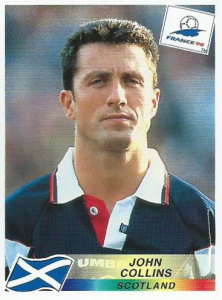
Happy Birthday to John Collins

scan00131

Happy Birthday to John Collins who will be 48 today. John played for Scotland 58 times and scored a valuable 12 goals including a certain one in Paris, in front of a massive Worldwide TV audience. He also has a unique place in Scotland history as being captain of the team for all of three seconds.

John was first capped as a Hibs player in February 1988 in of all places Riyadh, Saudi Arabia where Andy Roxburgh’s team were playing a friendly. John scored Scotland’s second goal a couple of minutes after Mo Johnston had scored an equaliser, however, the game was to finish 2-2.

He then seemed to have been forgotten about until the 1990 World Cup warm up games and although he was a substitute in two of three games he played; he must have been thought of highly enough by Roxburgh to be given a place in the squad for the World Cup in Italy.

John didn’t play in the World Cup but returned to the side in October 1990 as a late substitute in Euro Qualifier against Switzerland which Scotland won 2-1. This was John’s first cap as a Celtic player.

However, once more John was only used sparingly at this point and yet in March 1991, he came on as a sub against Bulgaria at Hampden in the 82nd minute to score a minute later to give Scotland the lead. A lead that was squandered in the final minute as Bulgaria equalised. However Scotland did qualify for the Euros despite this setback.

Again, it would be appearances in warm up matches, this time prior to Euros ’92 in Sweden that John would return to the side. The squads for the Euros were only of 20 players and John was deemed surplus to requirement this time round and didn’t make the cut for the finals.

The campaign for USA ’94 was always going to be a tough one; Scotland were in the second pot but were unfortunate in that both the Portuguese and the Swiss who were in pots 3 and 4 respectively were beginning to develop some really excellent players and teams. To add to that Italy were the Pot 1 team we ended up with.

The campaign under Roxburgh got off to a bad start with a 3-1 defeat in Berne, this was followed by 0-0 draw with Portugal at home in which John was reinstated to the team. John was soon given a run in the team by the manager and repaid this with a goal against Estonia as the Scot won 3-0 and then another up at Pittodrie against Switzerland in a 1-1.

By the time of the start of the campaign for the 1996 Euros in England, John had won 18 caps and Craig Brown had been in charge for a few months. John would play in all the qualifiers for the Euros scoring goals against Finland, twice against the Faroes (home and away) and finally against San Marino.

He would also finally play at a major tournament, by this time John had become an integral part of the Scotland set up, scoring goals as well as making them. He played in all three games in England and as we all know despite drawing with Netherlands and beating Switzerland Scotland failed to progress by the narrowest of margins.

At the start of the campaign for France ’98, Scotland got off to a good start with 0-0 draw in Vienna; by this time Collins was playing with AS Monaco. In the next game away to Latvia, Collins scored an excellent goal from a well worked free kick in October ’96, but the next game would mark the most bizarre incident in John Collin’s Scotland career.

Scotland were due to play Estonia on October 9th in Tallinn but made a complaint about the inadequacy of the floodlights in the stadium. This complaint was upheld and the game was rescheduled for several hours earlier. The Estonians took umbrage to this decision and refused to turn up for the game. Gary McAllister was suspended for this match and so Captaincy went to Collins. The game was started without the opposition, with Billy Dodds passing to Collins and then the ref blowing his whistle and thus John has become a well-used pub question. Who only ever captained Scotland for three seconds?

Although Scotland would be made to replay this game in John’s then home stadium; the Stade Louis II and eeked out 0-0 draw, Scotland reached the finals as the best placed runners-up with Austria taking first place.
scan001110

As we all know the first game in France ’98 was a world spectacle with Scotland lined up to play the World Champions; this would also be John’s fiftieth cap for Scotland. Brazil took an early lead but John would equalise from the penalty spot in 38th minute; a moment I imagine a lot of us won’t forget whether you were in France or like me watching it at home. Sadly, we would all rather forget Tom Boyd’s calamitous own goal in the second half. John would also play in the draw with Norway and in that lacklustre performance against Morocco that we would also choose to forget.

In the summer of ’98 John would move to Everton and although he played in Scotland’s opening game in the campaign for the Euro’s 2000, he would only gain 5 more caps. He did score once more for Scotland taking a penalty at Ibrox as Scotland beat Bosnia-Herzegovina 1-0.

His final two games would be in the play-off games against England; the first of which was the 2-0 defeat at Hampden with Paul Scholes wrecking our chances of progress but John did get to sign off in good style with that memorable victory over England with Don Hutchison providing the game’s only goal.

So Happy Birthday John and thanks for some great goals and great memories.


David Stuart
Who’s up fer a game of cards?

Scan0003


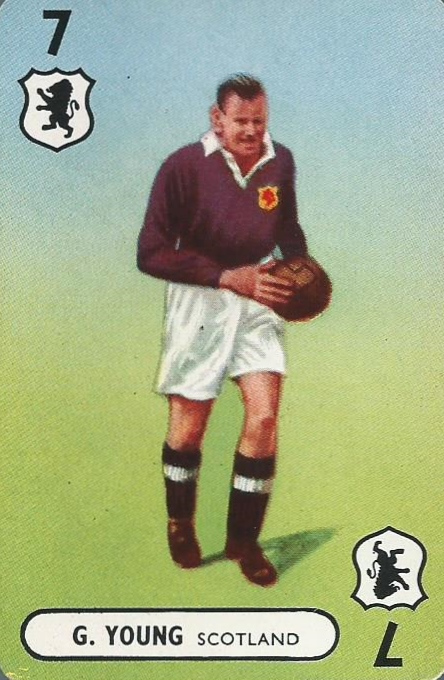
While we wait for the new series of Game of Thrones, how about a game of cards with Scotland players? I suppose football cards have probably always been played with over the years in one way or another. I remember you used to use your doublers and skite them towards a wall and who got the closest to the wall won all the cards. Did we call that Skites? Maybe it was a just a Glasgow thing I don’t really know.

Anyway there have been some cards that were ready made games. The Pepys Company in 1947 released a set of Whist cards, which had eleven players from each of the Home International teams. These were quite well done with good accurate drawings of the players and were a good looking set. Among the Scottish players were Bobby Brown, Jackie Husband, Gordon Smith and George Young with his giant sized ears. Did George inspire Roald Dahl’s BFG?

Scan0013

Fast forward to the seventies and the Top Trump cards and in particular to the 1978 World Cup, sadly there was to be no England players in this one due to the fact that as Andy Cameron  once put “they didnae qualify”. However, there was some Scotland players in the set including the likes of Dalglish, Gemmill, Willie Johnston and others.

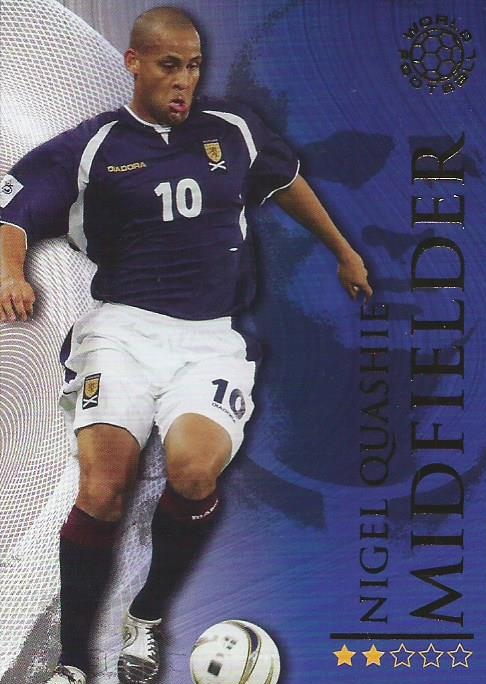
Nowadays, it’s almost like cards have been dumbed down with next to no player info and all numbers correlating to games splashed across the front and back. You do still get Scotland in them, even though we don’t qualify for tournaments. Futera cards bring out cards every year it seems with some Scots players and you would have been able to collect such players as Darren Fletcher, James McFadden, Gary Naysmith but also the likes of John Fleck and Nigel Quashie. A selection of the cards are of course to be found on the cards and sticker section of the website.

Scan0007

David Stuart

Happy Birthday to David Hay

Scan0017

Happy Birthday to David Hay who will be 68 today. Thinking back even though I was only eleven at the time David Hay was one of my heroes of the 1974 team. He was exemplary midfielder who was tough in the tackle but also had a greats burst of speed as he ran at defences. He looked as though he would be in the Scotland team for years but sadly it was not to be.

David was first picked by Bobby Brown in 1970. Bobby obviously felt it was time to move on from the remnants of the 60’s and Scotland’s failure to reach the World Cup in Mexico. He began to look for younger players and for the Home Internationals series of 1970, he brought in several  untried players and for the first game against Northern Ireland in Belfast; David was brought in at full back along with Billy Dickson of Kilmarnock, Willie Carr of Coventry and Derby’s John O’Hare. It would be O’Hare who would score the games’ only goal.

All four would play in the Welsh and English game with Hay being moved more into a midfield position. Although Scotland failed to score in both games they never conceded either. Hay in the book ‘Paradise Lost the David Hay Story’ by Ken Gallacher does talk about being booed by certain sections of the Scotland support at the time because he was a Celtic player, which is something other players of that era have voiced.

Hay played in five more games for Bobby Brown including Euro Qualifier defeats in Denmark, Belgium and Portugal and also in the defeat to Northern Ireland and the draw with Wales in the Home Internationals of 1971, reverting back to full back.

Tommy Docherty chose David in midfield for his first three matches in charge in late 1971, starting with a 2-1 defeat of Portugal at Hampden with O’Hare again among the goals and then the 1-0 win over Belgium at Pittodrie. John O’Hare would provide the only goal but this game also saw the introduction of fellow Celtic ‘Quality Street Kid’ Kenny Dalglish to the national side coming on as a sub for Alex Cropley in the second half. Hay would also play in a 2-1 friendly loss to Netherlands with Johan Cruyff among the scorers for the Dutch in Amsterdam.

However, Hay fell off of Docherty’s radar at this point and came back into the team under Willie Ormond in May 1973 for the first Home International lining up against Wales at Ninian Park. Cardiff. Pure Quality was added to the team that day with Daniel Fergus McGrain making his debut as a Scotland player also. Gorgeous George Graham netted a double as Scotland own 2-0. Scotland lost the remaining game to Northern Ireland (2-1) and England (1-0) to finish third in the Championship that year and this was followed that summer by two 1-0 defeats away to Switzerland and at Home to Brazil (my first ever Scotland game). However, better times were just around the corner for Hay and Scotland.

September 26th, 1973 and Scotland play Czechoslovakia and a win would take us through to the World Cup Finals and if you need to know more, then you’re on the wrong Facebook page.

Having beaten the Czechs at Hampden and qualified, Scotland then travelled to Bratislava a month later for a meaningless game. Meaningless or not I’m sure it was a very proud 25 year old David Hay who led the team out as captain that day. Scotland lost one nil.

Hay was given this honour again in March 1974, as the Scots lost 2-1 to World Cup hosts West Germany in the Waldstadion, Frankfurt

Scotland started the 1974 Home Internationals series with another defeat to Northern Ireland going down 1-0 at Hampden. However, they hit their stride with a 2-0 win against Wales a few days later with Kenny Dalglish and Sandy Jardine from the penalty spot and were unstoppable as they beat England two nil on the following Saturday. Joe Jordan is officially given as the scorer of the first goal although it is England’s Mike Pejic who gets the final touch, the other goal is a definite own goal from Colin Todd though.

It was a great boost to Scotland’s confidence and although there would be issues on the small tour prior to Germany including a defeat to Belgium, money issues, drinking sessions and the acrimony with the press by the time of first game against Zaire in the Westfalenstadion, Dortmund on June 14th, 1974, Scotland Hay were ready.

The story of that World Cup has been told many times but as I have said as an impressionable 11 year old it was David Hay that stood out for me; playing in all three games with great skill and desire. It did seem as though he had the chance to become one of Scotland’s great players along with fellow Quality Street Kids, McGrain and Dalglish but it never happened.

David moved to Chelsea in the summer of 1974, where bad luck would dog him for the rest of his short career with injuries, an eye operation on a childhood injury and even a family bereavement all preventing him from playing for Scotland again; by 1979 he was forced to retire from the game with knee injuries.

He had been one of my early heroes in a Scotland shirt and if fate had been kind to him, he would’ve won more than the 27 caps he did.

Happy Birthday and all the best David.


David Stuart

Happy Birthday Dave McPherson

scan00144

Happy Birthday Dave McPherson, who will be 52 today. Dave had a seesaw career which saw him move from Rangers to Hearts to Rangers and finally back to Hearts. Rather surprisingly, it was as a Hearts player that he would win 23 of his 27 caps and also play in Italia ’90 and the 1992 Euros.

His first cap came as a Hearts player in a vital World Cup match against Cyprus in April 1989 at Hampden playing in central defence alongside Alex McLeish. Goals from Mo Johnston and Ally McCoist would see Scotland victorious although the Cypriots did give us nervous moments when they equalised at one point.

Rous Cup duty was next as Scotland lost to England at Hampden 2-0 with goals from Chris Waddell and Steve Bull. McPherson was dropped and Willie Miller was reinstated to the team in central defence, however Dave was back in as right back for a qualifier against Norway at Hampden as the Scots drew 1-1 but it was enough to see them through to Italia ’90 at the expense of France.

Andy Roxburgh struggled to find a player for the right back slot despite Stewart McKimmie being available and as the finals approached he went with McPherson at right back. Dave played in the final friendly, a 2-1 win over Malta away and then went on to play in all three games in Italy, which as usual saw highs and lows for Scotland. Defeat to Costa Rica was followed by a nerve wracking win over Sweden and then the anti-climactic defeat to a poor Brazil team meant Scotland again headed home from the group stage. In the final game Dave was moved to central defence in place of his Hearts teammate Craig Levein.

Dave was becoming an established part of the team and would play in most of the Qualifiers for the Euros in 1992 slotting in either at full back or in the centre. With the partnership of Miller and McLeish coming to an end there didn’t seem to be a settled defence at any point with the likes of Richard Gough, Gary Gillespie, Craig Levein, Alan McLaren and even the likes of Stevie Nicol and Tom Boyd being played there on occasion.

Scotland started the group well with two wins in a row against Romania and Switzerland and then a draw in Sofia to Bulgaria and despite drawing with Bulgaria at home, Switzerland away and losing to Romania away; a win in the final game at Hampden against San Marino was all that was needed to qualify. Paul McStay provided a goal in ten minutes to settle nerves and further first half goals from Gough and Gordon Durie allowed to party to start. Ally McCoist would add a second half goal and so Scotland qualified for their first European Championships.

Scotland had topped a rather cutthroat group with eleven points just ahead of Switzerland and Romania on ten each and Bulgaria a point further behind on nine with San Marino on the old Eurovision classic of nil points. McPherson had played in all but one of the games and indeed played in all five of Scotland’s pre-tournament friendlies as well, which included wins in both the USA and Canada. Dave played the full ninety minutes in each, which is quite remarkable given the amount of substitutions in these types of games.

It is important to remember that this was an eight team tournament at the time but still Scotland were given a difficult draw and would be facing the Netherlands, a reunited Germany and CIS, which was the newly dissolved USSR flying the flag under the banner of the Commonwealth of Independent States which included Russia, Ukraine, Belarus and all those Stans i.e. Uzbekistan, Kazakhstan and the like.

Dave lined up alongside Richard Gough for his 21st cap against the Dutch in Gothenberg. The Dutch team was full of stars such as Ruud Gullit, Dennis Bergkamp and Marco Van Basten. The Scots gave a good account of themselves but ultimately lost out to a Bergkamp goal in the 77th minute.

Again, against the Germans Scotland played well but lost out to goals from Karl-Heinz Riedle and Effen Effenberg (or Steffan as his parents like to call him).

By the final game of the group, Scotland were out of it but with CIS having drawn their first two games and only two points for a win at this time they still had the chance to progress. However, it was Scotland who came out on top rather convincingly with Paul McStay giving us an early lead and then Brian McClair finally scoring his first Scotland goal to put us 2-0 up in the first 16 minutes. There was a bit of fortune to McClair’s goal as it was defected in but it was no more than they deserved. A Gary McAllister penalty in the 83rd minutes sealed a memorable win for Scotland.

scan00031

That was McPherson’s last Scotland action as a Hearts player as a return to Ibrox for £1.3m soon followed. However, his move westward would not result in many more caps although he played in three of Scotland’s opening USA ’94 qualifiers; a 3-1 defeat in Switzerland, a 0-0 with Italy at Ibrox and then a 3-0 victory over Malta in the same side.

It would be the qualifier in Lisbon in April ’93 that would be his undoing as a rather hapless Scotland defence were tore apart by a blistering Portuguese performance as the Scots lost 5-0; McPherson and Gough were the major scapegoats for that night and never played again for Scotland.

McPherson would of course make that trip along the M8 once more back to Tynecastle and play for Hearts up until 1999. Happy Birthday to Dave McPherson or as Tony Gubba would call him in commentary McFearson, and all the best.


David Stuart


Happy Birthday Wee Willie Henderson.


13501893_10153752337926705_3427129326433315963_n

Willie Henderson turned 72 on January 24th. It’s fair to say that Henderson’s legacy as a great winger suffers due to comparison to one of the all-time Scottish greats, Jimmy Johnstone who played at the same time. Both were born in the same year separated by 9 months and five miles or so. Henderson was also slightly taller at 5ft. 4” compared to Jinky’s 5ft. 2”.
Willie was first capped by Scotland at the age of eighteen under Ian McColl, playing in the first game of the 1962-’63 Home Internationals against Wales at Ninian Park, Cardiff in October 1962. Scotland won 3-2 with goals from an Eric Caldow penalty, Denis Law and Willie scoring what would prove to be the winner.
A month later and Willie scored again in between four goals by Denis Law as the Scots routed Northern Ireland 5-1 at Hampden.
The final game of the Championships is part of the 1960’s Scottish legacy as the Scots won 2-1 despite going down to ten men early in the game after Eric Caldow’s leg was broken in three places following a tackle by England’s Bobby Smith. Eric was winning his 40th cap and this was to prove to be his last, although he would get back in the Rangers team the following season.
Scotland won the day thanks to two goals by Jim Baxter and despite England scoring with ten minutes to go, they held out for a famous victory. One of the most famous photos of Willie Henderson is of him carrying the Lion Rampant flag around Wembley after the game with his team mates, rather surprisingly he does not have a trademark Cuban cigar hanging from his lips.
Scotland’s next game is another one that is remembered for some unsavoury moments as Austria came to Hampden for a friendly; two sendings off and a further wee barney involving Denis Law and English ref Finney decided to wrap things up early in the 79th minute. Scotland had been leading 4-1 with two goals apiece from Law and Davie Wilson. The SFA do count these goals in official records although that is not always true of abandoned matches generally.
Game number five and Willie finally tastes defeat at the hands of the not so mighty Norway in Bergen June ‘63. Law was on killer form at the time and scored a hat-trick but lapses in defence in the last ten minutes allowed the Norwegians to sneak it 4-3. This was followed by another defeat in Dublin as they lost one nil to the Republic.
Next up, 4 days later is Spain at The Bernabeu and the Scots go a goal down after only eight minutes. However, this Scotland team did not fold like so many others; in a blistering 17 minute spell in the first half; first Law, then David Gibson, Leicester teammate Frank McLintock and finally Davie Wilson all score and the Scots go in at half-time 4 goals to 2. Willie would add a second early in the first half and Ian St. John would wrap it all up with a final goal in the 83rd minute. What a strange two weeks.
Winter of ’63 saw some of the worst weather Britain has ever seen and it didn’t start too well for Scotland in Belfast for the first game of the Home Internationals against Northern Ireland. Scotland lost 2-1 with Ian St. John scoring for Scotland. Revenge on Norway that winter was no doubt sweet as Denis Law laid waste to their defence with four goals at Hampden and Dave Mackay piped in with two. Remarkably Norway had scored after only eight minutes and perhaps thought they were on their way to another victory until Denis intervened.
A 2-1 victory over Wales at Hampden followed a fortnight later with John White of Spurs and Law scoring once more.
April, 1964 and Scotland beat England once more with an Alan Gilzean goal in the 72nd minute. This was followed a month later with a 2-2 friendly draw with West Germany in Hanover. There was a double each for Alan Gilzean and German legend Uwe Seeler.
Willie had played in 12 straight games but was injured for the next few. So who did Ian McColl replace him with? Jinky Johnstone of course, who made his debut for Scotland in October 1964 in a 3-2 defeat to Wales in Cardiff.
Henderson would return for the April 1965 game against England. Scotland drew this game 2-2, despite going down to goals from Jimmy Greaves and Bobby Charlton after 35 minutes. The ever reliable Law scored six minutes later and in his final Scotland game Ian St. John would score in the 59th minute to equalise.
Almost a year after the eight goal fest in the Bernabeu, Scotland and Spain contrived to draw nothing each at Hampden in early May ’65, which would be Ian McColl’s last game in charge, as he would head South to manage Sunderland.
Although only a few months in the Celtic job, Jock Stein was asked to take charge for the rest of the 1966 World Cup Qualifiers. Scotland had already beaten Finland at home 3-1 in their first game.
Jock would pick Henderson as his first choice right winger for six of his seven games as Scotland Manager with Willie injured for the final one. Jock got off to a good start with two good away results in World Cup Qualifiers. A one each draw in Chorzow, Poland with Law scoring was proceeded with a 2-1 win in Helsinki with John Greig and Davie Wilson, who like Ian St. John signed off his Scotland career with a goal. However, these were to be followed by two defeats in October; the first in Belfast as the Scots went down 3-2 despite a Gilzean double but worse was to follow as Scotland lost two late goals to Poland in a vital World Cup Qualifier to lose 2-1 after Billy McNeill had given us an early lead.
In November 1965, Italy came calling to Hampden to play in front of a crowd of just over 100,000 remarkably 7000 down on the Polish game. Jock gave debuts to Bobby Murdoch of Celtic and Ronnie McKinnon of Rangers; It would not be until the 88th minute that John Greig would break the sturdy Italian defence and send the crowd in delirium.
A fortnight later and only 49,888 turned up to see Scotland win 4-1 with two goals from Bobby Murdoch, one from Henderson and another from John Greig. Murdoch was the only Celtic player in the team that night with five Rangers players in the team as well as Jim Baxter, then of Sunderland. You certainly couldn’t accuse Stein of being biased.
Henderson would miss the final qualifier as a depleted Scotland side lost 3-0 in Italy. Caps for Willie become less often with both Jimmy Johnstone and now Charlie Cooke of Chelsea vying for the right wing place.
John Prentice would pick Willie for his second game in charge in June ’66; a 3-0 friendly defeat at home to Netherlands. John had chosen players only from home based clubs for this game with Pat Stanton and Jim Scott of Hibs making their debuts along with David Smith of Rangers and Andy Penman of Dundee. For Penman and Scott this would be their only caps and as an experimented the idea of not playing Anglos was binned.
Malcolm McDonald would pick Willie for his only two games as Manager for Home Internationals against Wales and then Northern Ireland in late 1966. The first a one all draw in Cardiff with Denis Law netting and the second a 2-1 victory over the Irish in Glasgow with Celts Murdoch and Bobby Lennox on his debut, netting. These games doubled up as Euro Qualifiers.
The Euro dream was over when Willie returned for a game against the Netherlands under Bobby Brown in May ’68, which ended in a nothing each draw in Amsterdam.
Caps 25, 26 and 27 came in May 1969; three games with goals totalling 15, unfortunately 4 were for England in a drubbing at Wembley as the Scots lost 4-1, a few days after drawing 1-1 with Northern Ireland. Colin Stein scored in both games. Colin would better that and so much more as he put four past Cyprus at Hampden in a World Cup Qualifier. Willie also got among the goals as did Eddie Gray of Leeds, Billy McNeill and Tommy Gemmell.
Bobby retained Willie for a friendly in September ‘69 as Scotland drew one each with the Republic of Ireland in Dublin with Stein scoring for his fifth game in a row.
Willie was brought back for one final game a 2-0 defeat to Portugal in Lisbon in 1971 and that was it for him. He would play for Rangers for one more season before becoming a football nomad almost playing in as many continents as David Beckham before retiring from the game in 1979.
Happy Birthday Wee Willie and all the best.

David Stuart

Peter Lorimer; the Real Hot Shot Hamish

scan000431

I was thinking about Peter Lorimer the other day and thinking there’s another great Scottish player who on the International front never made the big impact that he did on a club level in English First Division and even in European competitions. Peter was well known for his powerful shooting and was nicknamed ‘Lash’ because of it.
Peter was the last player to be capped in the 1960’s coming on as a late sub in Scotland’s final World Cup Qualifier in November 1969 against Austria for Hugh Curran; who also made his debut that night along with Francis Burns of Manchester United playing in his only game. West Germany had already qualified, which is why Bobby Brown went with a side that was quite inexperienced. They lost two nil.
As for Peter, he didn’t feature again until 1971, which if you read the Bobby Moncur article the other day you would wasn’t a great year for Scotland. Peter played in a 0-0 draw with Wales and a one nil defeat to Northern Ireland.
He played in all three games in the 1972 Home Internationals under Tommy Docherty and indeed scored in the 2-0 defeat of Northern Ireland and hit the only goal as Scotland beat Wales 1-0 at Hampden as were all the games that year. Scotland lost one nil to England in the final game of the series, which as Hamish Husband pointed out the other day was a rather dirty game. There were twenty fouls committed in the first twenty minutes. Must have been a bruising contest and I do wonder how much actual playing time there was.
Lorimer like a lot of English club players didn’t travel to Brazil for the Independence tourney; mostly at the behest of their respective clubs but Docherty did play him in our opening games of the World Cup Qualifiers, away and at home against Denmark which marked Tommy’s last games in charge. Scotland won the first game in Copenhagen 4-1 and Peter scored the second goal of the game at Hampden as they won 2-0.
Peter scored in six minutes and started off a rout in Scotland’s next game unfortunately it was an own goal and was followed by four more as Scotland lost to England in Willie Ormond’s first game as manager in February 1973 aka the Valentine Day’s Massacre.
Lorimer would again feature in a defeat to England as the Scots narrowly lost 1-0 at Wembley in May that year.
Timing is everything and although Peter did not play on the night of the victory over Czechoslovakia and World Cup Qualification, he did play in the game against England a year later which Scotland won 2-0 and was then an integral part of the team; which we all know because of his most famous moment in a Scotland jersey as he walloped in the first goal of our World Cup against Zaire. Peter then did his trademark celebration clapping his hands above his head.
Peter played in the games against Brazil and Yugoslavia; in the Brazil game if you watch the highlights he takes a few free kicks outside the area from a long way out such was the power in his shot.
Although, Peter would play in a few more games after the World Cup with the emergence of the likes of Masson and Rioch he became surplus to requirement and that was it for Scotland, although he would play on for quite a few years and would become Leeds United all time goalscorer, a record which he still holds and is doubtful it will ever be broken.
(For stickeraholics out there the photo is a Leaf sticker from the 100 Years of Soccer Stars set from 1988)

David Stuart

You Only Get an ‘oo’ from Colin Stein


Scan0001


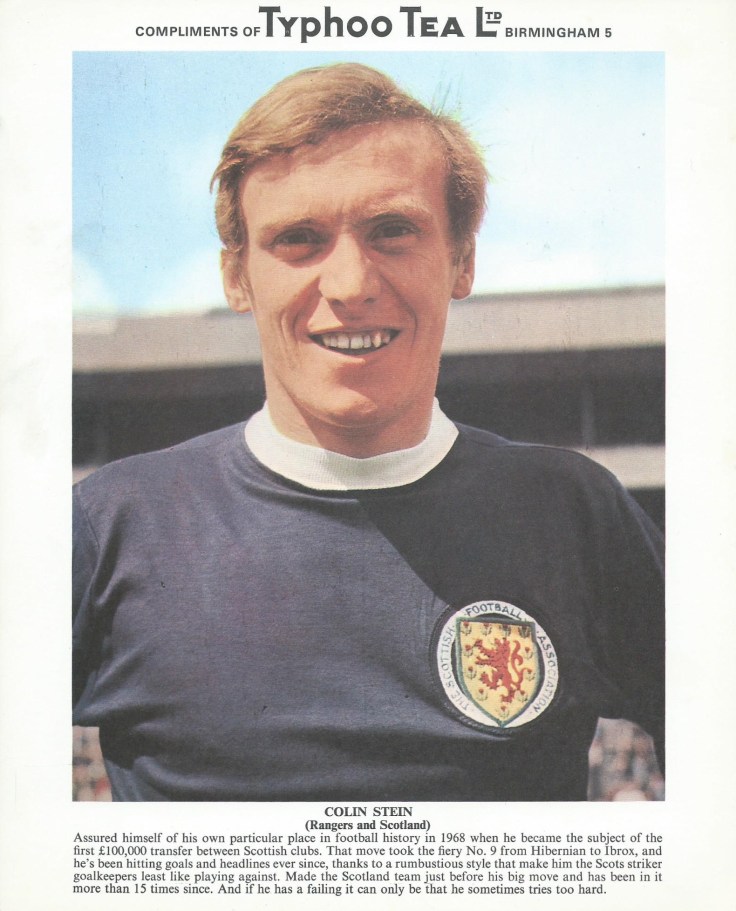
I know it doesn’t rhyme but I’m sure you know what I mean. Anyway this card is from the early 70’s and to tell you truth had I known of the existence of these large cards back then I’m sure I would have pestered the hell out of my mum to buy Typhoo tea. However, we were a Brooke Bond family at the time and we collected the cards from the tea packets such as the History of Aviation, Prehistoric Animals and the like.

I collected cards from an early age of almost any type be it Football, TV Series themed and even the Monkees. Every football season brought new cards and I rushed out to the ice cream van and shops at any opportunity to buy cards. Of course, things change and eventually I swapped the cards for football programmes, which I swapped for Marvel Comics, which I then swapped for 7” singles. Of course, with vinyl on its way back big time I sold my collection a few years back to buy football cards. Elton John once sang a song about it.

Of course had I known that in forty years Scottish football cards would be worth a good sum maybe I might have kept them. As I was starting to buy cards on eBay I came across the Typhoo set and found them quite interesting but the fact they were selling at over a tenner each put me off. Then I came across this one and thought ‘oo’ need to buy that one sometime. There are a few Scotland players featured such as Willie Henderson, Denis Law, Billy McNeill, Dave Mackay and others, however, this is the only one with a player with a Scotland strip on.

The strip itself is quite nostalgic as I received this for Christmas; I think when I was five and six and used to imagine that I was Alan Gilzean, my Scotland hero at the time. Funny enough I grew up to be just like him i.e. bald! As I say it was a Christmas gift but this is one I actually tried on before the big day. I seem to remember it was my older brother Andy who figuratively killed Santa Claus for me with particular glee. I probably didn’t believe him when he told me Santa didn’t exist and so he took me into my parents room and showed me were my gifts were hidden and of course with minutes I had decided, bugger the whole Santa thing and had the strip on. I do wonder if my parents ever realised but the reality is that kids at five aren’t generally bright at folding away gifts in their packaging so I guess they did.

Back to the card and Colin Stein. There are not too many footballer cards of Stein as a Rangers player, in fact I can only think of one. I do wonder if he tried to get more than the tenner A&BC paid in copyright to players for their image and that’s why.

The card describes Colin as having a rumbustious style and of the type that goalkeepers least like playing against. Like Andy Gray, Colin was full tilt and I don’t think too many keepers liked the idea of him bearing down on them. Overall, Colin played 21 times for Scotland; 17 as a Rangers player and 4 as a Coventry one scoring 10 goals although six of them came against Cyprus; a bit like Steven Fletcher who has 8 with six of them against Gibraltar.


David Stuart

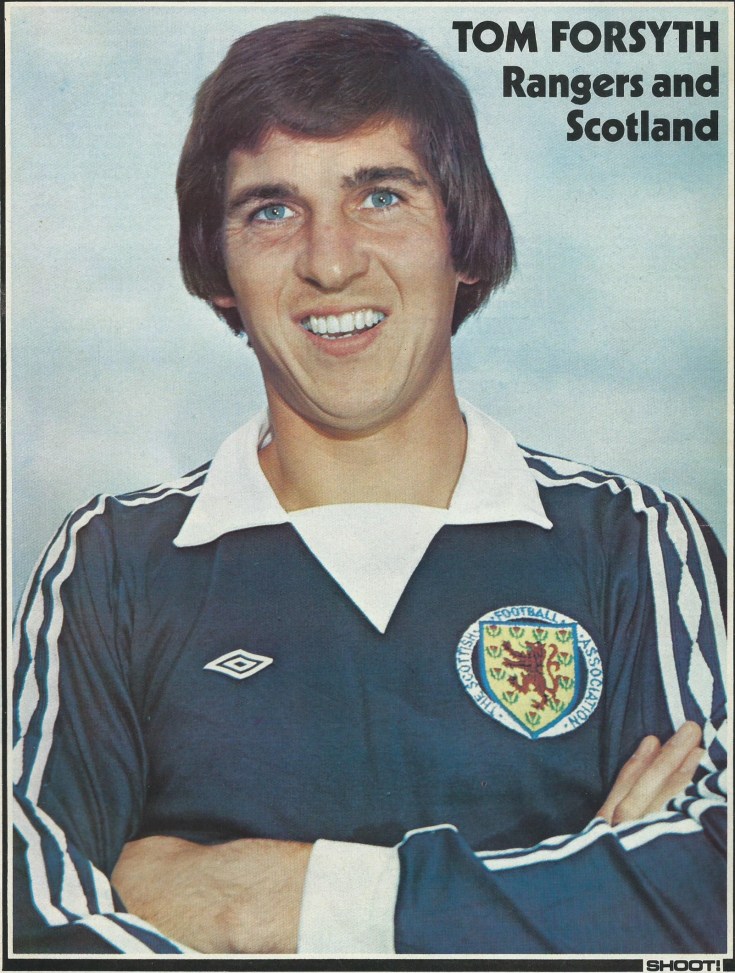
Happy Birthday Tom Forsyth

Scan0008Happy Birthday Tom ‘Jaws’ Forsyth who will be 67 today. Tom will be remembered quite fondly by Rangers supporters but also us Scotland fans as he played a big part in the successful side that won the Home Internationals two years in a row and then helped get us to Argentina.

Tom was first capped as a Motherwell player in 1971 by Bobby Brown in a European Qualifier in Copenhagen. Jocky Scott also made his debut that night but Scotland lost one nil to a goal by Finn Laudrup; father of Brian and Michael. (No, not the Matchstalk Men and Matchstalk Cats and Dogs guys but the footballers).

It would be two years later and as a Rangers player that Tom would return to the side now under Willie Ormond; this was for the dead rubber game against Czechoslovakia in the World Cup Qualifiers as Scotland had already reached the finals. Once more, Tom was involved in a one nil defeat in Bratislava and it was apparently Tom who gave away the penalty having been adjudged to have handled the ball.

It would be almost three years later that Tom was brought back into the fold and would then be a consistent performer for Scotland for the next two years.

Tom’s first game back was the friendly against Switzerland at Hampden where among those making their debuts were Alan Rough, Frank Gray and Willie Pettigrew. Scotland won 1-0 from Pettigrew’s goal in two minutes. Tom had lined up in with Hibs player John Blackley in defence and rather oddly had been given the Captain’s role for the one and only time.

For the Home Internationals he would play alongside his Rangers central partner, Colin Jackson. Scotland swept all before them with a 3-1 victory over Wales and then a 3-0 beating of Northern Ireland. It is perhaps in the final game of the Championships that Tom cemented his reputation with Scotland fans. Kenny Dalglish had accurately put the ball through Ray Clemence’s legs to give Scotland a 2-1 lead but with moments remaining it looks as though Mick Channon is about to get a clear shot on goal until Tom rather deftly slides in and hooks the ball away cleanly away, where a lesser player may well have floored Channon in attempting to do this.

Tom played in a friendly in September ’76 where Scotland routed Finland 6-0 and then missed the opening two games in the 1978 World Cup qualification; a 2-0 defeat to Czechoslovakia in Prague and 1-0 win over Wales at Hampden.

He did return for the 3-1 friendly win over Sweden in April 1977, which would be Willie Ormond’s last game in charge before heading to Tynecastle to manage Hearts.

Ally Macleod started his reign as Scotland manager for the 1977 Home International series; Tom would play in all three games alongside Gordon McQueen. Scotland got off to a slow start with a 0-0 draw with Wales at the Racecourse Ground but hit their stride with a 3-0 win over Northern Ireland at Hampden a few days later. The England game is of course legendary with McQueen and Dalglish supplying the goals and for the pitch invasion as the final whistle went as Scotland had won 2-1.

A tour of South America followed with Martin Buchan partnering Tom throughout. The tour started with a 4-2 defeat of Chile in Santiago, then a 1-1 draw with future World Cup hosts Argentina. Don Masson said at the time “we didn’t just draw the game; we were cheated out of winning it.” Tom had been the fall guy as an Argentinian forward had dived for a penalty, which was given and scored with 9 minutes remaining. Don Masson had given Scotland the lead only four minutes earlier from the penalty spot.

Two second half goals gave Brazil a 2-0 win in the Maracana in the final game of the tournament. Overall it had been a good South American tour and it would be hoped to hold Scotland in good stead if they were to return the following year.

Tom played alongside McQueen in both the Czechoslovakia and Welsh victories that gave Scotland their place in Argentina. However, McQueen would be injured as Scotland stumbled through the Home Internationals in 1978 with two opening one each draws against Northern Ireland and Wales with Derek Johnstone scoring both the Scotland goals. For the England game; Forsyth lined up with Kenny Burns of Notts Forest as his partner and a rather nervy Scotland side lost out to a late Steve Coppell goal. Maybe with the World Cup just around the corner and McQueen already counted out, a lot of players were perhaps more worried about sustaining an injury than beating England?

Do I really need to go into the story of failure, despair, a moment of exaltation followed by more despair, in the realisation that we started the World Cup two weeks too late, that is the World Cup ’78 story?  Anyway, Tom lined up with Martin Buchan for the Peru game but was dropped for the Iran game with Kenny Burns taking his place. Tom did come on as a second half sub for Buchan in this game and was on the pitch when the Iranians scored an equaliser.

In the final game and that which would be Tom’s final game for Scotland; Buchan was restored to the starting line-up as Scotland beat Holland 3-2 in the game that Archie Gemmill will be forever remembered for.

Buchan and McQueen were chosen to start Scotland’s first game of the 1980 Euro campaign in Vienna, Austria as the Scots went down 3-2. This would Macleod’s last game in charge and as Jock Stein started, he retained the central partnership and Tom never returned to Scotland duty although he would still go on to play for Rangers for a few more seasons.

Happy Birthday Tom and thanks for some great memories along the way.


David Stuart

Photo Quiz Time

I’ve been quite busy recently and haven’t got around to adding some cards and stickers to the website. However, today I finally got round to adding a few and I thought I would post some as a reminder to give the website the occasional visit too.

However, as the photo quiz went down well the other day I thought would try out another one, this time from the Cards and Stickers section, where you will find all the answers. Maybe hold back in letting everyone else know who they are thought. BTW did everyone get Alex James and Billy Liddell as the last two players in the photos the other day.

David Stuart

Blog at WordPress.com.

Up ↑