Search

The Scotland Epistles Football Magazine

Scotland Football Fanzine

Scotland v. Qatar – To boycott or not to boycott

11217682_1625091554394883_6498966237769290969_n

I think it was Clint Eastwood who once said ‘Opinions are like arseholes- everybody has one.’ So here is mine – my opinion that is.I don’t think Qatar should have been awarded the 2022 World Cup Finals for a whole host of reasons – but mostly football and climatic. I also think that Qatar have a lot of questions to answer when it comes to alleged human rights violations but sadly so do a helluva lot of other countries on this planet and the UK cosies up to most of them, trades with them and quite possibly sells weapons to some of them. So why single out Qatar?

There has never been any consistency of approach on the issue of human rights to the extent that we invited the likes of the USSR and East Germany over to Scotland to play friendly matches whilst saying next to nothing about the murderous activities of the Secret Police in those countries. And just for good measure we also played friendlies against Franco’s fascist Spain. I won’t even bother elaborating on South America [aka MilitaryJuntasWereUs].

We should also maybe take a long, hard look in the mirror and reflect on our own track record on human rights in recent decades. I would suggest that we’re not always the good guys that we like to think we are.A possible boycott of either the 2018 or 2022 World Cup Finals is perhaps worthy of a separate debate however and it brings to mind an excellent book by Jon Spurling entitled ‘Death or Glory – The dark history of the World Cup’ which highlights some of the extremes that Governments will go to in order to achieve ‘success’ at international football and includes our old friend Zaire.

11062146_1625091577728214_3387338113811971838_n

I suspect that a revised edition could have chapters on Brazil [2014] as well as Russia and Qatar.Returning to the point in question I think a boycott of the Scotland-Qatar match would be an ineffective and inconsistent course of action. I just want to support Scotland irrespective of whether the opposition is good, bad or ugly or a combination of all three.That said, I do of course respect the decision of any individual who does intend to boycott the game or indeed any other game. Freedom of choice is a precious thing.

Robert Marshall

First posted on Facebook June 2nd, 2015

Backpass May / June Issue

10376274_1624916554412383_1393429241183847737_n

So once again I was looking through the latest football magazines and came across one with a Scottish Internationalist on the front, Bruce Rioch with his lesser known brother Neil. Neil also played with Luton and Aston Villa alongside Bruce but his career never hit the heights it did for Bruce although apparently he is the answer to a trivia question now i.e. Who was the first Englishman to touch the ball in the 1966 World Cup? The answer Neil Rioch, as he was a ballboy and the Germans hit the ball out of play before an English player could hit it.
There are interviews with both Bruce and Neil, it is interesting that Bruce was Arsenal manager for one year only but it was he who signed the great Denis Bergkamp. There is also a couple of paragraphs on his time with Scotland, mostly about games at Wembley and it actually passes over any mention of the nadir that was Argentina.
Elsewhere in the magazine, Pat Nevin looks back on his time with Scotland in winning the 1982 UEFA Under 18 Championship, where he was the Player of the Tournament. Ex- Dundee player Jim Steele looks back on his career with Dundee, Southampton and playing in America. Jim was called up for a Scotland game in 1971 against Belgium but never played nor was he picked again. Craig Brown has a column and writes about the Kilmarnock Scottish Champions of 1964-65 season. Other than that there not much else that is Scottish although I can’t believe a Reading Historian gives his All time Reading XI and there’s no place for Graeme Murty!

David Stuart

First posted on Facebook June 2nd, 2015

Happy Birthday George Burley -Yes really!

11141755_1624839171086788_1108359964792549344_n

It’s Liz Hurley’s 50th birthday on 10th June which means that statement is irrelevant to this facebook page on at least two counts.

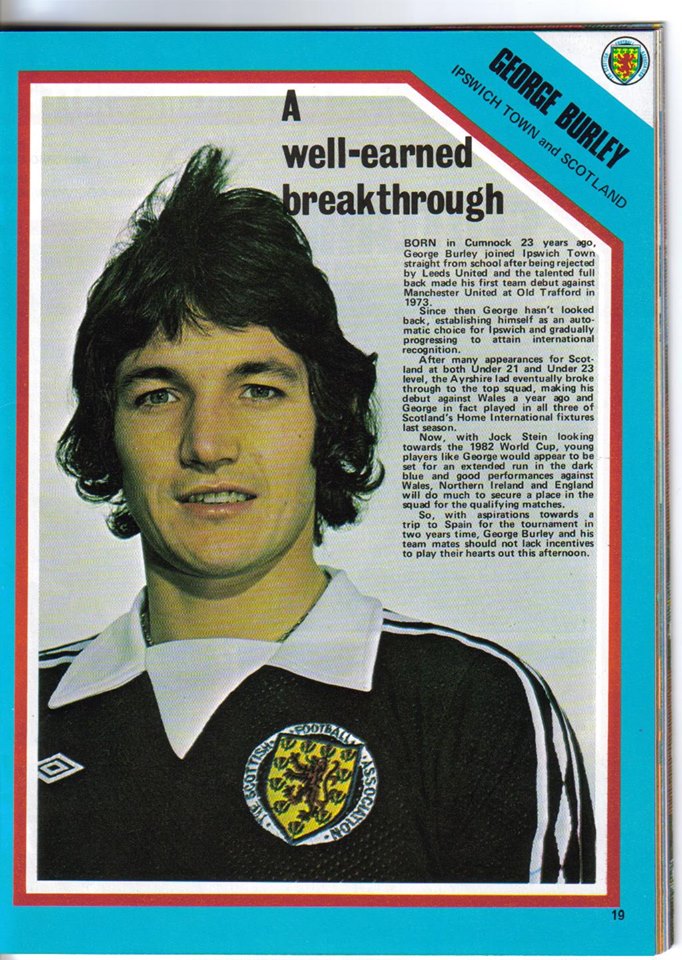
Through gritted teeth then, it’s George Burley’s 59th birthday on 3rd June. George won eleven caps for Scotland between 1979 and 1982 and was a non-playing member of the Spain 82 World Cup Finals squad. The attached image of George the player is from the programme for the 1980 Scotland-England match which the visitors won 2-0. The Ipswich Town ‘Tractor Boy’ got his eighth cap that day when he replaced St. Mirren’s Iain Munro after 62 minutes.On a more positive note Hurly-Burley also played in Euro-qualifiers where we skelped Norway 4-0 in Oslo and Portugal 4-1 at Hampden.

11147071_1624839197753452_3390107526703308864_n

George also has the distinction of being one of that rare group who have both played for and managed their country – achievements that supporters like myself can only dream about. Sometimes however the dreams turn into nightmares and I still regularly wake up screaming ‘for Chissakes will someone mark Ramsey!?!’

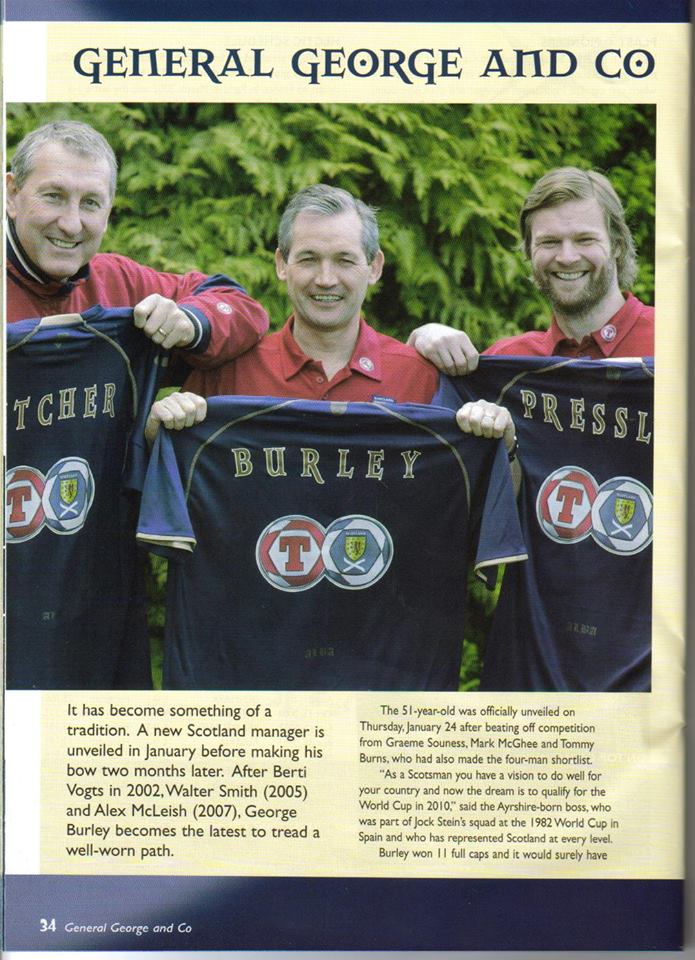
The managerial image is from the programme for the 2008 friendly against Croatia. It was the ‘scream-team’s’ first game in charge and it ended in a 1-1 draw.

A decent, Ayrshire man is our George [so no doubt I’ll incur the wrath of Hamish Husband] but the managerial memories are still painful and even his initials upset me! On the basis though of – ‘It’s only a game’ – a very happy birthday to you Mr. Burley.

Robert Marshall

Footnote:-
SEB&T editor Robert Marshall and I (Alan Nelson) had Ian Munro as a PE teacher when he was a young St Mirren player I was surprised that he made it as a footballer -especially a defender – as I always thought that he was too nice/compassionate/caring an individual [eg He didn’t shout at me when I dropped the bean bags!]. Comparing Iain Munro to someone like Graeme Souness would be a bit like comparing a goldfish to a pirhana! Souness would probably have had me greetin….

First posted on Facebook June 1st, 2015

The height of the obsession?

11109268_1624577511112954_8685229510298736721_n

Yet another de-cluttering exercise in the Marshall household unearthed a gem that I didn’t know I had. The 1972/73 Arthur Montford’s Scotsport Yearbook was the second of its kind and extended to 68 A4 pages for 45 pence. It mostly reviewed the 71/72 season with articles on Celtic’s 7th league title in a row, Celtic’s demolition of Hibs in the Scottish Cup Final, Partick Thistle’s demolition of Celtic in the League Cup Final, Glasgow Rangers winning the European Cup Winners Cup plus a look at Barcelona, Dumbarton, Arbroath, Airdrie and Cambuslang Rangers!

On the international front a feature on Tommy Docherty touched on Scotland’s exploits at the 1972 Brazilian Independence tournament but elsewhere photographs and analysis concentrated on that year’s Scotland v. England fixture – with the visitors winning 1-0 in front of 119,325 – the last game against the auld enemy to top the 100,000 mark.It can be argued that for over 100 years we were obsessed with meeting and beating England at football. I wonder however, if the obsession reached its peak around 1972/73? By the time the 1974 game at Hampden came around we had a bigger stage to perform on – the first of five consecutive world cup finals.

That said, the images from 1972 make for interesting copy. I particularly like the back cover photo which gives you a close up of the old rectangular-shaped goalposts which allegedly cost Saint Etienne the European Cup Final in 1976!

11235386_1624577544446284_8082281261175668438_n
I’m sure that the advert for the Daily Express Swopcards would be enough to get the likes of a young David Stuart worked up into a lather until he was old enough to drink, chase women….and buy boxes of football cards.

11393020_1624577571112948_4848714079445866094_n

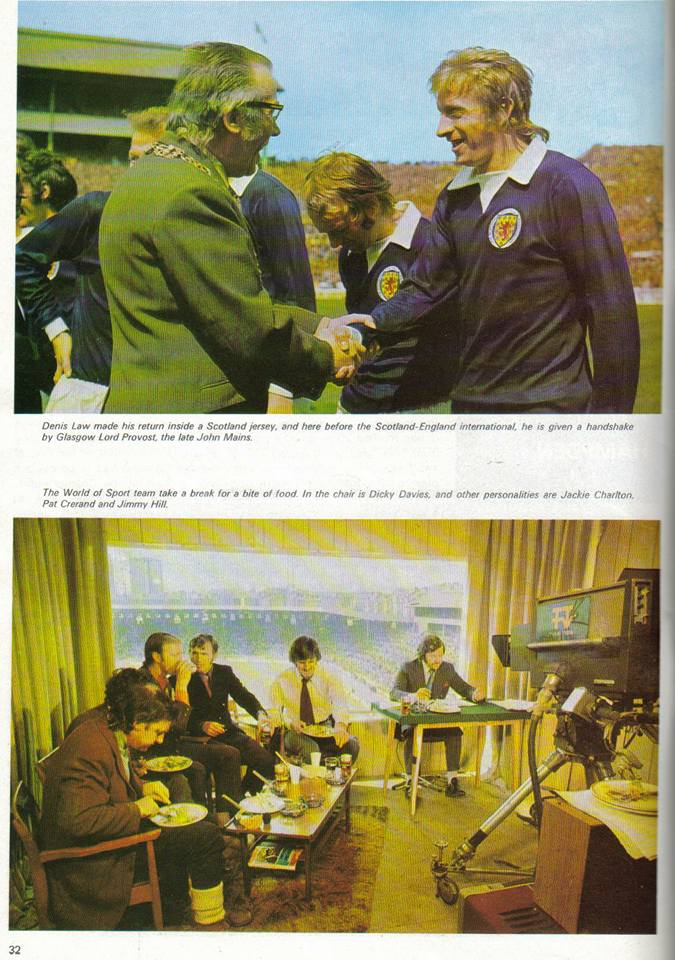
The other photos include the Lawman being presented to Glasgow’s Lord Provost prior to kick-off whilst high above the east terracing a temporary studio houses ITV’s World of Sport team which includes Dicky Davies and Jimmy Hill plus ex-internationalists Jackie Charlton and Pat Crerand. These esteemed gentlemen appear to be enjoying a spot of lunch in somewhat basic surroundings although the rug under the coffee table is a nice touch. I wonder what the toilet facilities were like?

Robert Marshall

First posted on Facebook 1st June, 2015

Who was Ronnie Simpson.

10847443_1577127822524590_1198410138317069307_o

During the Arsenal and Aston Villa FA Cup Final, after Alexis Sanchez had scored that wonderful second goal for Arsenal, a caption flashed up on the screen stating he was the second Chilean to score in a FA Cup Final and asking who the first was. It turned out, it was a guy called George Robledo who scored in the 1952 final for Newcastle. Robledo’s story in itself is quite fascinating and well worth a peek at his Wikipedia page.
However, being a bit of an anorak I turned to my Celtic supporting work colleague and asked him who the goalkeeper was for Newcastle that day. He didn’t know and was surprised to hear it was Ronnie Simpson, the future Lisbon Lion.
Ping! Went that sad light bulb in my head and suddenly an article on Ronnie Simpson started to formulate but I have no idea why I decided to do it in US quiz Show Jeopardy style.
Who represented Great Britain in football at the 1948 Olympics and yet would have to wait until 1967 before being capped by Scotland?
Who is Ronnie Simpson.In 1948, Matt Busby was asked to pick a team for the London Olympics to represent Great Britain. As it has to be an amateur team there was no major outcry from various football associations nor did Sepp Blatter who was probably in charge of FIFA at the time raise any objections. There were a few Scots in the team, which having Queens Park players to pick from did help. Among them was 17 year old Ronnie Simpson who played two games in the tournament. Team GB ended up 4th losing in a play-off to Denmark for the bronze medal. No one else from the squad achieved any great success as football players.
Who played in goals for Newcastle in their 1952 and 1955 FA Cup wins at Wembley and yet would have to wait ‘til 1967 to make his debut for Scotland at the same ground?
Who was Ronnie Simpson.Ronnie joined Newcastle in 1951 and stayed there until 1960 winning the FA Cup twice. Ronnie had made his debut for Queens Park in 1945 at aged 14 years and 304 days, which is an unofficial record as the youngest player to appear for a Scottish League Club. However, as this was during the war years it is not deemed an official match. Ronnie went on play for Third Lanark before joining Newcastle.
At 36 years and 196 days he is the oldest player to make his debut for Scotland and that is a record that will stick! His debut of course, came in the famous 3-2 defeat of England in 1967. Ronnie played for Scotland five times, including a draw with England in 1968 and a World Cup Qualifier against Austria which Scotland won 2-1 at Hampden in November 1968. The photo is taken from the October 1967 defeat to Northern Ireland at Windsor Park, which saw us fail to reach the 1968 Euro finals. Ronnie saved a penalty in this game.
And now my personal favourite. The father played for Rangers and Scotland, the son for Celtic and Scotland. Who were they?
Who were Jimmy and Ronnie Simpson.Jimmy Simpson played for Rangers between 1927 and 1940, having played previously with Dundee United. As centre half, he won the Scottish League 5 times and the Scottish Cup 4. His time with Scotland was quite good too. Jimmy played 14 times for the National side between 1934 and ‘37, captaining them thirteen times including two wins against England, playing alongside the likes of Hughie Gallacher, Bob McPhail and the wonderfully named Dally Duncan. So there you go Ronnie Simpson, so much more than 1967 and I didn’t even mention being sold by Jock Stein from Hibs to Celtic due to his poor attitude to training nor his time as a Tory councillor in Edinburgh.
David Stuart

First posted on Facebook June 1st 2015

Please Buy the Cow

So we’re only a week away from the game against the Mighty Qatar; are you all excited? Well, I know, not exactly. Unfortunately Scotland Epistles. Bullshit & Thistles sellers won’t be there in numbers either. It’s my wife’s birthday and although a trip to Edinburgh would be nice. “ Come on Nan, we’ll see the Castle, walk the Royal Mile, take in a nice meal and have a few wee drinks . . . and then sell the Epistles outside of Easter Road, take in a football game and then sell some more after.” Nah, just can’t see that one working.

Anyway, so I won’t be there. I will be in Bute seeing the Castle, walking the High Street, having a bag of chips and getting pie eyed to celebrate the wife’s birthday and if she’s lucky they’ll be something more amorous later on.
As for Mr. Nelson, he doesn’t do friendlies. He doesn’t seem to do Sales either. Alan have you no friends or relatives to flog the magazine to? So who does that leave for next Friday?
Yep, the head of the unholy trinity Robert Marshall, as you can see from the photo below he takes his selling quite seriously.

22507_1623942397843132_1559191516779960845_n

So next Friday please keep an eye out for a sad anorak shouting “ the Scotland Epistles” and if you haven’t already bought one, please do and if you have, get yer mate to buy one.
Robert, Alan and I really enjoy this mad wee adventure we’re on and have put in a lot time and effort to produce two magazines and almost daily input to the Facebook page of late. We have committed ourselves to two more magazines but would love to see it go beyond issue four and also to see the pages go back up to 48. I know you might be thinking with the Facebook page, why buy the cow when you’re getting the milk for free? That might be true but please help us in this endeavour so we can grow and keep producing little snippets on Scotland for you to enjoy.
In a couple of days the listing for the mags on ebay will lapse and will be relisted. Alan will post a link to the new listings but please have a look and consider the mags if you haven’t already bought one. Other than that keep spreading the word and sharing the Facebook articles and photos.
And if you see Robert next Friday, even if you’re not buying let Robert know you enjoy the Facebook page.

David Stuart

First posted on Facebook May 30th, 2015

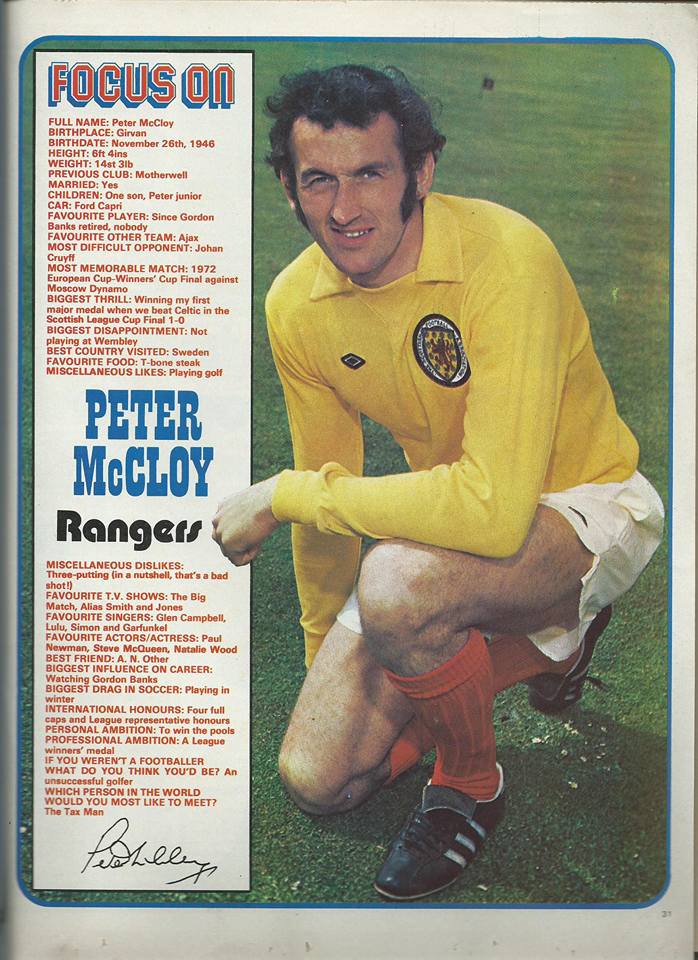
Focus on Peter McLoy

11391221_1623772121193493_112382931078904491_n

On was regular item of Shoot magazine in the 70’s and 80’s; where players were asked a set list of questions. Some were football related i.e. Favourite Player, Most Difficult Opponent, Biggest Thrill and then there personal questions such as Favourite T.V. Show (T.V. was given the proper two full stops every time), Favourite Singers etc.
Most of the answers by players were generally banal, in fact former Notts County player David McVay called his hilarious autobiography “Steak Diana Ross – Diary of a Football Nobody” after the most likely answers for favourite food and singers. Former Scotland player, Don Masson comes in for a bit of a slagging in the book and David’s description of Notts County boss Jimmy Sirrel’s unique management style is well worth a peek.
Peter McLoy or the Girvan Lighthouse as he was affectionately known had played for Scotland 4 times although by the time of this article (July ’74) he had played his last game for Scotland the year before. In Willie Ormond’s first game in charge Bobby Clark of Aberdeen who had been a regular for Scotland at the time retained his place. However, Bobby was one of the scapegoats following the 5 nil drubbing by England on a wet miserable night at Hampden in February 1973.
So three months later, Peter was given his chance in a Home International game against Wales in Wrexham. Scotland won two nil that day thanks to goals by George Graham of Manchester United. Also making their Scotland debut that day were Danny McGrain, Jim Holton (who if asked his height on Focus On would have to answer 6ft 1in, which doesn’t rhyme as well), Derek Johnstone and also Derek Parlane of Rangers.
Alas, this was Peter’s only win in a Scotland jersey as narrow defeats to Northern Ireland, Switzerland and Brazil followed. In the latter game it was team mate Derek Johnstone who scored an own goal to give Brazil the win at Hampden. As to Focus On; Peter’s Favourite Player was Gordon Banks, most difficult opponent Johan Cryuff whom he had faced a couple of times as a Rangers player. His biggest disappointment was not playing at Wembley. Ally Hunter had been given the go ahead against England in between Peter’s Scotland appearances.
As for T.V. show, it was the Big Match and Alias Smith and Jones, singers included Glen Campbell and Lulu (Lulu for f**k’s sake Peter!), his Favourite Food was of course T-bone Steak. At least his Miscellaneous Dislike was not shaving but three putting at Golf. (No surprise there).

David Stuart

First posted on Facebook May 29th, 2015

GLORIOUS JUNE

11222297_1623567094547329_2548175278695607534_n

June is a glorious month especially in the even-numbered years when it features the World or Euro Championship finals. If you are looking for some extra special dates for a celebratory Barbie then why not choose from the undernoted five which have borne witness to Scotland’s grand total of six victories at major tournament finals.
11 June 78 World Cup Mendoza,Argentina Scotland 3 Netherlands 2

14 June 74 World Cup Dortmund, Germany Scotland 2 Zaire 0

15 June 82 World Cup Malaga, Spain Scotland 5 New Zealand 2

16 June 90 World Cup Genoa, Italy Scotland 2 Sweden 1

18 June 92 Euros Norkopping, Sweden Scotland 3 C.I.S. 0

18 June 96 Euros Birmingham, England Scotland 1 Switzerland 0

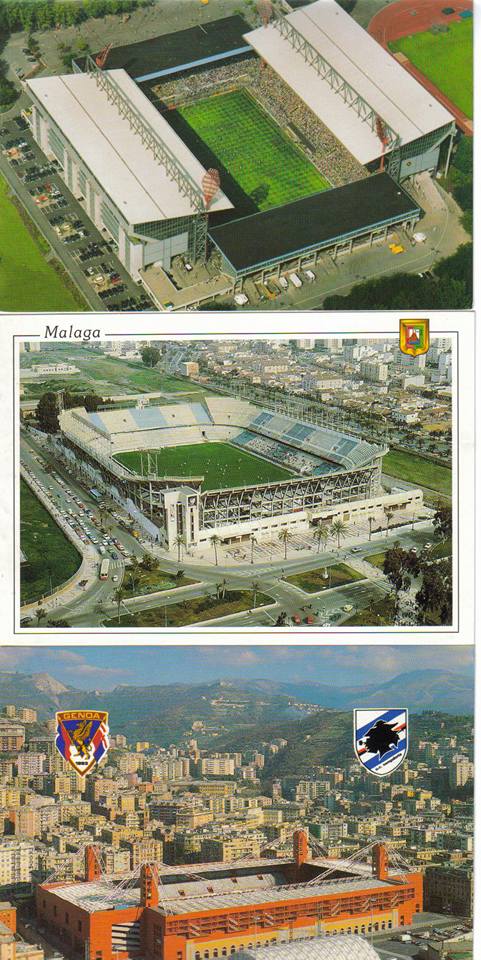
I’ve attached postcard images of three of the World Cup venues where we have tasted victory and we’ll try to dig out something else nearer each individual date. The Westfalen Stadion in Dortmund in 1974 [where Scotland treated Zaire with the leniency of a first offender] was also the blueprint, apparently, for the remodelled Ibrox Stadium ie cheerio running track and large terracing. Somewhat ironically, the Westfalen Stadion was itself considerably re-modelled for the 2006 World Cup but includes standing areas for club matches.

Malaga’s then uncovered Estadio la Rosaleda [aka The Rose Garden] had standing areas behind each goal during the 1982 World Cup Finals and I was on the lower tier of the furthest away terracing [ie the NORTH terracing for the benefit of David Stuart] to watch Scotland put the New Zealand all-whites to the sword.There was also a moat however that prevented us from mobbing John Wark and the boys at the final whistle.

Genoa’s Stadio Luigi Ferraris is another box-stand masterpiece which apparently was the inspiration for the re-developed Deepdale Stadium of Preston North End. The link here is Craig Brown who managed the Lancashire club between 2002 and 2004 and who assisted Andy Roxburgh in guiding Scotland to victory over Sweden in Genoa at Italia 90.

I particularly like the postcards that afford you a view of the adjacent topography-be it the dry [in summer] river bed to the right of La Rosaleda or the Genoan Hills which overlook Luigi Ferraris – well it turns me on anyway. Hopefully JUNE 2016 will necessitate an update for this article.

Robert Marshall

First posted on Facebook 28th May, 2015

Every Picture Tells a Story (Again)

11377217_1623386644565374_1206896613014949474_n

One of these days, the Scotland Epistles, Bullshit & Thistles magazine is going to make a profit and before Robert unloads it to a deserving charity, I’m going to put in an expenses claim. I’ve been buying a lot of Scotland magazine covers and clippings over the last ten months or so and as the Facebook page has grown I,’ve had to buy some more. In most cases, the picture tells the story and I move on from there but sometimes, like this photo it’s hard to see where the story is going to take us.Jim Hermiston was a full back who played for Aberdeen from 1966 to 1975 and was one of the first names to be included in the Aberdeen Hall of Fame. I could just rewrite his Wikipedia page and dress it up as my own but it’s a photo of Jim in a Scotland strip on the one occasion that he wore it. The wonderful thing about the internet is that you can stumble upon the most helpful websites, in this case it was Fitba stats, which has details of Scotland games at Full, B, under 21 and 23 levels. Most excellent it is.
The occasion was an Under 23 friendly against Wales in Swansea, which unfortunately Scotland lost one nil. The line-up for the game is quite interesting with only four of the thirteen players used failing to make full caps. It does beggar the question was Under 23’s a better way to prepare young players for the full team rather than under 21’s.
The line-up was as follows; in goals Motherwell’s Keith MacRae, one of the ones not to progress to a full cap. Next up was Celtic’s Davie Hay, who as we all know was a major part of our 1974 World Cup Squad, as did Sandy Jardine who replaced him during the game. Hermiston was next and was substituted for Hearts’ Peter Oliver, this would also be Oliver’s only appearance.
Next up is probably one of the most interesting players. Eddie Kelly was an Arsenal player who indeed would score a goal in the FA Cup Final later that year against Liverpool, which Arsenal famously won as part of their double that year. Eddie incidentally goes down in history as the first substitute to ever score a goal in a FA Cup final. Eddie would also go on to be captain of Arsenal at one point and yet he never won a Full Scotland cap. I can barely imagine a Scot playing for Arsenal now, never mind one being the Captain. Frank Munro played for both Dundee United and Aberdeen before moving on to Wolves where he won all his Under 23 caps and 9 full ones. Unfortunately for Frank, Scotland only won one game in which he played. Martin Buchan, Jim’s team mate at Aberdeen was number six that night and can be seen in the background of the photo. Buchan would play as a Manchester United player in both the 1974 and 1978 World Cups. Asa Hartford of West Brom, would also play in the ’78 and ’82 World Cups gaining 50 caps in total for Scotland.
Coventry’s ginger headed wonder player Willie Carr was next up. Willie would only gain 6 caps for the Full team but unlike Munro, he would never play in a losing side. Carr played over 250 times for Coventry and also Wolves.
Our bustling centre forward that night was the mighty Joe Harper of Aberdeen. Joe would play four times for Scotland and remarkably three of those were against Denmark. His two goals came in World Cup and Euro qualifiers in Copenhagen. Maybe you shouldn’t have celebrated that second time around, Joe? Joe would be one of the Copenhagen five, who were banned for life from playing for Scotland after a night out went awry. Joe and Arthur Graham would have their bans lifted, however, Billy Bremner, Willie Young and Pat McCluskey would not. Sadly for the latter two they would never represent their country. Perhaps Joe might have preferred the ban to continue as his final game was against Iran in Argentina and we all know how miserable that was.
John Connolly of St. Johnstone was number ten that night. Connolly would play for the full team, but only the once, against Switzerland in 1973, lasting only 46 minutes. John was an Everton player at the time.
The final player was Tommy Hutchison, not quite archetypal winger we were used to in Scotland given a lot of us grew up with Jimmy Johnstone and Willie Henderson as what a winger should look like. Tommy was with Blackpool at the time but by the time of his first full International in that legendary game against Czechoslovakia which saw us qualify for West Germany ’74, Tommy was a Coventry player. Tommy gained 17 caps in total and some say he should’ve went to Argentina as he was playing the best football of his life at the time.
So there you go, one picture and eight hundred words later I told you it wasn’t about Jim Hermiston but if any Aberdeen fans want to add to the story, please do.

PS I’m just glad the shadow that’s coming through on the picture is not a Scot or I’d need to write another ton of words.

David Stuart

First posted on Facebook 28th May, 2015

Blog at WordPress.com.

Up ↑