Search

The Scotland Epistles Football Magazine

Scotland Football Fanzine

Author

David Stuart

Focus On Alex McLeish

11752093_1642787682625270_4576074089855670235_n

I tend to stay away from doing pieces on players that gained a lot of caps. It’s so much easier to tell someone’s story when there’s only 15 caps or even 30 but Alex gained 77 and is third in the all-time list behind Kenny Dalglish and Jim Leighton. So here goes. Jock Stein gave Alex his first cap against Portugal in March, 1980 in a fine 4-1 win at Hampden in a Euro Qualifier. Of course being a Euro qualifier despite this great result we were already well out of contention, finishing fourth behind Belgium, Austria and Portugal. Thank goodness we still had Norway to prop us up. Also making his debut that night and for his only cap as an Aberdeen player was Stevie Archibald who despite his pedigree i.e. Spurs, Barcelona and Clyde never quite sparked in a Scotland shirt, only scoring 4 goals in 27 appearances. Although Alex would start in the first few games of the campaign to reach Spain ’82, by season ’81-’82 he seems to have fallen out the picture with Jock Stein preferring to play in the main Alan Hansen alongside Willie Miller, which as we all know proved to be a mistake come the World Cup. Alex did get game time during the World Cup, making a 30 minute appearance as a sub in the game against Brazil.
Throughout the qualifiers for Mexico ’86, Jock Stein had gone with the Miller / McLeish partnership as would his club manager Alex Ferguson for the play-offs against Australia, however Alex would play in the in opening game against Denmark and would then miss the final two games. I have to be honest and haven’t been able to confirm if he was injured or not;or if his club boss simply left him out in favour of David Narey.
Alex would finally get to play a big part in the World Cup Finals for Italia ’90 where he played in all three games against Costa Rica, Sweden and Brazil. After, the World Cup Alex would play in the first few games of a finally successful Euro campaign but by 1991 was being left out for players such as Craig Levein, Richard Gough and Dave McPherson (that can’t be right, can it?). A final swansong in February 1993 in a World Cup Qualifier against Malta would be Alex’s last appearance in a Scotland shirt. He would of course go on to manage Scotland rather successfully in some ways, in 2007 but like many a fan it rankles with me that he jumped ship to an average English club side in Birmingham City at the first opportunity.
As to his Focus on, it’s a bit boring but the reason for that becomes clear at the end when asked “ If not a player, what job would you do?”, “Hopefully, an accountant” came his reply and sadly this was actually true as Alex was studying accountancy at the time (Summer ’80).
Other than that his favourite food is . . . Steak! Sorry folks there’s no Scandinavian beauty to post here as he goes for Meryl Streep as his actress. His favourite player is Ruud Krol of Holland and childhood hero was Gerd Muller of West Germany. Favourite singers are Joni Mitchell and Phil Collins of Genesis.
And that was all she wrote as they say.

David Stuart

First posted on Facebook July 22nd, 2015

Not the Curse of Berti Vogts

11057235_1642322126005159_617348069270384412_n

In issue 2 of the Scotland Epistles, Bullshit & Thistles magazine I wrote an article called ‘ The Curse Of Berti Vogts’; the premise was that the bizarre amount of players that were given their debut cap by Berti and how their career ended prematurely or has been hampered by injury. If you think of John Kennedy, Lee Wilkie, Michael Stewart, Peter Canero as proof of the former and how even established Scotland players like Darren Fletcher, Gary Caldwell, James McFadden and Craig Gordon have had to overcome long term injuries. However, for the record with Steven Caldwell announcing his retirement this month I would like to clarify that Steven was not capped initially by Berti but by Craig Brown in April, 2001. So this one is not added to Berti’s cursed list.
Mind you if you have a look at the list of players making their debut that night at the Zawisza Stadium in Bydgosccz, it would seem that some sort of curse was involved that night too. Along with Steven making their one and only appearance in a Scotland shirt were John O’Neill of Hibs, Dunfermline’s Barry Nicholson, Charlie Miller, then of Dundee United and Andy McLaren of Kilmarnock; all of them who have had their hard times in some ways in their football career. The game was a classic of a goal each and numerous substitutions, which of course probably meant that an initial guarded first half was followed by a disrupted second half with the paying punters (20,000) wondering why they turned up in the first place. I think if people are paying money to see these internationals there has to be a limit on the subs; as all too often the game descends into farce. Incidentally, Scott Booth of Twente Enschede scored the Scotland goal.
As for Steven, he would win 12 caps under 5 managers with Craig Levein being the last, which says a lot about the state of Scotland management in last decade or so. Steven would have some highs with the 3 nil away win in Slovenia being the top of the list but whether it was enough to wipe out the memory of 4 nil defeats to both Wales and Norway I’m not too sure.
If you want to read more on the Curse of Berti Vogts issue 2 of the Epistles is still available on eBay. As for issue 3, hopefully it will be going to the printers on July 27th and will ab available shortly after.

David Stuart

First posted on Facebook July 20th, 2015

The British Home Internationals Trophy

11050779_1642121219358583_3641223104490507505_n

If you were to ask me if there was a trophy for the Home Internationals I would probably have answered no as I don’t recall ever seeing it. So it was a surprise when I came across this photo and there it is. I suppose given the permutations on the final day of the Championships, it wasn’t always available for the winning team to hold it aloft. After all it would be quite embarrassing for it to sit at Wembley only for the Irish to win it at Windsor Park.
Apparently the cup was first played for 80 years ago this year and was part of the King George V’s Jubilee celebrations. I have included two other photos to show what a magnificent looking trophy it was.

11751851_1642121309358574_3467601077742883500_n
The main photo is of course of Joe Jordan, Tom Forsyth and Danny McGrain in an England top, with the trophy. This was taken at Hampden in May 1976, as we have just beaten England 2-1 to clinch the trophy with goals from Don Masson and Kenny Dalglish. All three players pictured had a big part in that win. Jordan with some great wing play to cross the ball for Dalglish to put the ball through Clemence’s legs. There’s also the sight of Danny McGrain splitting the English defence with a great run and passing move just failing to connect fully as he shoots. However, best of all, in the last few minutes as Channon looks to be clean through; a great clearing tackle from Big Tam helps see the game out. Great days and have a look at the video on You Tube. Go for the full length version though and see us denied a penalty too!
As for the trophy; it now belongs to the Northern Irish FA as they were the last winners. For the moment though, it sits on long term loan to the National Museum of Football. Maybe we should request for it to be on display at our National Museum of Football as we won it on quite a few occasions too.

11743017_1642121296025242_3466659952573549412_n

David Stuart

First posted on Facebook July 20th, 2015

Happy Birthday Peter Cormack

11017483_1640890836148288_7549080792898743434_n

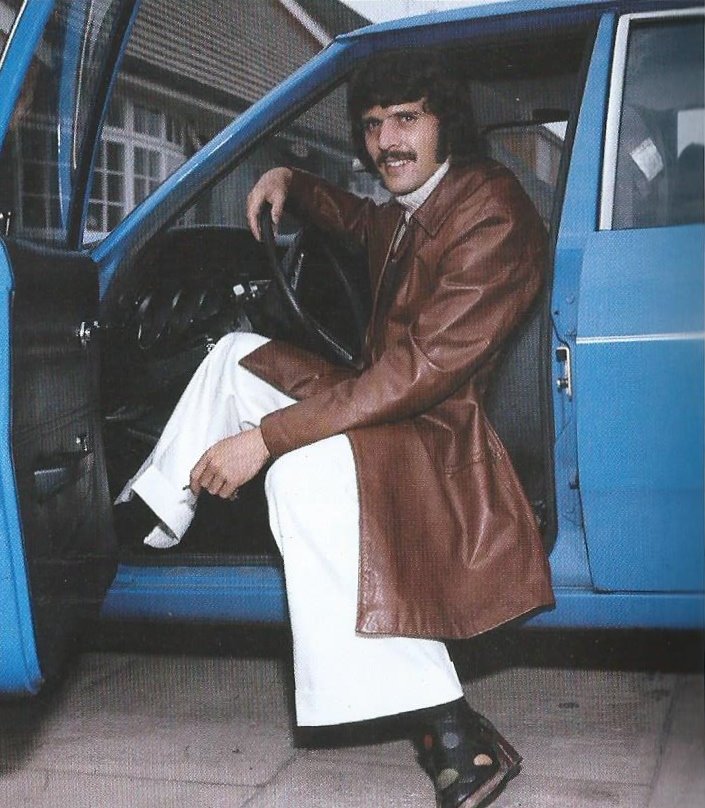
Peter Cormack will be 69 on July 17th. It’s fair to say that Peter’s Scotland career never really reached the heights that was expected of him. Peter had flourished under Jock Stein at Hibernian as a teenager and indeed he would make his Scotland debut at the age of 19.

Peter had played for the Under-23 side a couple of times prior to his first full team game and lining up alongside against Brazil on 25th June 1966 were a couple of familiar faces. Billy Bremner and Charlie Cooke had played with Peter in the Under-23 side but had progressed to first team before him. Also making his debut that day was John Clark of Celtic.

This was a pre-World Cup warm up for Brazil and show were such players as Jairzinho, Gerson and Pele. Stevie Chalmers of Celtic put Scotland ahead in the first minute but Brazil equalised through Servilio in the 16th minute and the game ended 1-1.

Surprisingly it would be a couple of years before Peter would play again for Scotland coming on as a sub with 3 minutes to go in a 1-0 defeat to Denmark. However, a year later things pick up again as Peter plays two games in a row. The first in September 1969, the Republic of Ireland game at Dalymount Park which I mentioned the other day.

He is then picked for the World Cup Qualifier against West Germany. At this point Scotland were still very much in the hunt for a place in Mexico and any kind of result against the Germans would put Scotland in a good position going into their last game against Austria.

Scotland got off to a great start with Jimmy Johnstone scoring in only three minutes, however the Germans equalised just before half time and then went into the lead in 60 minutes. Alan Gilzean would equalise four minutes later but with only nine minutes to go a final German gaol broke Scottish hearts. It was shortly after this that Tommy Gemmell went on the rampage having being hacked down by Helmut Haller; Tommy decided to take full blooded revenge and whacked Haller a cracker. Tommy became only the fourth Scotland players to be sent off and the third Celtic player to do so on National duty with Bertie Auld and Pat Crerand being his predecessors.

Scotland lost the final World Cup Qualifier against Austria in Vienna with Peter missing out but who knows what would have happened had we drawn in Hamburg but isn’t that always the way?

As for Peter, after another period of absence would see him come on as a sub, again against Denmark in November 1970 in a Euro qualifier. This would be his first game as a Nottingham Forest player. Scotland won one nil, thanks to a John O’Hare goal

1971 would Peter’s best year for representing Scotland as he would win his final four caps; mind you it wasn’t a great year for Scotland as their playing record would read P10 W2 D1 L7 F5 A14.

Peter would play in defeats to Portugal, England and Denmark and a nil nil draw against Wales. These results would see the ending of Bobby Brown’s reign as Scottish manager and the beginning of Tommy Docherty’s. In fact, the two Scotland wins would be under Tommy and without Peter. Docherty would bring Peter on as a late sub against the Netherlands in Amsterdam in December ’71 and that would be it for Peter . . . well almost.

Peter would become a Liverpool player in 1972 and would be a pivotal part of their season ’72-’73 Championship and UEFA Cup winning team but there would be no Scotland recall for him that year. However, despite not having played for Scotland since 1971 Peter was chosen as part of the 22 players that travelled to Germany for the 1974 World Cup. It is strange that Scotland played six games prior to the World Cup that year and Willie Ormond chose not to play him but still took him to Germany as part of the squad.

That was it for Peter and Scotland, although his international record was pretty poor as Scotland would only win once with Peter involved and even then the goal had been scored long before he came on.

Happy Birthday Peter and all the best. I do wonder, do you still have those white flares and polka dotted high heels?

11745723_1640890989481606_5868635404382109135_n (1)

David Stuart

First posted on Facebook July 17th, 2015

Men Can Multi-Task

11059395_1640495489521156_868668426984799300_n
Couldn’t resist another Colin Stein photo taken I have been informed by Hamish Husband from Hugh Taylor’s The Scottish Football Book No.16.  I was initially a bit puzzled as to the game as well. It turns out it is West Germany v Scotland in a World Cup Qualifier from October ’69. Scotland lost 3-2 and lost out in going to Mexico ’70. If you watch highlights of this game there is two pitch invasions by the Germans after their second and third goals. Although, it’s all very civilised and seems to be middle aged gentleman in trilby’s, you do wonder what would be made of it today.

The goalkeeper is Sepp Maier which kind of threw me at the time as he was wearing black socks when the rest of his team wore white. Of course the other thing about Sepp Maier was those giant gloves. I always imagined when he took them off he had these giant hands that fitted the whole of the glove.
However, it’s really the referee in the photo that’s worth noticing. Is he multi-tasking by blowing his whistle and farting at the same time? Again if you look at the video of the game on You Tube, the ref starts the game with a white top on but changes to black in the second half. Must’ve clashed with the Germans on TV one supposes.
David Stuart

First posted on Facebook July 17th, 2015. Amended 7th October, 2015

Is It A Bird, Is It A Plane, Is It A Penalty

11010518_1640158832888155_8862034015904717596_o

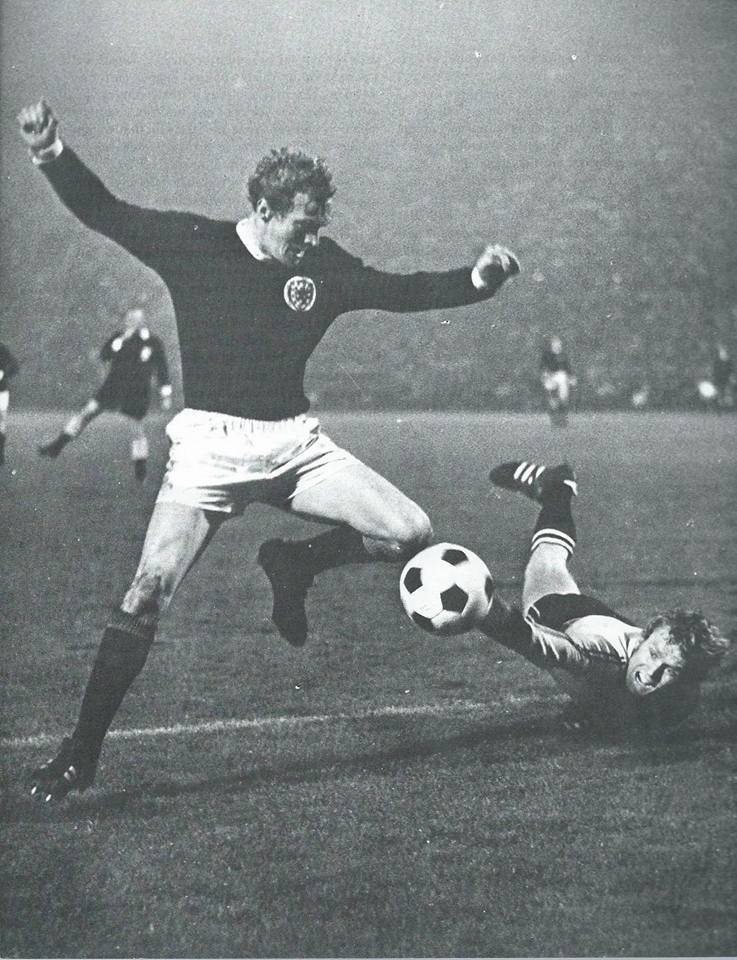
. . . no it’s a dive according to German referee Schulenberg despite the outcries of 137,000 Scottish fans at Hampden and goodness knows how many watching at home that year. The photo is taken from the Daily Record Book of Scottish Football that I mentioned the other day. Colin Stein has just been upended in spectacular fashion by Brian Labone. Certainly in the article in the book it suggests it was a stonewaller but perhaps Colin has over-egged the pudding with the perfection of the dive something I’m sure many a player would be proud of today.
As Scotland had failed to reach that summer’s World Cup in Mexico, it was quite a young and mostly inexperienced team that faced England that day. Celtic’s David Hay, Kilmarnock’s Billy Dickson, Derby’s John O’Hare and Coventry’s Willie Carr had all been given their debuts in the opening game of that seasons Home Internationals against Northern Ireland a week before and had also played against Wales in the midweek. Only Hay and O’Hare would reach double figures in caps and O’Hare’s five goals in thirteen games was pretty good for a Scotland striker of any period. In goal Jim Cruickshank of Hearts was also gaining his third cap that day whilst Bobby Moncur of Newcastle would be gaining his fifth. However, the team had not exactly set the heather alight. A one nil win against Northern Ireland in Belfast, against an Irish side which contained Pat Jennings, Derek Dougan and George Best with O’Hare supplying the goal was as good as it got. This was actually the last game Scotland would play in Belfast for ten years due to safety fears.
This was followed by a nil nil against Wales on the Wednesday and then a scoring blank against England too on the Saturday. Of course had we got the penalty, which as I reach the end of this article I am no longer ambivalent about, it would have been all different. IT WAS A PENALTY REF!
Conspiracy theorists out there may like to point out that there is no video of this game on You Tube to check out the veracity of the penalty claim.

David Stuart

First posted on Facebook 15th July, 2015

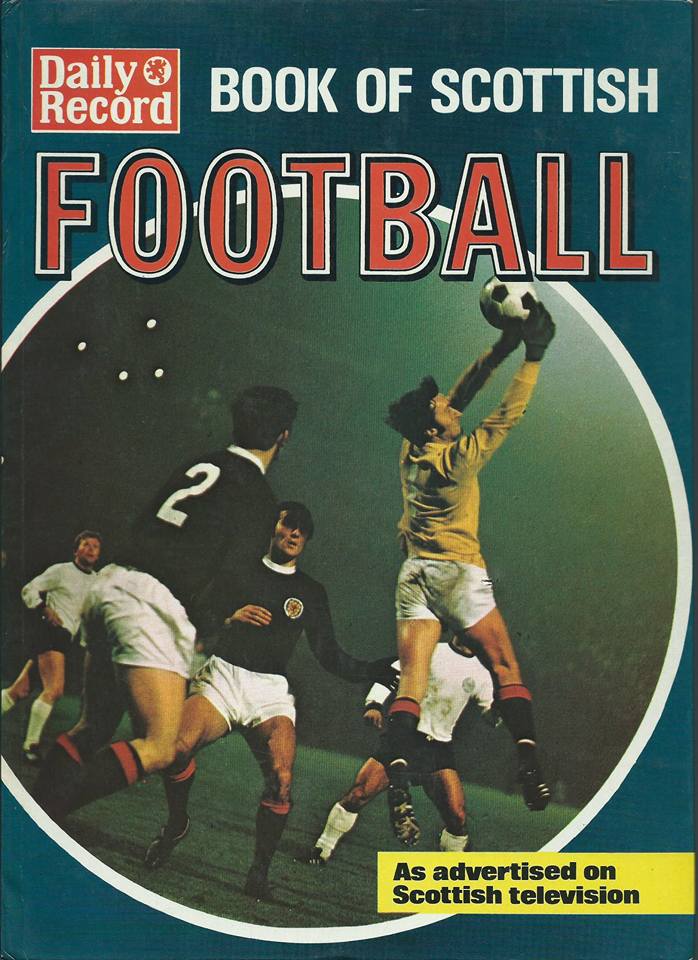
The Daily Record Book of Scottish Football 1970

11745678_1639618519608853_5088068744075720447_n

Not sure how many of these there were but I’ve only ever seen three of them. I can only imagine that the Record wanted part of the Christmas annual market that the Scottish Football Book edited by Hugh Taylor got. That reached up to the mid-twenties in releases. The funny thing is that Hugh Taylor contributes to this too.
It is quite a high quality book for a football annual with plenty of great photographs throughout and it seems to have a fair share of pieces on teams that weren’t Rangers or Celtic, although rather predictably both these teams get more colour photos. The front cover shows Goalkeeper Jim Herriot then of Birmingham City clutching the ball in what would be his last appearance in a Scotland shirt. This was in the World Cup Qualifier against West Germany which Scotland lost 3-2 in Hamburg, effectively ending their World Cup hopes for Mexico ’70. Also, in the picture are Rangers pair John Greig and Ronnie McKinnon.

11705138_1639618546275517_5044439306095198745_n

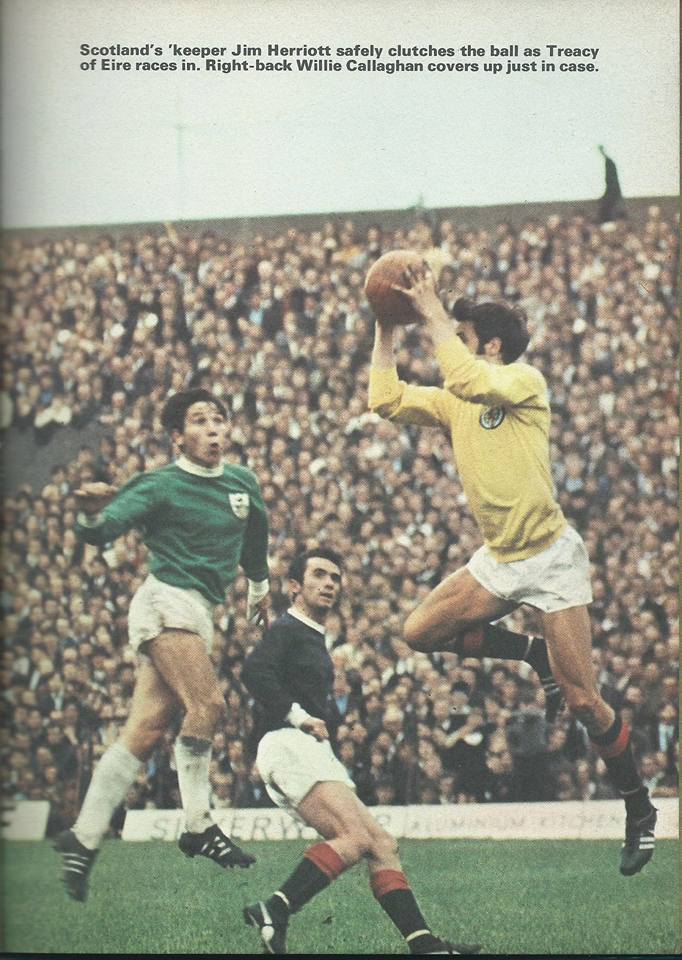
Jim Herriot also appears in a photo inside which is from a friendly against Republic of Ireland in September 1969. It’s taken in the second half . . . and how do I know that? Simple Jim Herriot and Dunfermline’s Willie Callaghan were second half substitutes for Ernie McGarr of Aberdeen and Tommy Gemmell respectively. Callaghan won only two caps for Scotland. This game ended one all with Colin Stein scoring for Scotland. The game took place at Dalymount Park so beloved of Robert Marshall who once bored me by telling how much the programme for this game goes for. I think it was up to £60 or something like that but I tend to fall asleep around programme buffs.

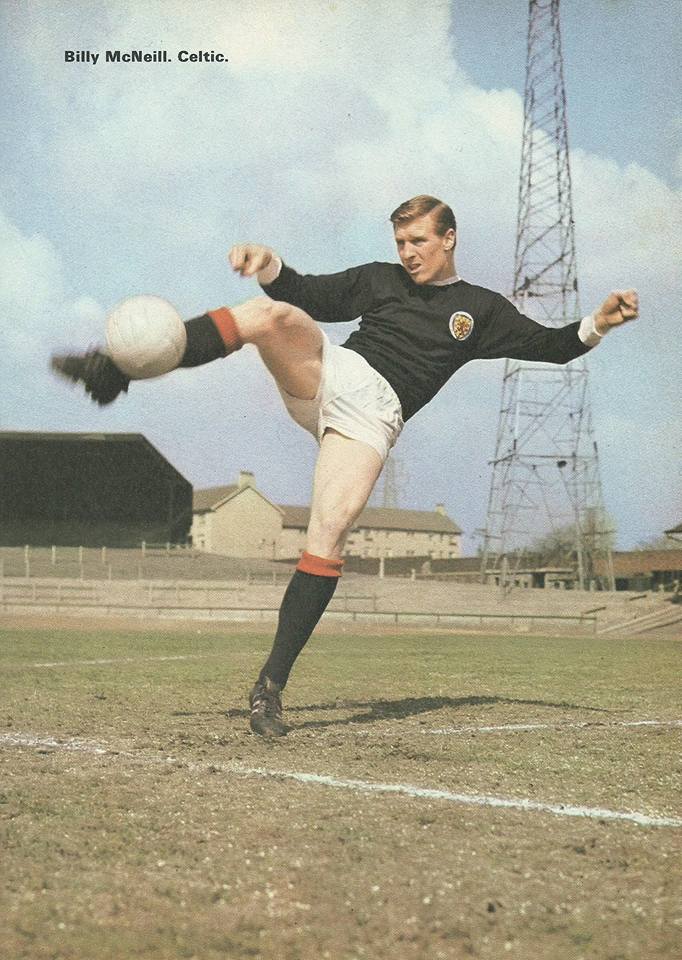
The other photo is of course Billy McNeill in a Scotland strip at what looks like Parkhead for some reason.

11738043_1639618572942181_5662253454422372700_n

Also, inside there’s an article on Aberdeen winning the Scottish Cup, Celtic losing the European Cup as well as a look at the recent Home Internationals although it does bemoan Scotland’s failure to beat Wales and England, both games ending in nil nil draw. It describes the Welsh games as thus “For 90 minutes Scotland gave the Welsh the hiding of their lives, but, as so often happens, they just couldn’t get the ball in the net past Wales’ Fourth Division ‘keeper Tony Millington.”
It’s a good wee book and well purchasing if you get the chance.

David Stuart

First posted on Facebook July 14th, 2015

Pride of Scottish Football – James McFadden

11752490_1639616189609086_2885020048475531812_n

As far as I am aware one of the last Scottish Football magazines to appear in paper format [before the Famous Tartan Army Magazine fought a rearguard action] was one entitled Pride of Scottish Football.

Issue 10 dates from April 2004 and now represents a classic piece of early 21st century nostalgia with cult hero James McFadden adorning the front cover alongside the heading ‘Great Expectations’ and the suggestion that he may be the ‘Next big thing.’Well here we now are in 2015, McFadden is aged 32 and he hasn’t played for Scotland for five years. Most frustratingly he is stuck on the 48 cap mark- just two short of the half-century necessary for inclusion in the S.F.A. Roll of Honour. His 15 international goals has him 7th equal overall but with a better goals per game ratio that Kenny Dalglish, Ally McCoist and Kenny Miller who are all above him in the Scotland scorers league. Sadly, McFadden reminds me of former England star Michael Owen in that he too appears to have lost his ‘Mojo’ way too early.

Back to the magazine which concentrated on the positives from the November 2003 Euro Play -offs against the Netherlands. The highlight was of course McFadden’s second goal for Scotland which gave us a 1-0 victory in the first leg at Hampden. The second leg result is then dismissed as a fluke followed by the rallying-call ”What we did to Holland at Hampden was only the start of a new era in our national game. So roll on the world cup qualifiers!”So the world cup qualifiers rolled on and we rolled over… but then came the Euro 2008 campaign and McFadden’s wondergoal in Paris which gave us a 1-0 victory over the 2006 World Cup Runners-Up. Still, qualification eluded us.

11143119_1639616216275750_9088466041153536309_n

McFadden’s last game for Scotland was in that Euro qualifier against Liechtenstein at Hampden in September 2010 and shortly afterwards he picked up a serious injury which has had a debilitating affect on his career.

Last season McFadden made 19 appearances for St. Johnstone, scoring only two goals. Who knows what the future holds of the one-time Scotland talisman and occasional bad boy. Ever the optimist, I’m still holding out for an international comeback.Meantime, looking at the current set-up I wonder who will now be our next big thing. Ikechi Anya? Matt Ritchie? Ryan Gauld?

Robert Marshall

First posted on Facebook July 13th, 2015

Jimmy Murray R.I.P.

Scan0001

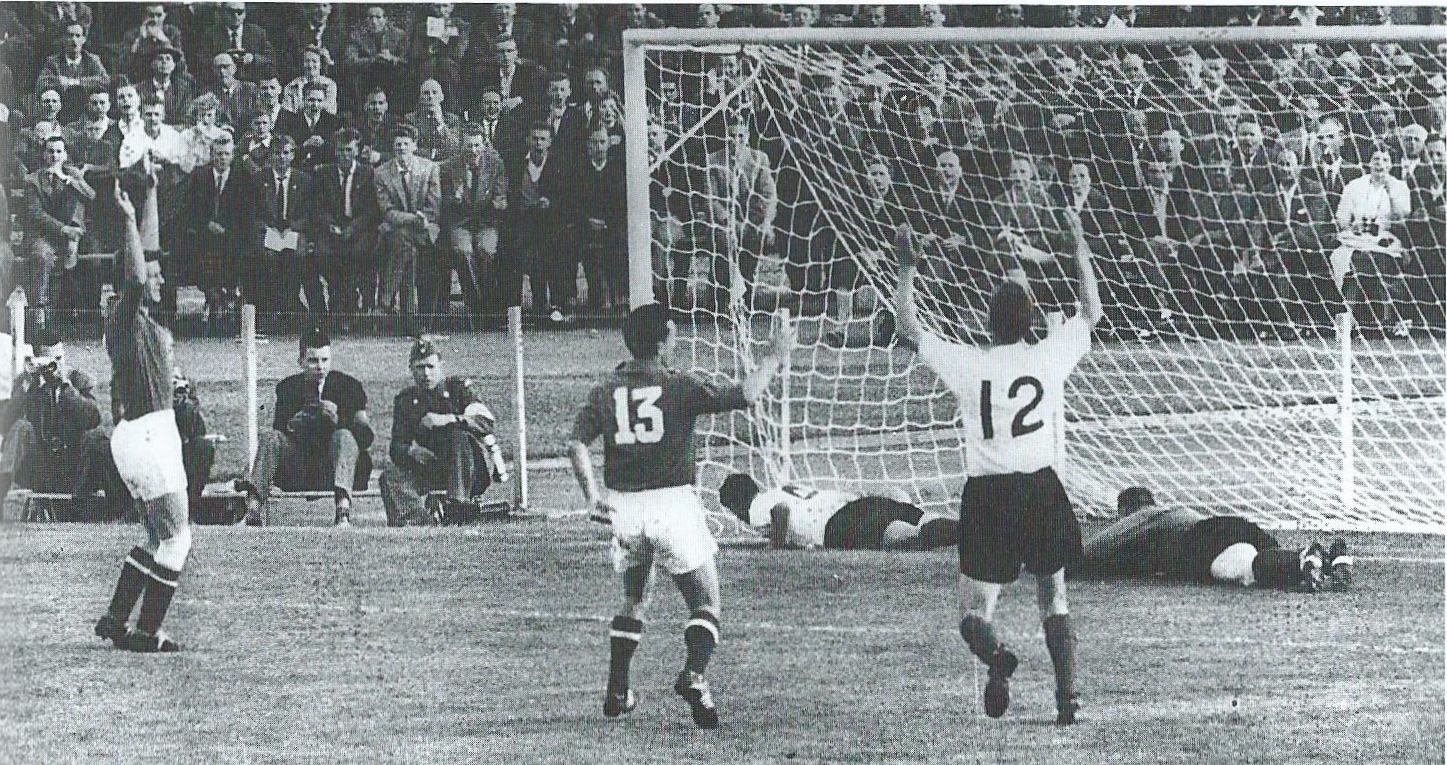
Former Scotland and Hearts midfielder or inside right in old money, Jimmy Murray passed away on July 10th at the age of 82. Jimmy’s claim to fame is that he was the scorer of Scotland’s first ever World Cup Finals goal.
Overall, Jimmy only played five times for the National team, all five of his games took place between April and June 1958 as would Stewart Imlach who played four games over this period and never again played for Scotland too.
His first Scotland cap came against England on April 19th, 1958 in front of a staggering crowd of 127,874. I had mentioned this game the other day in the Jamie Forrest article as Jim Forrest of Motherwell also made his debut that day. England won 4-0 with Bobby Charlton among the goalscorers.

Unlike Jim Forrest, Jimmy Murray’s Scotland career did not finish with that game. Jimmy also played in two World Cup warm up games; against Hungary at home in a 1-1 draw where Imlach made his debut and then a 2-1 victory against Poland in Warsaw with Bobby Collins scoring both goals.

Then onto Vasteras in Sweden for the World Cup opener against Yugoslavia. Yugoslavia went into an early lead before Jimmy scored his record book entry goal in the 51st minute for the game to finish one all.

Both Murray and Imlach missed the next game, a 3-2 defeat to Paraguay but returned for the final group match against France. Hearts team mate Dave Mackay would also feature in the line up that day gaining his second cap, a year after his first. The Scots were narrowly defeated 2-1 by a French team that ended up third in the competition.

For Murray that was it, with no recall to the National side although Murray had already won a League Championship with Hearts and would indeed repeat that feat the following season. It is again an indication of the West of Scotland bias that was prevalent at that time, that saw very few Hearts players of this period gain more than a handful of caps.Of the 1958 squad with the passing of Jimmy, Dave Mackay and also John Hewie this year, there are only a few of them still alive. Tommy Docherty who travelled but was not chosen to play; apparently due to a fall out with a SFA official and Doug Cowie are both still alive and were also members of the 1954 squad too. Also surviving from ‘58 are Eric Caldow, Graham Leggat and John Coyle. Also surviving from 1954 travelling squad are Johnny MacKenzie and Jock Aird. Jock also went on to play for New Zealand as well.As to World Cup goalscorers, they’re a rare breed too with only nineteen in total and even one of them is Iranian Andranik Eskandarian who scored for us in 1978.

For the record top of the list is Joe Jordan with 4 in three World Cups (’74, ’78 and ’82), then comes Kenny Dalglish with 2 in ’78 and ’82, also on two are Archie Gemmill (’78) and John Wark (’82). The others in chronological order are; Jimmy Murray, Jackie Mudie, Bobby Collins and Sammy Baird all 1958. Peter Lorimer in 1974 and in 1982 a veritable feast with John Robertson, Stevie Archibald, David Narey and Graeme Souness adding to the list. Gordon Strachan was the solitary scorer in Mexico ’86.1990 brought goals from Stuart McCall and Mo Johnston and in our final Finals appearance a John Collins penalty and a Craig Burley complete the list.
So here’s to Jimmy Murray, the first of a few and may we remember him for years to come.

David Stuart

(The photo is taken from Richard Keir’s excellent book Scotland the Complete International Football Record and is apparently just after Jimmy Murray has scored that legendary goal. I assume Jimmy is the player on the ground)

First posted on Facebook 12th July, 2015

Blog at WordPress.com.

Up ↑