Search

The Scotland Epistles Football Magazine

Scotland Football Fanzine

Author

David Stuart

Goal Magazine – August 23rd 1969

11220852_1618167255087313_7271627019274549037_n

The Tommy Lawrence picture posted a few days ago came from the above magazine but there was some other Scottish interest in it and I thought I would show them too.

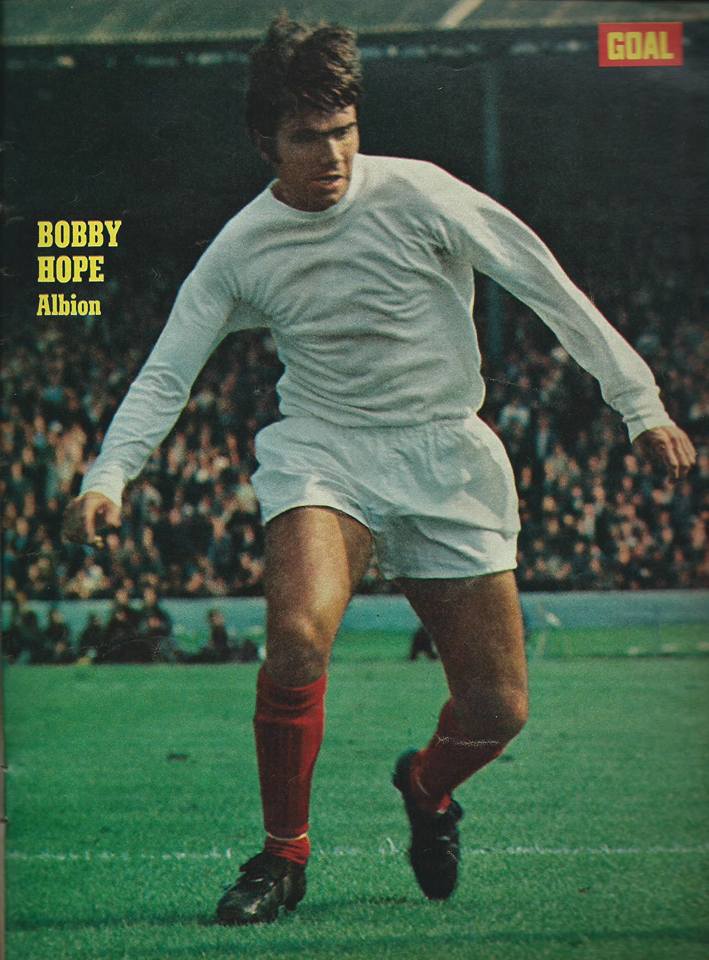
Inside Forward Bobby Hope of West Brom is probably not a name synonymous with the Scotland team, although he featured in a few Scottish football card sets of the late 60’s. Bobby played over 350 games for West Brom and also went on to play for Birmingham City, Philadelphia Atoms and the Dallas Tornadoes and in between a stint at Sheffield Wednesday.

Bobby must surely have one of the shortest debut games in Scotland history having started a match. In May 1968, Bobby started against Netherlands in Amsterdam but was subbed after only 12 minutes, when Jimmy Smith, then of Aberdeen, playing his first game came on. The game finished nil nil. However, unlike Celtic’s John Kennedy who suffered a similar fate in 2004, Bobby did get another game for Scotland. In October 1968, Bobby lined up against Denmark in Copenhagen in a match that saw debuts given to Jim Herriot, Tommy McLean and Colin Stein. Bobby Lennox scored the only goal of the night and that was the end of Bobby’s international career.
10458735_1618167285087310_5600173187101883348_n
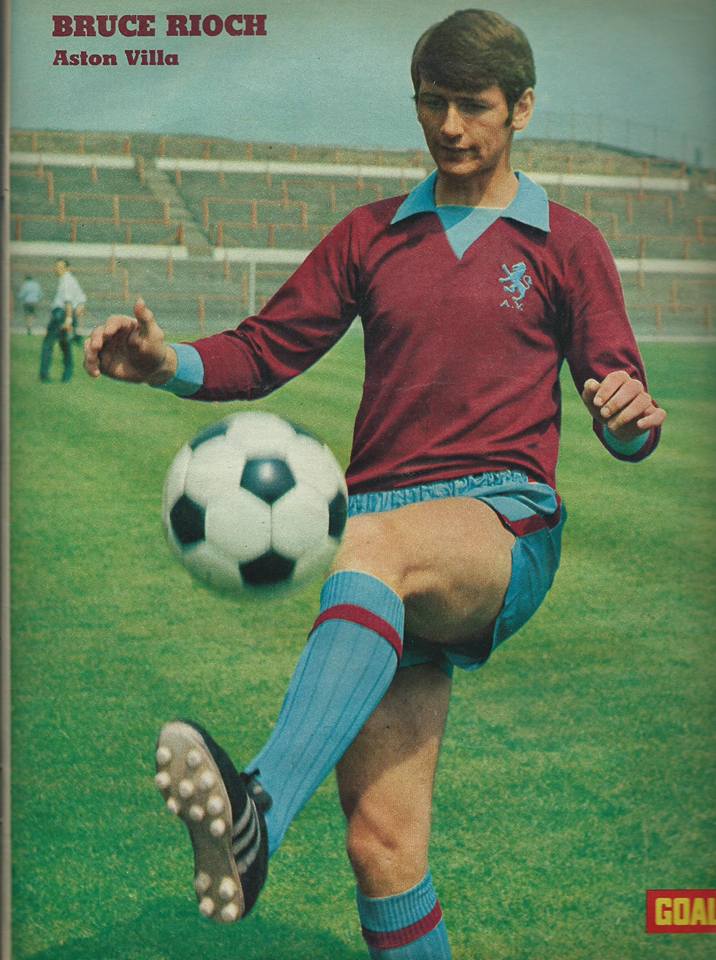
A few pages on and it’s a young Bruce Rioch in his Aston Villa playing days that is featured. Remarkably Bruce had been signed from Luton for £100,000 and had been bought by future Scotland manager Tommy Docherty during his ill-fated tenure at Villa Park. In fact most of Tommy’s managerial appointments could be described as ill-fated except perhaps his management of Scotland. Of course, Bruce wasn’t capped until he was playing at Derby County and it was Willie Ormond who picked him.
11208630_1618167348420637_4082612973910926769_n
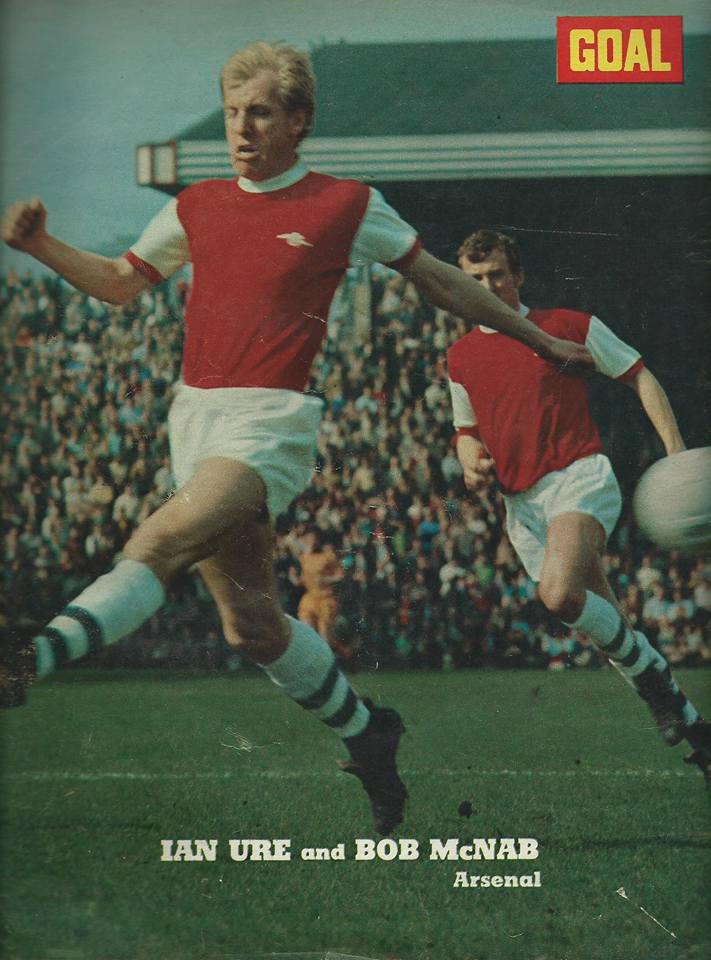
On to the back page and it’s Ian Ure during his time with Arsenal, similar to Peter Marinello and Charlie Nicholas, Ure’s time at Arsenal never reached the heights it was hoped to. His time at Arsenal is mainly remembered for some high profile mistakes. Ian earned 11 caps for Scotland and eight of them came when he was with Dundee, the team he had won the Scottish First Division with and also reached the Semi-Finals of the European Cup.
There is also a short article on Willie Wallace inside, saying that he no longer wishes to be chosen to play for Scotland as he felt there “ is no point in being a Scottish reserve, with no chance of playing”.

David Stuart

First posted on Facebook May 16th, 2015
OUT OF AFRICA

11265195_1617691668468205_4489103894438736240_n

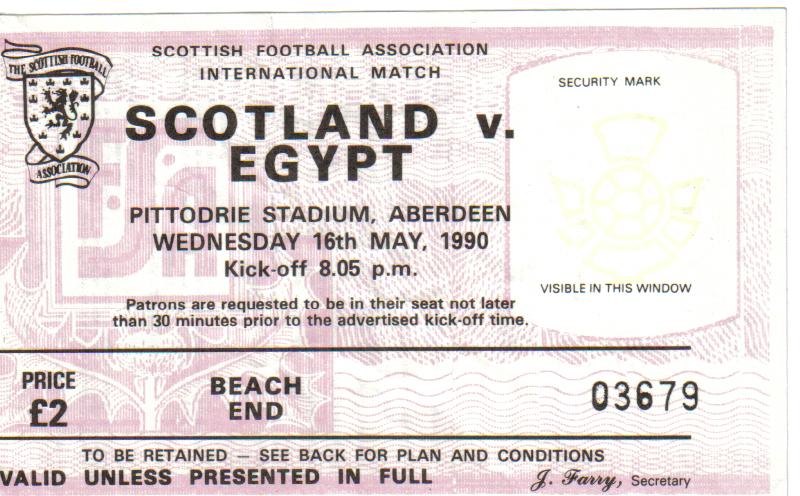
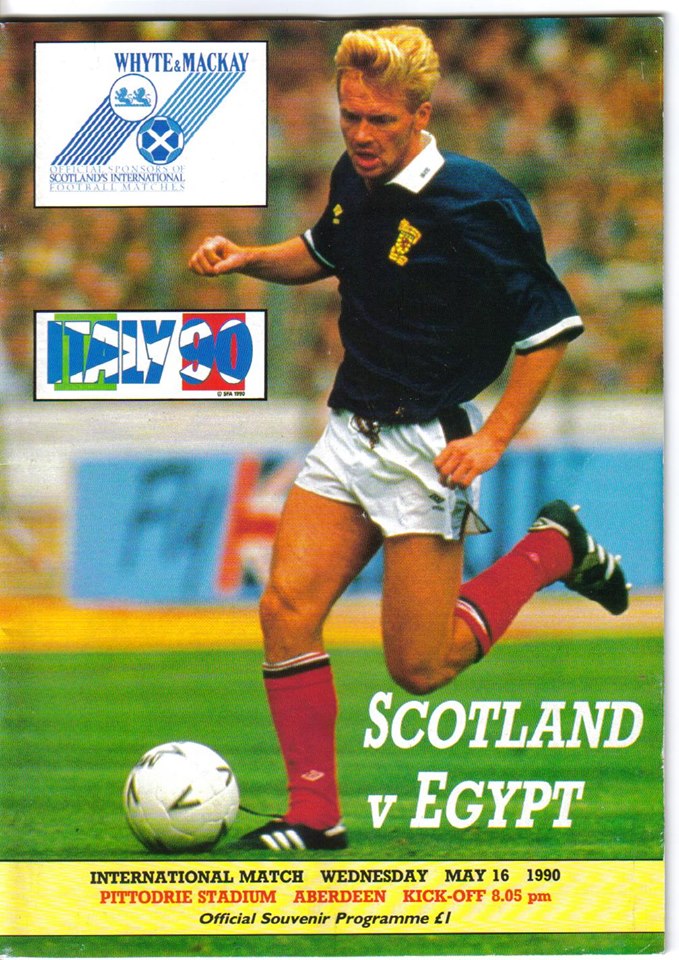
A quarter of a century ago Scotland were preparing to go to Italia 90 – our fifth world cup finals in a row! As part of our preparations we arranged a game at Pittodrie [on 16 May] against fellow world cup finalists Egypt who as it so happened would be in England’s group in Sardinia/Sicily. Egypt also took part in the 1934 World Cup Finals in Italy because back then, unlike us numpties, they thought a global tournament might be a good idea. D’oh!

I remember wearing an Arab head-dress to the game partly because someone had told me that Aberdeen in May can be a bit Sub-Saharan.I was misinformed -Lawrence of Maryhill?-what a tosser… Alas I wasn’t the only eejit there that evening as a nervy, error-strewn performance by Scotland helped Egypt to a 3-1 victory. Former Aberdeen player Bryan Gunn made his debut in goals, Alex McLeish was captain, Ally McCoist netted for Scotland and Craig Levein didn’t come on until the 89th minute so we can’t really blame the future/former Scotland manager for that one. Pity.

11013160_1617691685134870_3621540637820191806_n

I believe this match was the first time that an African nation had played us on Scottish soil [at full level] and I personally think it very disappointing that since then we’ve only had Nigeria [2002] and South Africa [2007] visit these shores. Co-incidently [or otherwise] none of them have rated an invite to Hampden. I’d love to see the likes of Algeria, Ivory Coast, Ghana, Cameroon or Morocco strut their stuff at Mount Florida. What about a benefit match to help raise funds to fight the Ebola virus in West Africa or does no-one do that kind of thing anymore?

Robert Marshall

First posted on Facebook May 14th, 2015

So Who’s Up for a Barney?

11057502_1617394485164590_8031871076739080935_n 11245485_1617394445164594_1671084566860181599_n

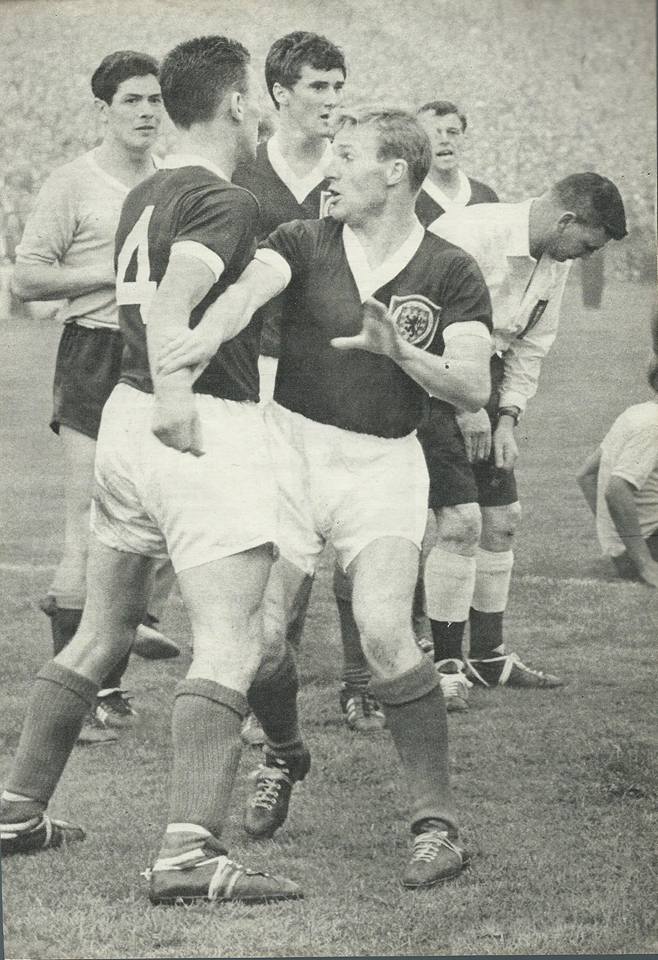
By the looks of it, Pat Crerand and if you’ve read his book ‘Never Turn The Other Cheek’ it will be no surprise, as he was very much a role model for Roy Keane, in his unwillingness to suffer fools readily and to hit first and ask questions later.
These pictures are from a game against Uruguay at Hampden in May 1962 and it looks as though Pat is trying to get at the injured player. Looking on in the first picture are Jim Baxter and Eric Caldow. The brave man in the second photo, holding back Pat this time is Davie Wilson.
Given it was a friendly, the ref may have felt a little bit lenient as this didn’t lead to a sending off, although Pat had been sent off previously for Scotland in Bratislava against Czechoslovakia 35 minutes into a World Cup Qualifier, which we lost 4 – 0. To be fair though to Pat we were already two down by this point.

Pat would play for Scotland a total of 16 times but would become increasingly frustrated at not being in the first eleven, so knocked it on it’s head by the late 60’s. This was not uncommon, as there were no subs allowed in those days, so a lot of players were turning up as part of the squad to find they had no chance of playing.
As to the Uruguay game, Scotland were defeated 3-2, having lost three goals to the Uruguayans with no reply by early into the second half before staging a comeback through late goals by Jim Baxter and Ralph Brand.
This wasn’t the only ‘unfriendly’ friendly of the era, as events almost a year later would prove. Scotland v Austria had at times, proved to be towsy affairs before and after the war with one or two punches landed by enraged Scotsmen in Vienna. On May 8th. 1963, (two days after Mr and Mrs. Stuart had their blue eyed boy delivered), Scotland and Austria were once again at it.
Scotland raced into a three nil lead in front of an enthralled Hampden crowd of 94,000 with two goals by Davie Wilson and a third by Denis Law. Horst Nemec the Austrian centre forward, then took the opportunity to spit at referee Jim Finney, who sent him packing for an early shower. Law scored the fourth in 71 minutes which was quickly followed by Austrian consolation goal. However, the wheels truly fell aff the Austrians barra minutes later as Erich Hof was sent off for a foul on Henderson, which was then followed by Linhart having a kick at Denis Law, who then decided throw a retaliatory punch. At this point ref Finney had enough and walked off the park and the game was abandoned after 79 minutes.
Although I don’t think there’s any footage of the match, there is a British Pathe one from Vienna 1955 which the Scots win 4-1. There are one or two crunching tackle in this one two and there also a goal from Last Minute Reilly in of course the last minute.

David Stuart

First posted on Facebook May 13th, 2015

John Hewie – His Scotland Career

John Hewie passed away on May 11th, 2015

John Hewie of Charlton Athletic made his Scotland debut in a one all draw with England in April 14th 1956. John generally appeared as left back with Scotland with Alex Parker of Falkirk his right sided full back partner initially, but he would also play a lot with Eric Caldow of Rangers. Graham Leggat of Aberdeen scored for Scotland in a team with three of the Hibs ‘Famous Five’; Bobby Johnstone, then of Man. City along with Lawrie Reilly and Gordon Smith as well as Bobby Evans of Celtic and George Young of Rangers. The English team included Tom Finney, Nat Lofthouse, Johnny Haynes and one of the tragic victims of the Munich Air Disaster, Duncan Edwards.

10984235_1617256948511677_6730361840261816243_n
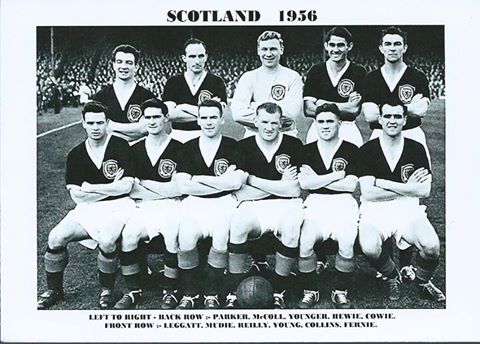
The photo is of the team for John’s third game which was against Wales on 20th October, 1956, which ended in a 2 all draw with Willie Fernie of Celtic and Lawrie Reilly of Hibs grabbing the other. I love the optical illusion of all of 5’ 3” Bobby Collins looking almost the same size of the man mountain at 6’ 2” that George Young was.
Qualification for the 1958 World Cup in Sweden began with a 4-2 win over Spain at Hampden with Jackie Mudie of Blackpool hitting a hat trick and John scoring his first goal for Scotland from the penalty spot. (His other goal would come in a 4 nil thrashing of Northern Ireland at Windsor Park, also from a penalty, in October 1959.) A 2-1 win against Switzerland in Basle in May 1957 with goals from Mudie and Bobby Collins followed. However, a 4-1 defeat with Gordon Smith of Hibs scoring, to Spain in Madrid left Scotland having to beat Switzerland to qualify, by virtue of Spain’s draw with Switzerland in the group opener.
This was achieved, on November 6th, 1957 with Alex Parker taking John’s place. The Scots stood at 3 -1 with ten minutes to go, when the Swiss made it 3-2, which must have led to a very nervy final ten minutes. The three goals came from Archie Robertson (Clyde), Mudie again and Alex Scott of Rangers for the third. Sweden here we come!
John played in two of our three games in Sweden. The first being a one all draw with Yugoslavia in Vasteras with Sammy Murray of Hearts scoring a second half equaliser. He then missed the 3-2 defeat to Paraguay with Parker again deputising. Mudie and Collins were the scorers for Scotland.
John returned for the final game against France which ended in a 2-1 defeat, Sammy Baird of Rangers scored our lone reply after two goals from French legends Raymond Kopa and World Cup record scorer Juste Fontaine. John only played a few times after this with Duncan Mackay of Celtic becoming the preferred choice of left back. His final game came in May 1960 in a 3-2 defeat at Hampden to Poland in a friendly, with Denis Law and Ian St. John bagging the goals for the Scots. In total, John won 19 caps for Scotland. As far as I can tell John is still the only Scot ever to be capped whilst playing for Charlton Athletic, although Tony Watt might have something to say about that in the near future.
So here’s to John Hewie, one of the select few players ever to grace the World Cup playing field for Scotland, may he rest in peace.
David Stuart

First posted on Facebook May 13th, 2015

For the benefit of all our Portuguese readers

11150685_1617256071845098_5151601683174553041_n 11260580_1617256058511766_8564010614820586807_n

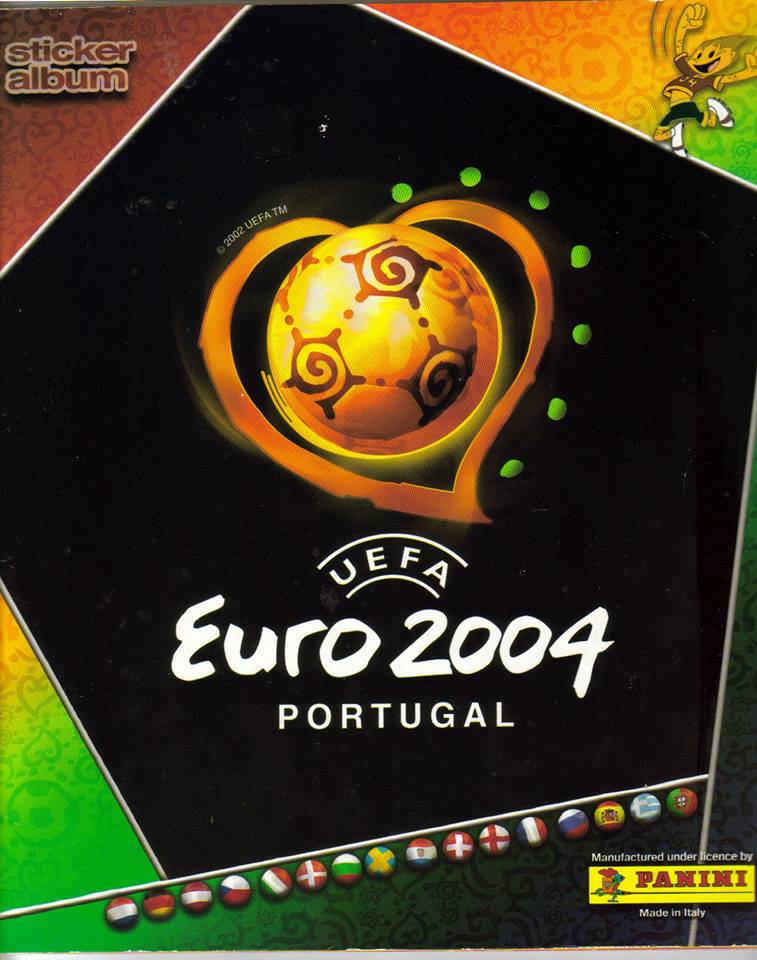
Following on from some of the feedback to the posting on the 1975 Scotland-Portugal match I thought I’d redress the balance and hunt out a programme from a Scotland away game with Portugal. Turns out the only one I have dates from November 2002 [co-incidently the last time the two sides have met] when a game in the city of Braga was billed as a Euro 2004 preparation match.

Portugal won 2-0 thanks to a first-half double from Pedro Pauletta. The home side were also able to call upon the likes of Figo, Simao, Rui Costa and Nuno Gomes. For our part we had Rab Douglas in goal, Paul Lambert was captain, Stevie Crawford and Scott Dobie lead the line up front whilst Lee Wilkie picked up a booking for his troubles. Portugal lead 7-4 in the series going back to 1950 with three matches drawn.As for Euro 2004 it must have been a fabulous tournament to stage and/or participate in.[Hopefully our game against Gibraltar in Faro will be our ‘Algarve Ascension’]. I still can’t believe however that Greece won it in 2004, but win it they did which surely gives hope to the likes of us. If memory serves, the Hellas Hurricanes did it with the aid of a German manager – now why didn’t we try something like that?

Robert Marshall

First posted on Facebook on May 13th, 2015

The price of love

10421324_1617255751845130_505169354413345501_n11150893_1617255775178461_2552297465104778840_n (1)

I see that UEFA have just announced the ticket prices for the 2016 Euro Finals in France. As you might expect, the opening game will be an expensive one with prices ranging from £54 to £428 – if I’ve done my conversion rate properly. For all other group stage games the prices are £18, £40, £76 and £104. If you want to go to the actual final then the price range is £61 to a whopping £644.

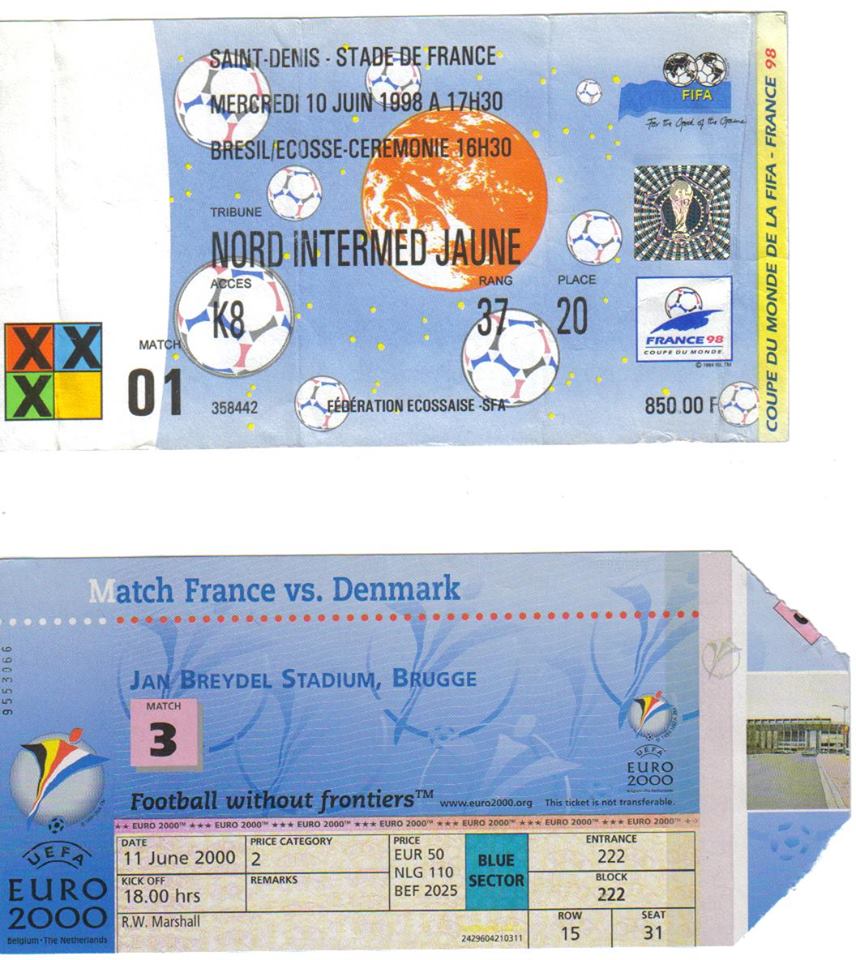
Looking back, my tickets for the group stage matches at the Spain 1982World Cup Finals cost only 300 pesetas each – about £1.60! At Euro 96 my ticket for the Holte End at Villa Park to see Scotland v. The Netherlands cost me £35 and when I gatecrashed Euro 2000, tickets for group matches in Brugge and Amsterdam cost me 50 Euros each.My dearest ticket proved to be that for the opening match of the 1998 World Cup Finals in France. It cost me 850 French Francs [about £85] to see Brazil rob Scotland. As for next year, well when you’ve been starved for 18 years I’m not sure ticket prices matter that much especially when there are golf clubs and 1970s medallions to be pawned!

Robert Marshall

First posted on Facebook May 13th, 2015

Is Billy Pissed?

11059603_1616764295227609_6297229298423054806_n 11267184_1616764278560944_281385656547766292_n

I was in W.H. Smith today looking through their football mags and I was pretty bored by what I saw, covers with the same footballers all the way through; it’s all Barca, Real, Bayern, Liverpool with Ronaldo and Messi plastered everywhere, great players but characters? Not so much, in fact there was club magazines for Chelsea and Arsenal with Man. Utd. And Liverpool (Gerrard) specials on sale. However, was there anything about Scottish teams and I don’t mean the Rangers News or Celtic View? Of course not. Am I likely to see a magazine with Naismith, Maloney or Andrew Robertson on the front? No. I’m not and the likelihood seeing Scottish players on a national magazine is a non-starter. Maybe that’s why I like the mags from the sixties and seventies so much; the Shoot, Goal, Charlie Buchan monthly, their front covers weren’t always about one or two clubs or just the top players, they did like to mix it up a bit. (Of course if you do want a magazine with lots of Scots on the front . . . whisper it, you could buy the Scotland Epistles).
Anyway talk about characters, here’s a wild one. Stirling’s finest Billy Bremner. Normally I go on to details about the player on front but Billy needs no real introduction. The front cover is from Goal magazine December 18th, 1971 and I think our Billy is pissed. The other photo was published later in the mag but I think it confirms Billy had a jar or two the night before. Would do you think?
Elsewhere, there’s a photo of Ian Ross of Liverpool, whom I believe came from ‘the Milton’ in Glasgow (where some of the best people come from). There’s also black and white photos of Jimmy Gabriel ( 2 caps in the early sixties), George Graham and an article on Peter Marinello, promising his playboy days are behind him and how he’s going to prove to be a success at Highbury. Ho Hum.
Finally, do you think Billy’s pissed?

First posted on Facebook May 11th, 2015

David Stuart

Scotland’s Euro 92 and 96 Venues.

10387628_1615840248653347_2515287032328429000_n

At Scotland’s two appearances to date in the European Championship Finals we have played in four cities and not only didthey contrast sharply but so did the stadia.

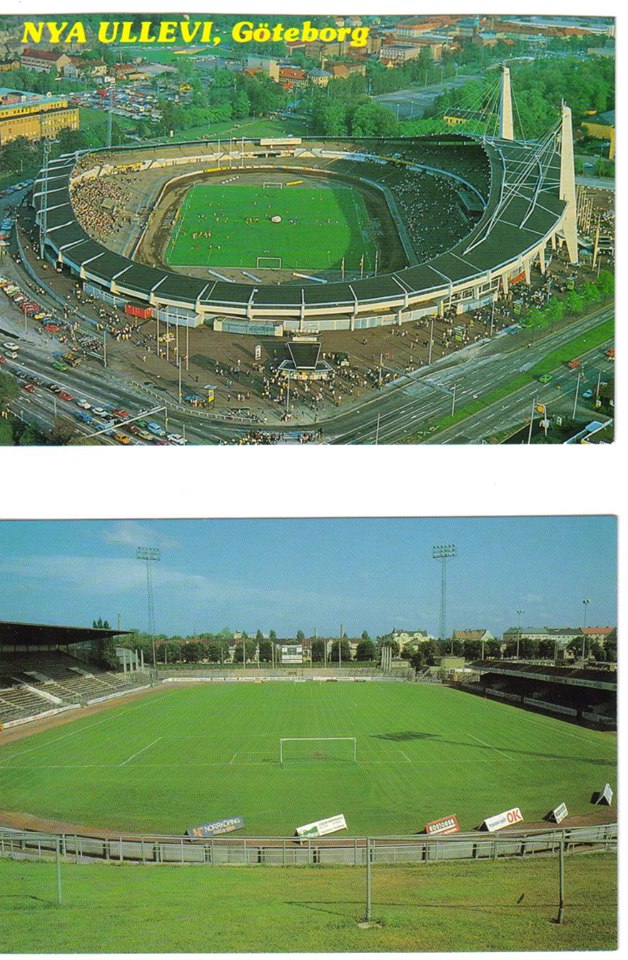
Scotland opened their Euro 92 campaign against the Netherlands in the 44,000 capacity Ullevi Stadion in Gothenburg. 35,720 saw us lose 0-1 thanks to a goal from Denis Bergkamp. Scotland then moved from the largest stadium in the tournament to the smallest – the 23,000 capacity Idrottsparken in Norrkoping. There,17,638 saw us lose, somewhat unluckily to Germany 0-2 whilst only 14,660 witnessed our 3-0 victory over the C.I.S. High prices plus low expectations may have been factors in these low attendances but comparatively speaking Sweden’s grounds were small and UEFA would raise the bar soon thereafter.

I purchased the two Swedish postcards in 2000 but I suspect the images pre-date the Euros. Interesting to note that on the reverse of the Gothenburg card there is a list of the record attendances for sports events held there including boxing,ice hockey, speedway and speed-skating as well as football. This is also the stadium that held mixed fortunes for Aberdeen and Dundee United in their European Finals. In 2009 a new football-only stadium opened in Gothenburg – I expect the track at the old stadium had something to do with it.

11045479_1615840328653339_2438349684259765292_n

Way down south – in Birmingham – 34,363 and then 34,926 of us piled into Villa Park to see Scotland draw 0-0 with our friends the Netherlands and then beat Switzerland 1-0 at Euro 96.The famous Holte End is nearest the camera and from there I clearly saw John Collins handle the ball in the far away penalty box against the Dutch but fortunately for us the referee, who was much closer, missed it completely. In between these two games a crowd of 76,864 were at Old Wembley [aka the most famous greyhound stadium in the world] to see a tragicomedy involving Scotland and England. When they rebuilt Wembley it too ditched the perimeter track. They also got rid of the external drainpipes which ticket-less Scots fans scaled to gain entry to the stadium in the 1970s. In case you didn’t know, Peter Parker was a Scotland supporter.

And so to France 2016 – hopefully. There the ten stadia have a capacity range of 33,000 to 81,000. Bring it on – please…

Robert Marshall

First posted on Facebook May 9th, 2015

Scotland Mascots

11212769_1615553838681988_1276587046446073380_n 11205632_1615553925348646_943346177545528833_n

I know I’ve harped on a bit about the possibility of France 2016 but I’m excited! Truth is, my nipples have been erect since the Ireland game at Celtic Park back in November….Moving quickly along, I’m now starting to think about an imaginative Scotland Team Mascot for next year’s Euros. What about a caricature transposing the head of Alex Salmond on to the body of Nicola Sturgeon and calling it Hamish Homerule – ach, that’s probably been done already by the petrified and morally bankrupt English press.

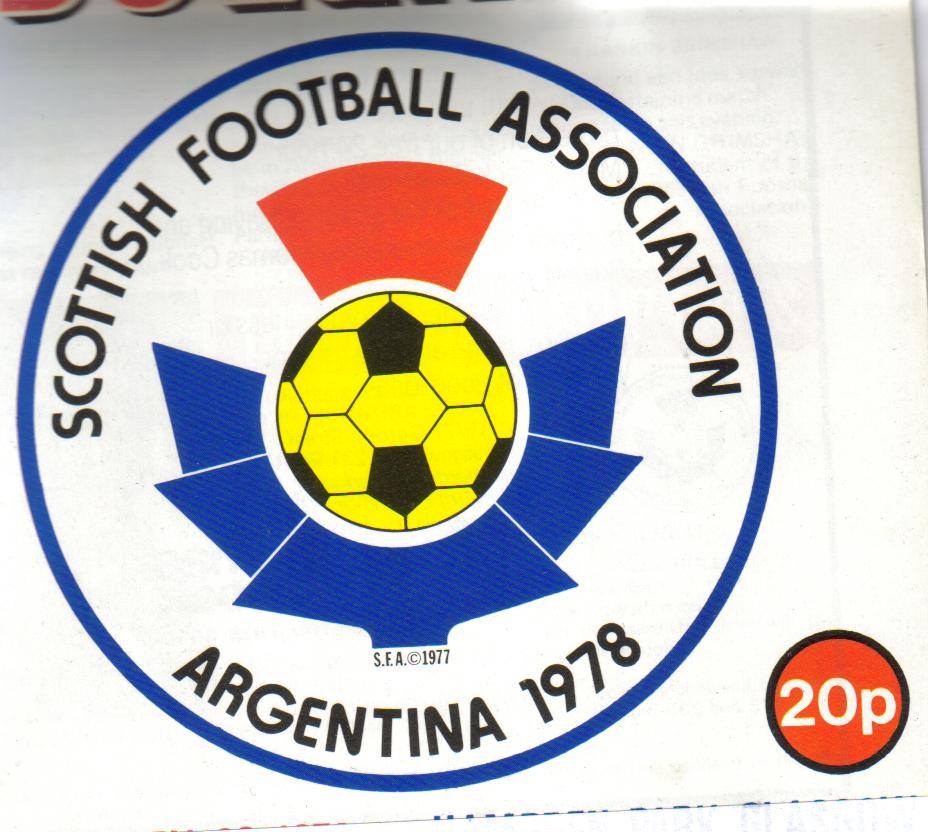
For a more serious suggestion maybe we can draw inspiration from our old World Cup Mascots. Roary Superscot was the Bremneresque mascot from 1974 complete with the letter S on the front of his shirt.[I foolishly thought it was a number 5 and that he had put his shirt on back to front]. In 1978 I think we went with a Thistle-like emblem rather than a mascot and in 1982 we had the rather glaikit-looking Sandy. This young lad sported a Scotland strip and a Tartan Bunnet but if it was supposed to be some sort of homage to the legendary Scotland defender Sandy Jardine then it failed miserably.

For the Mexico 86 world cup we roared back [sort of] in the shape of McMex – a pished-looking lion in a sombrero. I think we lost the plot altogether though with ‘Scoticus’ our mascot for Italia 90. Scoticus was a tartan-clad Roman centurion who looked disturbingly like Kenneth Williams in the film ‘Carry on Cleo’. I couldn’t find anything for France 98 [or indeed Euro 92 and 96] but surely there was something? I don’t believe that the marketing men failed to try and exploit the situation.

11109194_1615553888681983_4316143784825174907_n 11150893_1615553905348648_6250501579237786533_n 11196355_1615553948681977_7905705107886668393_n

Back to the future then and learning from history I propose a tough but funny, Chic Murray inspired, lion mascot called Roary MacLeod – in deference to two of Scotland’s greatest Champions – the aforementioned Roary Superscot and former manager Ally MacLeod. I’d also have Roary clad in a ‘loud but proud’ sports jacket in honour of the late, great Arthur Montford. I think we’re on a winner here.Fritz , the Editor of the Partick Thistle fanzine ‘Sick in the Basin’ is also no mean artist so if he can cobble this image together we can split the royalties 50/50 and help fund a one hundred page Scotland Epistles Summer 2016 Special. As David Cassidy used to sing ‘ I’m just a daydreamer, walking in the rain…..’

Robert Marshall

First posted on Facebook May 8th, 2015

Blog at WordPress.com.

Up ↑