Search

The Scotland Epistles Football Magazine

Scotland Football Fanzine

Author

David Stuart

There’s only one Stuart Kennedy

11107733_1623152921255413_7743118073526424125_n

As far as former Scotland internationalists go, there’s only one Stuart Kennedy and it’s his 62nd birthday on 31st May 2015. Stuart [who shouldn’t be confused with Stewart our ill-fated goalkeeper from 1975] was an over-lapping full-back in the mould of Jardine and McGrain – whose success arguably helped restrict Kennedy’s cap tally to just eight. Indeed Willie Donachie was often Kennedy’s defensive partner.

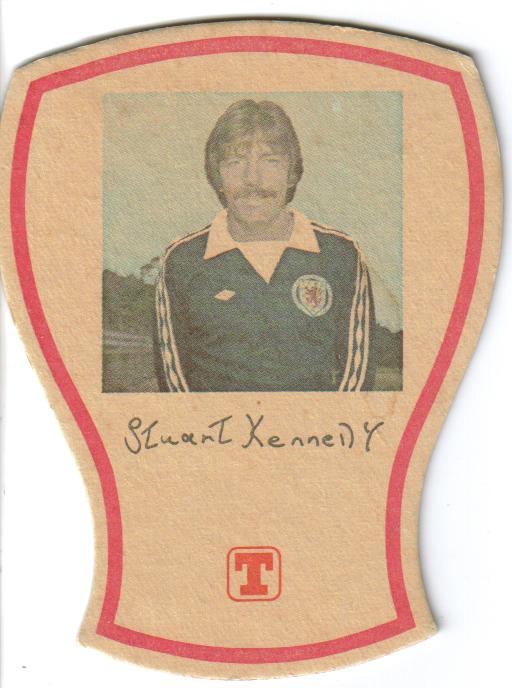
Those eight caps included two at the 1978 World Cup Finals versus Peru and the Netherlands hence ‘immortalisation’ on the attached Tennents Lager beermat. The Aberdeen defender won his debut cap however in a friendly victory over Bulgaria at Hampden in February 1978 with Coventry’s Jim Blyth and Ian Wallace also making their first appearance for Scotland that evening. His final cap was in a world cup qualifier against Portugal in Lisbon in 1981 whilst in the semi-final of the European Cup Winners Cup against Belgian side Waterschei he sustained a serious knee injury which sadly ended his career.
11351275_1623152937922078_4423138371811050143_n

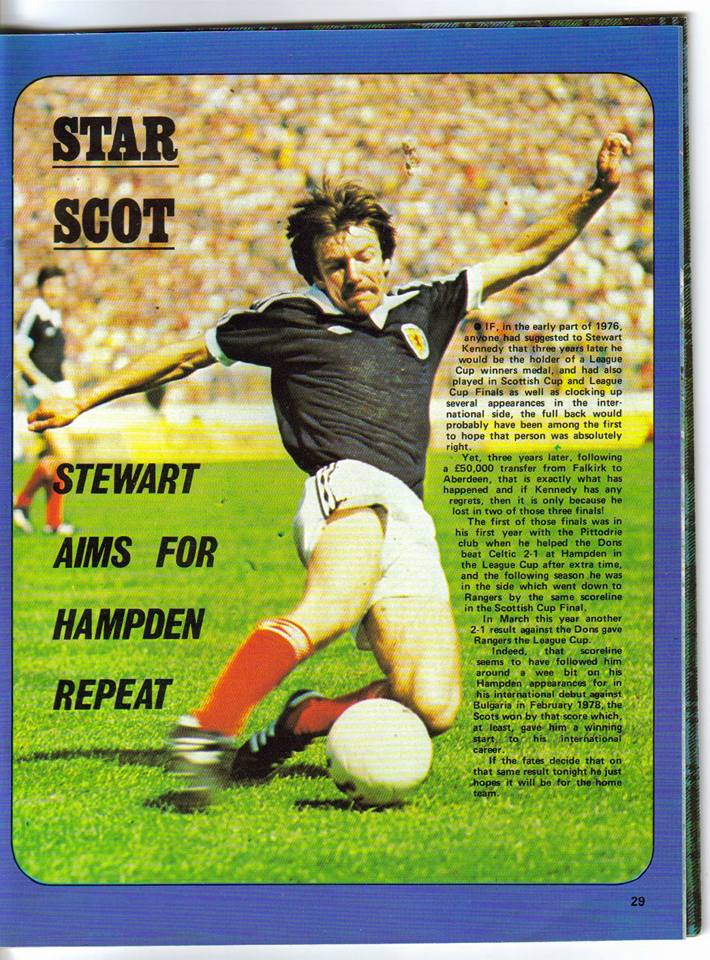
The other image attached is from the Scotland-Northern Ireland programme for the British Championship match in May 1979. However, not only did Kennedy not play that evening but they mis-spelt his first name and called him Stewart. Stuart or Stewart -what’s the difference? Is one a Jacobite version? Maybe I should ask our very own ‘Young Pretender’ David Stuart.

Anyway, as well as appreciating Kennedy’s football skills I once enjoyed a visit to his public house near Falkirk High train station which had its walls adorned with an excellent collection of football photographs and souvenirs, and which if memory serves, sold a nice pint of Tartan Special -several nice pints in fact.

Cheers Stuart and here’s to all the other bijou-boozers that indulge in a spot of Scotland memorabilia including the likes of the Pittodrie Bar, Aberdeen, the Tynecastle Arms, Edinburgh plus old Glasgow favourites the International Bar on Aikenhead Road and the Iron Horse on West Nile Street.

Robert Marshall

First posted on Facebook on May 27th, 2015

One More For All you Cover Lovers

994113_1622995324604506_7432073350294715720_n

So here’s another magazine cover from Charlie Buchan’s football monthly of July, 1964 this time. The photo is from the Home International match against England in April of that year. 4 Englishmen and one lone Scot who seems to be causing a bit of a panic. The Scotsman is of course Alan Gilzean, then of Dundee, playing in his third game for Scotland. The England players are Bobby Moore, Gordon Banks, Johnny Byrne and on the goal line Ray Wilson. Perhaps they were right to be panicked as Gilzean would score the only goal of the game in the 72nd minute in front of a Hampden crowd of 133,245.
Gilzean would go on to score 12 goals for Scotland in 22 games which is a really good return for a Scottish striker. There can’t be too many Scots who can claim to have scored against West Germany / Germany three times, having scored a double in a friendly shortly after this game in a two all draw. Gilzean also scored in a World Cup Qualifier in October 1969, which saw the Scots go down 3-2 to an 81st minute goal and our dreams of Mexico ’70 went that way too. Mind you nor can there be too many Dundee players who have scored four goals at Ibrox either. For further reading on Gilzean, I wholeheartedly recommend ‘In Search of Alan Gilzean: The Lost Legacy of a Dundee and Spurs Legend’ by James Morgan. In the Scotland team, two players were making their debuts, goalkeeper Campbell Forsyth of Kilmarnock and John Greig of Rangers. Forsyth would play 4 games in total for Scotland, Greig rather more. In fact, Greig would play in the next 20 consecutive games for Scotland and overall amassing a total of 44 caps, scoring three goals including his unforgettable 88th minute winner against Italy at Hampden in a World Cup Qualifier in November 1965.
The full Scottish line up was; Forsyth, Alex Hamilton (Dundee), Jim Kennedy (Celtic), Greig, Billy McNeill (Celtic), Jim Baxter (Rangers), Willie Henderson (Rangers), John White (Tottenham), Gilzean, Denis Law (Man Utd.) and Davie Wilson of Rangers.

11329947_1622995367937835_3191096520324361514_n
There’s not much of Scottish interest going on in the magazine itself except for an unusual action photo of Denis Law from a Scandinavia v Rest of Europe game (probably not that unusual as Denis was most likely going full tilt at the time). Denis was one of three Scots in the Europe line-up, which also included Jim Baxter and among the subs Alex Hamilton. The game was held to commemorate the 75th anniversary of Danish Independence. Europe won 4-2 with Denis getting a goal, alongside Eusebio and a Jimmy Greaves brace.
Law and Baxter had represented the Rest of the World in a game against England the year before to mark the anniversary of the forming of the Football Association. England won the game 2-1 with Greaves scoring again as did Denis.

David Stuart

First posted on Facebook May 27th, 2015

The hills have eyes……..

11113761_1622498217987550_7037356202274843023_n 11265123_1622498234654215_2684459776832196346_n

I think David Stuart’s idea about football statues is spot-on but can I suggest that we think big on this one. Let’s have some Stalinist-sized statues which straddle the approachways to Hampden – we could even have one of our friend Ray Clemence that is large enough to allow supporters buses and coaches to drive between his legs.

Bigger still, let’s utilise the nearby Campsie Hills or Cathkin Braes to create Scottish Football’s answer to Mount Rushmore. I would propose a monument to management in the shape of Ally MacLeod, Jock Stein, Andy Roxburgh and Craig Brown. If done properly it should be a damn sight more pleasing to the eye than those War of the Worlds like, invasion of the wind turbines. Of course we don’t need to restrict ourselves to just four images grouped together- we could have them dotted all over the Scottish landscape with Gordon Strachan strategically placed on the side of the southern uplands in order to welcome visitors heading north. Vogts, Burley and Levein on the Paps of Jura? If the political will is there, these suggestions could be converted into major capital projects that would help tackle unemployment as we strive to build this socialist paradise of ours. By jove, that Old Speckled Hen ale is strong stuff….

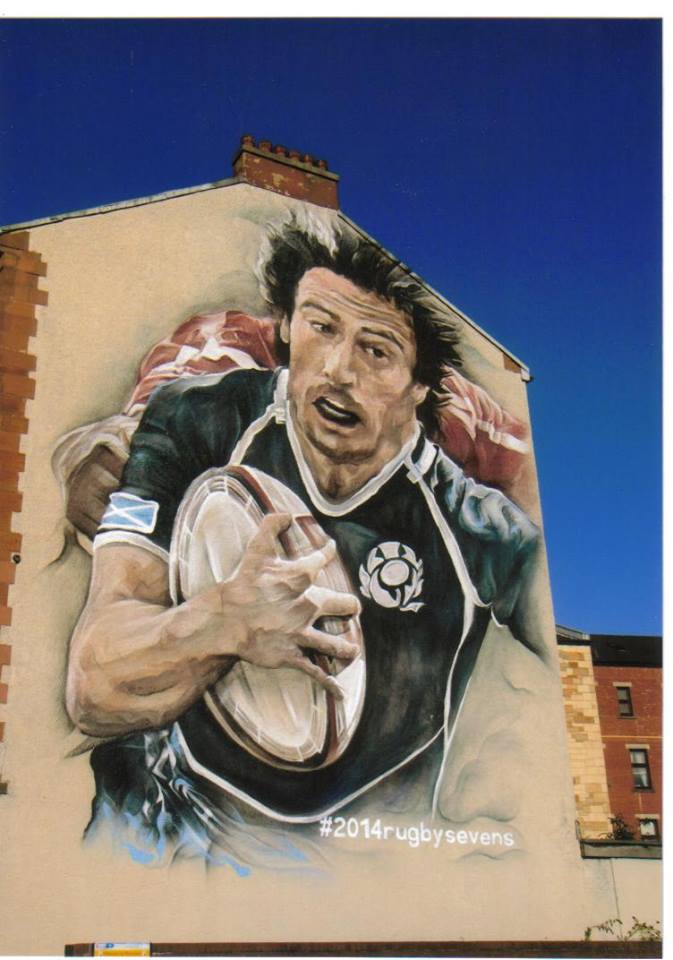
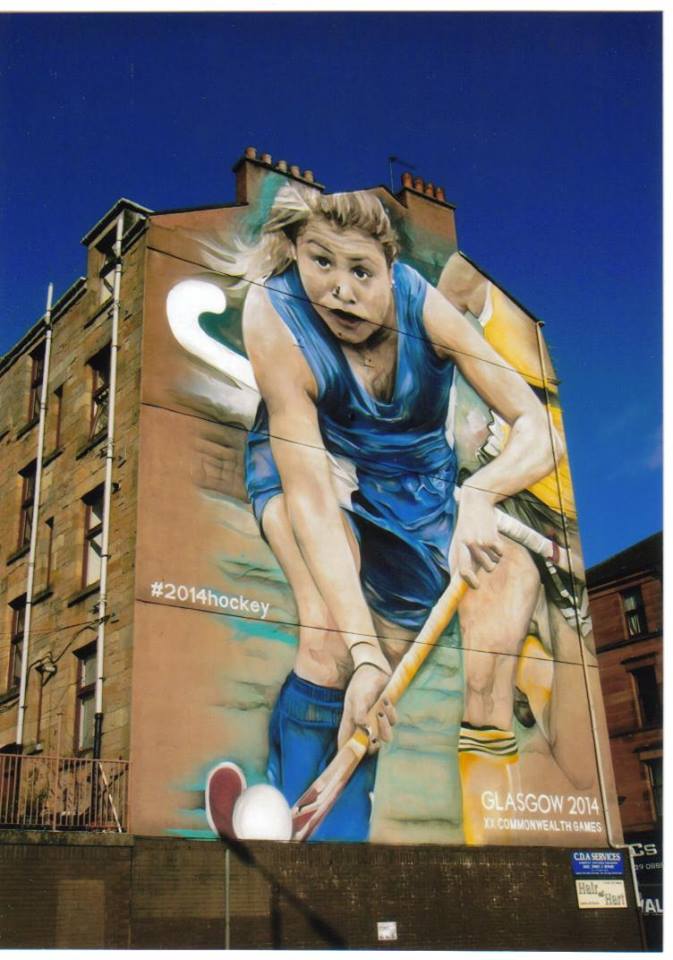
By way of a more practical suggestion, why not adorn some of our tenement gable-ends with paintings of our Scotland football heroes. Indeed, as we gear up for being a host at Euro 2020 we could also include some continental footballers who have starred at Hampden over the years – eg Puskas, Beckenbauer and Zidane. Something similar was done last year to promote the various sports of the Commonwealth Games held in Glasgow [and Edinburgh and Tayside] as the attached photographs from the Partick area of the city demonstrate. Football and art can go together- the likes of Jinky Johnstone and Davie Cooper proved that.

Robert Marshall

First posted on Facebook May 25th, 2015

When the Dons were King

11013212_1622494544654584_9029687579867889684_n

With Aberdeen having a revitalised season under Derek McInnes and finishing a good second to Celtic, it’s maybe time to look back at a time when the Dons began to rule supreme under Alex Ferguson as he was known then. This is a great photo and it taken from Shoot magazine in the early 80’s. It is a clipping so I don’t have the exact date but the narrative suggests it’s ’80 – ’81. The season after their first Premier title.
The premise is 17 Aberdeen players at the time who represented Scotland at all levels from Bobby Clark, Full International to Alan Lyons (schoolboy). Although all would not progress to full international status there were still some great players who made major contributions to the Aberdeen or other clubs around the country. In total this line up achieved 328 full international caps between them. Never mind the fact two of them actually got to manage the national team
The line-up is as follows; Neil Simpson (Youth) – Neil would win a total of five caps. Neale Cooper (Youth) – Neale never achieved full caps but did represent the Under 21’s a total of 15 times. Alex McLeish (Full) – Alex of course won 77 caps for the National team and managed them also. Jim Leighton (Under 21’s) – Jim progressed to become a Scotland legend gaining 91 caps in total. Bryan Gunn (Youth) – one of Norwich City’s fans favourites, Bryan had to leave Aberdeen to gain his full international caps, winning 6 in total. Bobby Clark (Full) – Bobby was coming to the end of his career and had won 17 caps for Scotland from1967 – ’73. Dougie Bell (under 21’s) – Dougie’s career never quite hit the heights of some of the others and he was quite nomadic with spells at Rangers, Hibs and Shrewsbury among others. Mark McGhee (Under 21’s) – Mark gained 4 caps in total scoring two goal including one against England in a one all draw in 1983. Of course Mark is the assistant manager to WGS at the moment with the Scotland Squad. Happy Birthday to Mark on the 25th of May when he will be 58. Drew Jarvie (Full) – Drew had won all his 3 caps in 1971 when he was an Airdrie player, although Drew was a sub in all three games, which we incidentally lost. Front Row; Andy Watson (Under 21’s) – another one whose career didn’t pan out all that successfully, after leaving Aberdeen Andy had periods with Leeds. Hearts and Hibs. However, Andy was one of Alex McLeish’s assistants in the Scotland set-up having worked with McLeish at Motherwell, Hibs and Rangers too. Stuart Kennedy (Full) – Stuart won eight caps in total, however injury would see him retire form the game early in 1983. Alan Lyons (schoolboy) – Alan is perhaps the one player in the picture that didn’t really make the grade it would seem. However, in fairness to him, he was well liked at Montrose where he ended up after some seasons at Forfar. Indeed, in the Montrose website he is one the ‘Links Park Legends’. Willie Miller (Full) – there’s not a lot needs to be said about the grouchy man of Scottish football, suffice to say he won 65 caps in total. Gordon Strachan (Full) – again not a man I need to go into any detail about. Gordon won 50 caps in total. Next up, Eric Black (Youth) – Eric would only win 2 full international caps and perhaps merited more, his caps came as a Metz player and both were substitute appearances However, Eric did score the opening goal of Aberdeen European Cup Winners Cup triumph in 1983 against Real Madrid in Gothenburg. Andy Dornan (Under 21’s) – Andy never established himself at Aberdeen and moved on to Motherwell and Walsall and stopped plying by 1990 it seems. Last but not least John Hewitt (Under 21’s) – John never gained a full international cap but had good career with Aberdeen with the highlight being the winning goal in Gothenburg.
I am not sure if any other team other than Old Firm ones could produce such a picture and a caps total like this and even then perhaps not. It would be interesting though to have a similar photo of the Dundee United team a few years later, as they would have gave this team a run for their money in terms of International players although again the caps count would come nowhere near this.

David Stuart

First posted on Facebook 25th May, 2015

Through to the Final

11351435_1622276234676415_985673910877408581_n

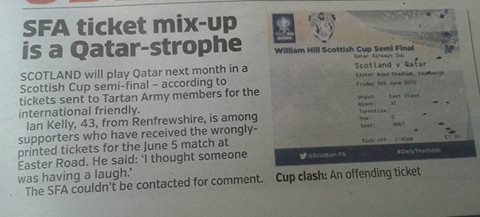
On Saturday I received my tickets for the Scotland -Qatar match on 5th June and I was intrigued to note that they are headed – albeit in very small print -‘Qatar Airways Cup’. So that story about the semi-final ticket mix up was close to the truth after all. We’re through to the final and there is a trophy up for grabs. I hope the prize is like one of those monster-sized golf trophies that is almost the same height as our manager.

11295598_1619095004994538_8056771035870141741_n

Excitingly isn’t it? I wonder who the SFA have arranged to present the cup. The Queen – Elizabeth or Nicola? Sepp Blatter? The Proclaimers? or even Jenners’ answer to Mrs Slocombe?

Hold on a minute though, the game is at Easter Road which is not a venue normally associated with Cup success although I suppose we should be grateful that Craig Levein is not still in charge as what’s the betting he’d try to resurrect the Scotland maroon jersey just for the occasion.OK, no more cheap Auld Reekie jibes- this Weegie is looking forward to an evening of cultured football in our capital city – and then bringing the cup back west.

11230586_10152937225911448_1856426716246268865_n

Robert Marshall

First posted on Facebook on May 25th, 2015

Look back in anger…and frustration…and bewilderment

11140347_1622275731343132_3614241643336435765_n

I thought I’d join David Stuart’s ‘Book Club’ and give mention to one of my favourite titles – Andrew Ward’s ‘Scotland The Team’ which was published in 1987 and which gives a season by season narrative account of the National team’s exploits as well as ‘pen pictures’ on individual players and managers. To the back of the book there are team line-ups and stats etc but it is in the narrative that the ‘gems’ lurk.
Apparently just before the world cup qualifier with England at Hampden in April 1950, a smallpox outbreak in Glasgow had caused a scare and so the players stayed out of the city until the day of the match – the Scots at Largs and the English at Troon. And of course we later chose to decline the invite to participate at the finals in Brazil.
The section on the 1954 World Cup Finals still defies belief. The selectors choose only 13 players for the trip to Switzerland which included only one goalkeeper. Furthermore, Rangers players [including regular skipper and then record cap holder George Young] were not included as they were required for the club’s trip to the USA. In Switzerland the players were forced to train in their club jerseys and were promptly nick-named the Liquorice Allsorts.
Yet another embarrassing moment occurred in our opening match when the Austrian captain presented Preston’s Willie Cunningham with a pennant and our skipper had nothing to hand back.

In our second match we were humiliated 7-0 by defending champions Uruquay which rounded off a poor season for British football. With England having been hammered twice by Hungary there was talk of a Great Britain team being entered for the next world cup! Holy narrow escape, Batman….
Team GB did not come about although ironically all four ‘British’ sides reached the 1958 World Cup Finals. At Sweden ’58 however Scotland were the only team without a manager- temporary boss Matt Busby was still recovering from the Munich air disaster and trainer Dawson Walker was left in charge of the players.

I usually enjoy indulging in a spot of nostalgia but with Scotland it can be painful stuff. I know my mind is starting to wander a bit here but when you consider that three of the Doctor Whos were Scottish, you’d think that one of them would do the decent thing and go back in time to ‘correct’ these basic errors.

11181586_1622275758009796_4606565886529075926_n

Robert Marshall

First posted on Facebook on May 25th, 2015

A Statue for Hampden

10410097_1622274731343232_5146562803329280657_n

Going to Hampden for a Scotland match should be a pilgrimage in a way, whether you’re travelling 500 miles or like me 500 yards. There should be a sense of the occasion, a sense of history and the shared legacy of it.
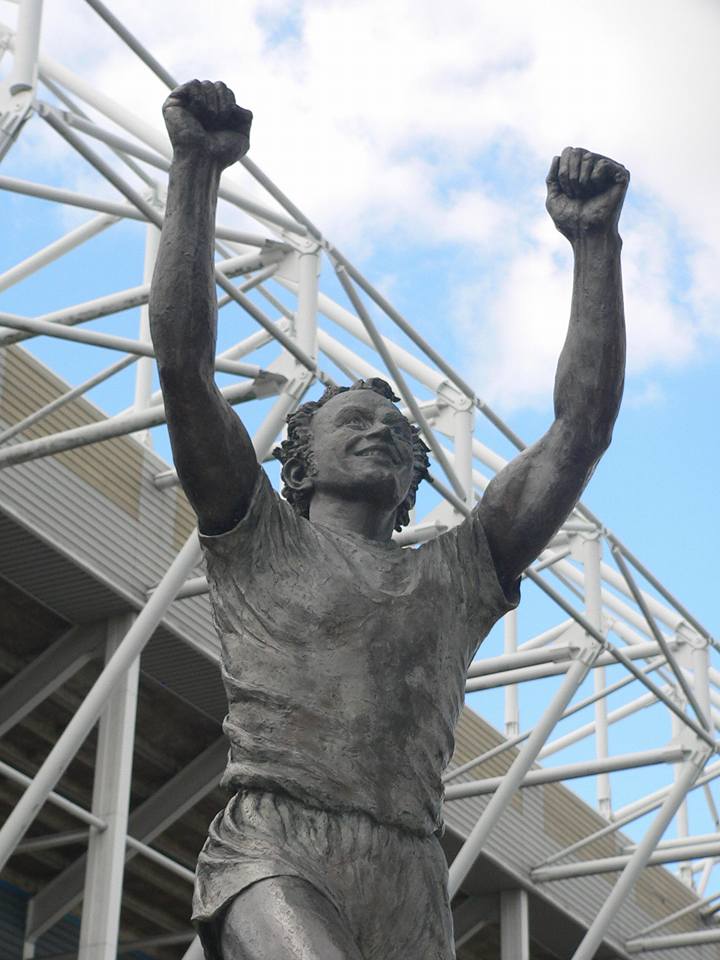
At Celtic Park, there’s quite a few statues including Jimmy Johnstone, Jock Stein and the newly unveiled Billy McNeill. I imagine quite a few Celtic fans take their sons, grandsons etc. and show them the statues before the game and tell tales of days gone past. I’m sure others do likewise with John Greig’s one at Ibrox and indeed Billy Bremner’s down at Elland Road, home of Leeds United. Although, I was in Barrow-In-Furness once and saw Emlyn Hughes’ statue and just thought “ Aye, yer still a dick.”
So what do we have at Hampden? Nothing, not a sausage, although I do admit to liking the big pictures on the concourse walls, although I was a bit confused when I was at the Gibraltar game to see two of what looked like a Peru goal from Argentina on show. However, we don’t have that icon that we can say to our sons etc. “Aye, he was a great player” to. Isn’t about time we did though?
So who could we have? Well, Denis Law is probably the most likely, in that one arm raised salute holding his collar by the cuff pose. I suppose we could have Billy Bremner in that iconic moment when he has just missed the opportunity to score against Brasil with his hands to his head. Or what about Jim Baxter playing keepy uppy at Wembley. Then there’s Archie Gemmil’s nonchalant pumped fist in the air when he has scored the greatest goal ever, ever.
Then there’s also WGS in Mexico ’86 when he pretends to jump the barrier. Or in the modern era what about James McFadden as he has just hit the trigger to score that great goal in France. Joe Jordan with his teeth out is always a classic pose.
Given our penchant for shooting ourselves in the foot, maybe one or two showing our less celebrated moments could be apt. What about Jinky on a rowing boat or even Jinky given the two fingers up to the press a couple of days after the boat incident. Chris Iwelumo missing against Norway. Alan Rough, Asa Hartford et al with perms! Barry Ferguson rubbing two fingers against his nose at Hampden after Boozegate. Willie Johnston holding out two pep pills.
Maybe we could have a surreal faceless Ally McLeod holding two Janus masks, one his happy ebullient self and the other that face of abject misery in Argentina where he seemed to age years in minutes.
Or what about a dedication to the Tartan Army with three foot soldiers in regalia, arms around each other with the two outer characters arms, also out so we can pose either side and have our photos taken. Of course they could all have sporrans to drop money into and raise funds for the Tartan Army Sunshine Appeal.
It goes without saying that about ten yards away there should be a lonely anorak reading his programme and I’m sure Robert Marshall would volunteer to model for it. It would also make an apt place for us to sell the Epistles magazine, rather than saying we will be on Somerville Drive selling the magazine, we can say, buy from the anorak at the Anorak.
It goes without saying that as long as it’s not Rod Stewart badly done like that Michael Jackson one at Fulham, a few years back.
At the very least let’s have some of the stands named after some of our greatest players, that way I won’t get East and West mixed up with North and South.

David Stuart

First posted on Facebook May 25th May, 2015

ROUS CUP 30TH ANNIVERSARY

10922515_1621517904752248_5214348825749700699_n 11377354_1621517931418912_3100577251960514693_n

On 25 May it will be the 30th anniversary of Scotland winning the first-ever Rous Cup courtesy of a 1-0 victory over England at Hampden in front of 66,489. Richard Gough – then of Dundee United – got us the winner in the 68th minute and the England team included the likes of Peter Shilton, Terry Butcher,Glenn Hoddle, Bryan Robson, John Barnes, Trevor Francis and Gary Lineker.

The Rous Cup was an end of season tournament – a supposed replacement for the British Championship – that was named after the former FIFA President Sir Stanley Rous and which ran from 1985 to 1989 inclusive. In 1985 and 1986 the Rous Cup comprised of one-off matches between the ‘Auld Enemies’ whilst from 1987 to 1989 it consisted of a triangular tournament involving Brazil, Colombia and Chile respectively. The final arithmetic shows that there were eleven Rous Cup matches in total- six at Hampden and five at Wembley and that both Scotland and England played in eight matches each. Roy Aitken and Alex McLeish plus England’s Chris Waddle all have eight Rous Cup appearances to their names.

England won the Rous Cup in 86, 88 and 89 with the Brazilians triumphing in 1987. Incidently, Scotland’s one home game of the 1988 competition was against Colombia but only 20,487 turned out to see Dundee United’s Kevin Gallacher and Andy Walker of Celtic win their debut caps against the colourful South Americans which included the likes of Jose Higuita [the goalie who became famous for his scorpion-kick clearances] and Carlos Valderrama [whose unusual hairstyle drew comment in the programme that he looked like a mixture of Ruud Gullit and Catweazle -google it if you must] as well as the ill-fated Andres Escobar.

Ultimately, the competition failed to capture the imagination of supporters and sponsors alike so don’t expect to see a replacement ‘Blatter Cup’ coming along any time soon. From an anorak perspective, the tournament did provide an unusual clutch of match programmes – as did the Kirin Cup and the Carling Nations Cup. And finally, surely it’s only a matter of time before Scotland are invited to take part in the ‘Baltic Cup’. I know that geographically we are some distance from the Baltic Sea- but it didn’t seem that far weather-wise against Gibraltar at Hampden in March

Robert Marshall

First posted on Facebook May 22nd, 2015

Charity Shop Score

11114356_1621515368085835_176508327429887054_n

I got hold of a cracking wee book today in a Charity Shop from 1982 called ‘The Football Industry – The Early Years of the Professional Game’ by John Hutchison. It’s not a detail of early games and cup winners etc. it’s more a look at differing aspects of the early game from the business i.e. adverts for Football boots, Turnstile makers to pavilion makers, then bits on players, supporters. It really is quite interesting although the book is about British football in general, it is written and published in Scotland and has a high Scottish content including a lot on Hearts for some reason. Here’s a quick whistle tour of the book

11102798_1621516038085768_7731575256595439865_n11351461_1621516008085771_1577617185227667731_n

There’s a photo of Isaac Begbie of Hearts (I kid you not Begbie!) who played 4 games for Scotland from 1890-94 and he is proudly showing off his trophies mostly for five a side games for some reason. There’s also a cartoon report on the 1900 game between Scotland and England which the Scots won 4-1 with R S McColl hitting a hat-trick.

11350605_1621516064752432_3272741971427305216_n11159945_1621515981419107_9150493429625437153_n

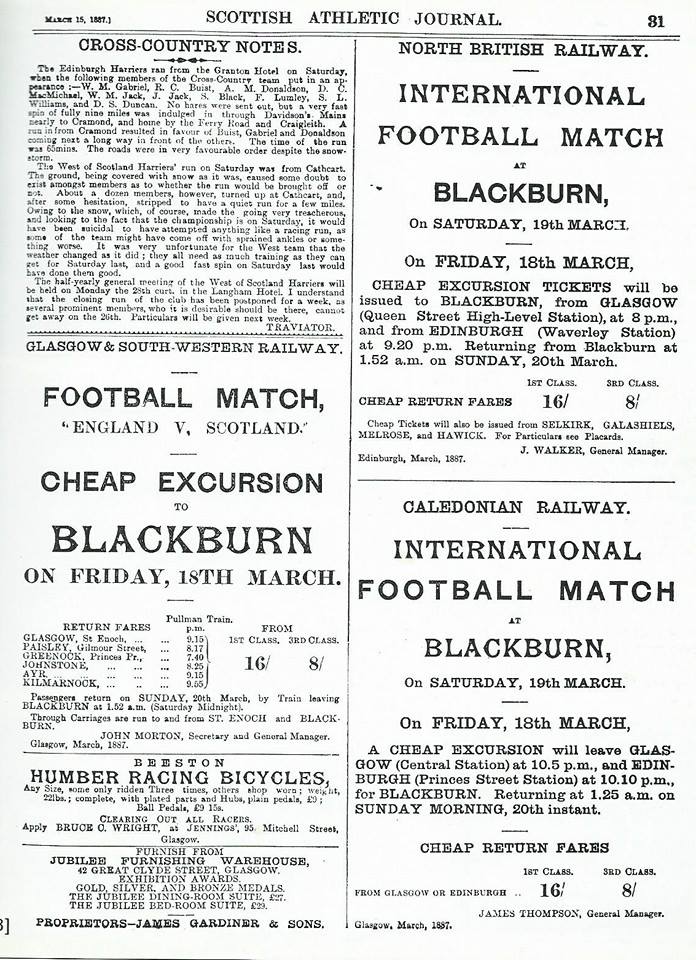
Adverts for train travel by three different rail companies from Scotland for the England game in Blackburn in 1887, which we won 3-2. There’s also a photo of the Crystal Palace ground in 1905 for the game against England which sadly we lost one nil. However, my favourite article is one from a contemporary newspaper in 1898 that starts off describing the throng of the crowd heading towards Celtic Park for the game against the Auld Enemy and then described Scotland team that lost three –one “a useless, feckless jumble of Colossal Frosts. Slow, turgid, nervous, blundering, they made an awful mess of their mission and their name”. Teams nowadays have it so easy. As I say a right cracking book and a wee bargain too as it was three books for a pound and I managed to pick up David Hay’s biography The Quiet Assassin which is quite a good read as I have it on my kindle already.

David Stuart

First posted on Facebook 22nd May, 2015

Blog at WordPress.com.

Up ↑