Search

The Scotland Epistles Football Magazine

Scotland Football Fanzine

Category

Uncategorized

1949 The Perfect Year

11019216_1633648403539198_3291889083791622345_n

A different team photo this time although not exactly a good looking bunch either. This photo is of the team prior to the Ireland game of October 1st 1949. There’s a couple of smiling faces but I’m sure there would have been more at the end of this game as Scotland won 8-2, one of their four wins in the perfect year of 1949.
I know four games isn’t much but still, in those four games Scotland beat England at Wembley, France and Wales at Hampden as well as the Irish pummelling. Overall the Scots scored 15 goals letting in three, two which were against Ireland.

Traditionally, right up until the late sixties the Home Internationals would start with games against Wales and Ireland in October and November with the English game in April of the following year. So the first game of 1949 was against England at Wembley in April 7th.

The Scotland team over these four games was mainly made up with home based players with Billy Steel of Derby County being the only exception. The line-up for Wembley was Jimmy Cowan (Morton), George Young, Sammy Cox (both Rangers), Bobby Evans (Celtic), Willie Woodburn (Rangers), George Aitken (East Fife), Willie Waddell (Rangers), Jimmy Mason (Third Lanark), Billy Houliston (Queen of the South), Billy Steel (Derby County) and Lawrie Reilly of Hibs.

Due to the war, opportunities for caps had been unavailable, so of this team only George Young (12) and Billy Steel (10) had caps in double figures. Sammy Cox and George Aitken were making their debuts.

Scotland beat England 3-1 with Mason, Steel and Reilly scoring for Scotland. Reilly had a habit of scoring against England, indeed 6 of his 22 goal tally were against the Auld Enemy. The England side itself contained legendary players such as Stanley Matthews, Stan Mortenson, Newcastle’s Jackie Milburn and Tom Finney. Having already beaten Wales and Ireland that season Scotland topped the British Championship that year

On April 27th France came to Hampden and Scotland defeated them 2-0 in front of a staggering crowd of 125,683. Third’s Jimmy Mason made way for another Rangers player ,with Willie Thornton taking his place. Goals that day, both came from Billy Steel.

So on to October and the start of the 1949-50 Home Internationals which would double up as qualifiers for the 1950 World Cup in Brazil with the top two teams going through.

Jimmy Mason was reinstated for the team to play Ireland on October 1st at Windsor Park, but Billy Houliston would lose his place to Henry Morris of East Fife. Henry was to make a debut that players can only dream of.

Henry scored after only two minutes. By half time the Scots were five nil up with Waddell scoring twice and Reilly and Steel adding one each. Steel would incidentally score four against the Irish at Hampden the following year in a six – one thrashing. Morris would add two in the second half to complete his hat-trick with Mason completing the Scots scoring.

Morris’ reward for scoring a hat-trick in his debut was to be never called up again for Scotland. As stated above, the game finished 8-2, England would go one better and beat the Irish 9-2 a month later.
The final game of the year would see Waddell, Mason and Morris all drop out with Liverpool’s Billy Liddell coming in, along with debut caps being given to Celtic’s John McPhail and Alex Linwood of Clyde. The Scots would win 2-0 with McPhail and Linwood justifying their selection by scoring the goals. England had already beaten Wales 4-1 in October.

So what was the Scotland team’s reward for the perfect year? Qualification for our first World Cup was already assured but in a moment of hubris the SFA decided that Scotland would only travel to Brazil as winners of the Championship that season. Fate would ensure that like any other time we have needed to be the English for a place in a major tournament we would fail, as the Scots lost one nil at Hampden in April 1950.

Scotland would be failed by the SFA and their committee mentality throughout the 50’s, whether it was their West of Scotland bias; failing to pick the best players available time after time, their incredulous cowardice in not standing up to Rangers who took their players on a tour of North America refusing to release for the 1954 World Cup or just the haphazard / amateurish way they went about their business back then.

However, given the recent ticket issues and the fuss over the Qatar game have things changed that much.

David Stuart

First posted on Facebook June 25th, 2015
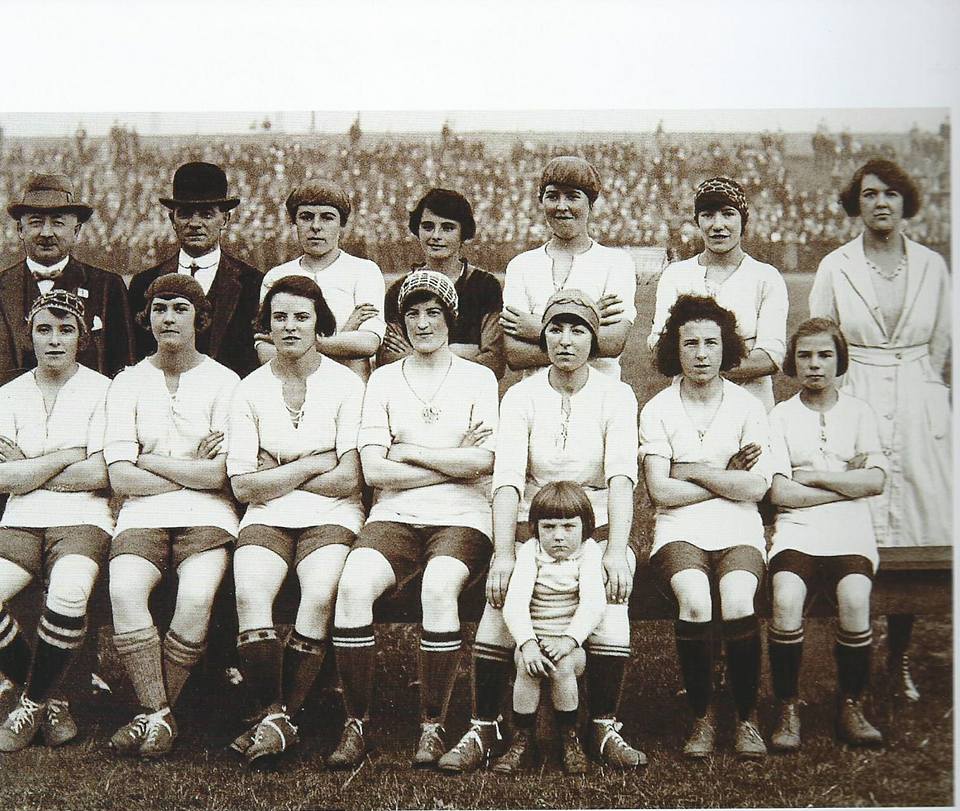
The Killie Stoaters!

1623292_1633031886934183_3638897174189599303_n

I know some of you enjoyed that picture of Julie Ege the other day but some of you may have felt a Facebook page about the Scotland football team shouldn’t have a picture of a Scandinavian beauty. So just for you guys, here’s a bevy of Scottish beauties. Apparently this is the Kilmarnock Ladies Team from the 1920’s, who also represented the national team at times. I don’t know about you but I’m heading over to Kilmarnock this Saturday to see if I can pick up a great granddaughter or two of one of these stoaters.

David Stuart

First posted on Facebook 24th June, 2015

ADVERTS TO HAUNT US – CENTAPOST PORTABLE TRAINING DEVICE

1508660_1633031600267545_1865633385367841160_n

I recently discovered WGS lurking on the back page of the programme for the February 1987 Scotland – Republic of Ireland Euro Championship qualifier. The then Old Trafford player was advertising something called ‘Centapost’ Portable Training Device.The associated blurb says it all – ”The go-anywhere, play-anywhere, easily portable new ball game. Recommended by Gordon Strachan of Manchester United and Scotland.

On the beach or in the park, it can be set up in seconds and ready for action. On either side are distinctively coloured touch sensitive pads – simply strike your pad with the ball, a ‘bleeper’ will sound off and your score will appear on the digital scoreboard.” The advert then closes with the boast – ”It’s probably the most exciting football invention since the ball”.

In 1987 I was playing amateur football -badly – and I have to confess I don’t remember this ‘ingenious’ new training device. I do remember being shown a barn door and being told to take it from there. I would like to hear from anyone who ever used ‘Centapost’ and if it helped turn them into a Graeme Sharp or even a Brian McClair. For all I know, a modern day version of this machine is central to the Germans’ training regime.

Back to the eighties, and Strachan would win his 40th cap in the said match against the Irish who would win 1-0 thanks to a goal from Mark Lawrenson. He must have ‘bored’ his way through our defence…..or maybe AH in his final Scotland appearance waved him through.

Robert Marshall

First posted on Facebook 24th June, 2015

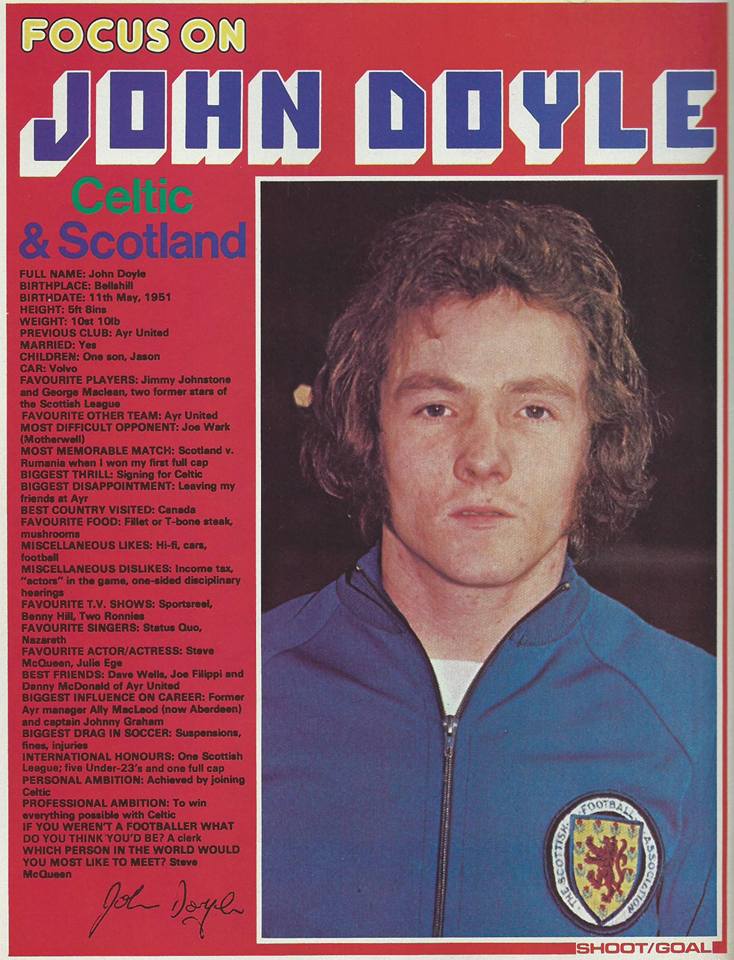
Focus On Johnny Doyle

11257896_1631212000449505_1379366092207601161_n

One of the things I love about doing this is coming across pictures of players in their Scotland strip or in this case tracksuit, when they only played for Scotland a couple of times. In Johnny’s case it was only one appearance in December, 1975 in a European Qualifier against Romania at Hampden. Scotland were at this point in transition; the team that did so valiantly at the World Cup in 1974 had started badly in their European campaign losing to Spain at Hampden and although we did manage to draw in both Spain and Romania that home loss had seen us play catch up to Spain all the way.
By the time of the Romania game, Scotland had also lost their inspirational captain, Billy Bremner after a night out in Copenhagen after a qualifier went awry and Billy among others was given a lifetime ban. Of the team that lined up that night only Martin Buchan, Kenny Dalglish and substitute Peter Lorimer had played in the previous years’ World Cup.
Also making his debut that night was Andy Gray, then of Aston Villa. The game ended up one each with Bruce Rioch netting for Scotland in front of a paltry 11,375 crowd. Looking back at Johnny’s one cap it is surprising that at the time he was an Ayr United player. Not the most fashionable of teams and indeed prior to Johnny’s cap that night, the last player to play for Scotland as an ‘Honest Man’ was Bob Hepburn winning is only cap in 1931. No United player has represented Scotland since although both Stevie Nicol and Gary Teale were capped as Under 21 players with Ayr before progressing to full honours playing for Liverpool and Derby County respectively.
The other surprise is that it was Willie Ormond and not Ally Macleod who gave Johnny his one and only cap. Macleod prior to managing Scotland had turned Ayr United in the late 60’s and early 70’s into a formidable force in Scottish football, which ultimately led to his taking over after Ormond resigned in April ’77. Of course, Ayr United were also managed by another future Scotland manager, who shall remain nameless at this point. As for Johnny Doyle, let’s face it, after his move to a certain team in the East End of Glasgow; if you didn’t support them you probably hated him, such was his commitment to the Celtic cause. Johnny was a fast, tenacious battler of a player, whom we would all have loved on our team but loathed in the opposition, he was also as one Celtic site refers to him as a ‘one man riot’. Johnny was well known for his, less than amicable relationships with referees.

10455210_1631212017116170_989694610363470926_n
As to his answers in the article they show his love for Celtic but also his affection for his time at Ayr United and a bit of his humour. His favourite players were Jimmy Johnstone and George ‘Dandy’ McLean. George would have played alongside Johnny at Somerset Park, in his long career as a bustling centre forward, George also played for St. Mirren, Rangers, Dundee and Dunfermline and like Johnny was capped once for Scotland against the Netherlands in 1968.
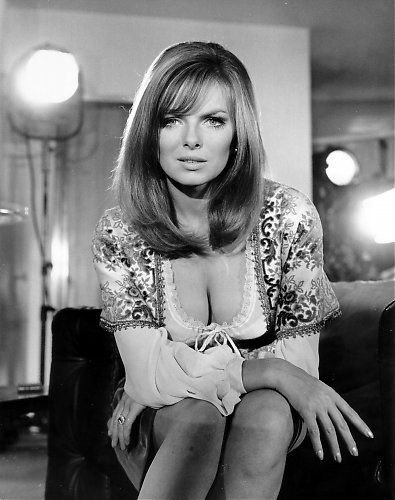
His most difficult opponent is listed as Tam Cowan’s favourite; Motherwell’s Joe Wark. Biggest Thrill was signing for Celtic but his Biggest Disappointment was leaving my friends at Ayr. Most memorable match was his International debut. His favourite food is of course steak but among his miscellaneous dislikes is one-sided disciplinary hearings and among his biggest drags in football are suspensions and fines! Favourite singers are not 70’s lounge singers at least but Status Quo and Nazareth, he was also a big fan of Benny Hill and the Two Ronnies. His favourite actor is Steve McQueen and actress is Julie Ege (a photo of her is a must for this article!) and finally his biggest influence on his career was Ally MacLeod and United captain Johnny Graham.
Sadly Johnny died after being electrocuted at home in 1981 at the age of 30, however loved or loathed him Johnny played for Scotland and that’s what we at the Epistles choose to remember.

David Stuart

First posted on Facebook June 20th, 2015

I JUST COULDN’T HELP MYSELF

11542046_1631209997116372_2236880273629804025_n

When UEFA’s Euro Championship Finals ticket application window opened earlier this month I just couldn’t help myself. As a graduate [with honours] from the Ally MacLeod School of Unbridled Optimism I applied for tickets for the actual final in Paris on 10th July 2016.

I know it’s a bit of a longshot [so I applied for the ‘cheap’ seats at 85 Euros a go] but I can’t help but wonder how many Greece fans wished they had given it a go in advance of the 2004 Finals. You’ve got to feel for Greece though haven’t you what with their economy in serious trouble and their national football team getting stuffed by the Faroe Islands. [Yes, we can laugh now…..].

Anyway I know it’s unlikely [a] my name will come out of the hat; and [b] that Scotland will reach the Final [We’ll probably lose out to Wales on penalties in the semi-finals] but you’ve got to hope/dream haven’t you?

If truth be told, over the years I’ve actually been rather unlucky with many of my ticket applications. For various reasons [that I won’t go into] I applied for tickets for Neil Diamond, Take That, The Singing Kettle and Olympic football at Hampden …….and I ended up getting them all!

Robert Marshall

First posted on Facebook June 20th June, 2015

Tommy in the Doc(k)

10155584_1630790300491675_2128475373298771460_n

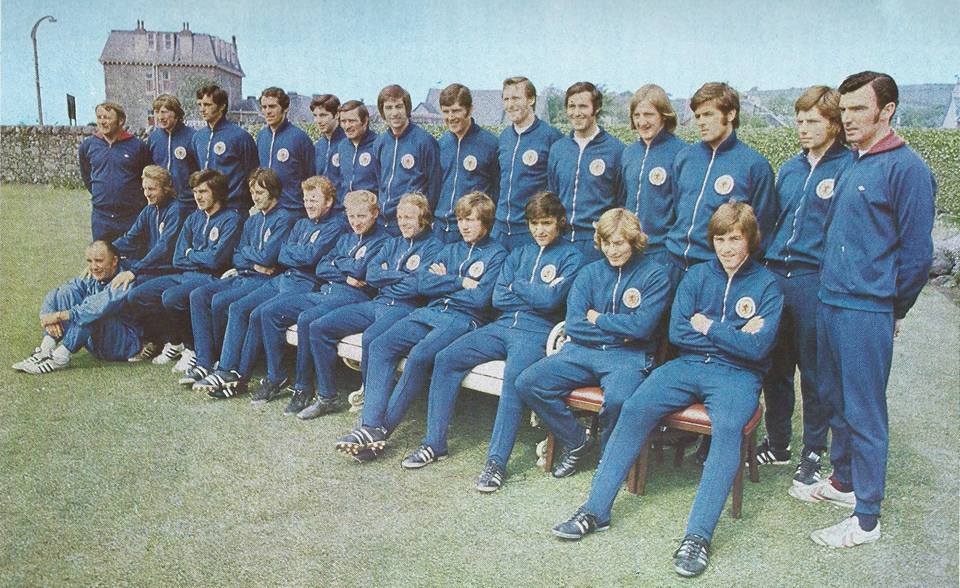
A couple of weeks ago, Robert Marshall posted an article on the Scotsport Yearbook season 72/73 but I was surprised when he gave me a loan of it, there was a cracking photo of the Scotland squad for the Home Internationals for season 71-72, which was Tommy Docherty’s only Championship as manager. Initially I was going to write a bit about the squad and the Championships but what intrigued me more was some of the players early in their Scotland careers that Tommy gave their debut cap too. That got me thinking, who did Tommy Docherty give debuts to and who was his successes and failures.

Tommy was in charge of Scotland for twelve games winning 7, drawing 2 and losing 3. His first game was against Portugal in a Euro qualifier on the 13th October, 1971. Straight away Tommy was controversial in picking two players, of Scottish parentage for the first time and in particular his choice of goalkeeper, Arsenal’s Bob Wilson. Bob was very much seen as an Englishman to all and sundry even though Bob himself is very proud of his Scottish heritage. The other player was Hibs’ Alex Cropley who was born in Aldershot, as his father was playing for Aldershot FC at the time. Funnily enough, Bruce Rioch was also born there, 4 years earlier than Cropley but it would take almost another 4 years for him to make his Scotland debut. Both Alex and Bob would only play twice for Scotland, Cropley would almost be on the cusp of call ups to future squads but bad luck with injuries would always seem to hinder his progress.

Also making their debut that night would be Sheffield United’s centre half Eddie Colquhoun who would win 9 caps in total, his last being Willie Ormond’s torrid debut as manager in 5 nil whitewash to England in 1973. Another of Arsenal’s double winning team of ’71, George Graham was given his chance. Graham would score 3 goals in 12 games for Scotland.

Colquhoun was replaced in 60 minutes by Martin Buchan who would actually move to Manchester United from Aberdeen prior to the Doc going there. Buchan would go on to play 34 games for Scotland.

Scotland won 2-1 against Portugal that night at Hampden with Archie Gemmill and John O’Hare scoring the goals.

Being a wily character, Tommy decided to reinstate Bobby Clark to first choice goalkeeper in his next game as this was against Belgium in another Euro qualifier at Pittodrie. He also choose the home clubs’ Buchan and debutant Stevie Murray to start. This would be Murray’s only Scotland game. In the 48th minute Alex Cropley was replaced by a Scotland legend in the making, Kenny Dalglish. The other sub that night was John Hansen of Partick Thistle making one of his only two appearances. Scotland won one nil with O’Hare scoring again.

There was no debutants in his next game a 2-1 defeat to the Netherlands in Amsterdam, to a team that included Cruyff, Krol and Neeskens. George Graham scored the sole Scotland goal.

Ally Hunter was given the goalie jersey next time round, a friendly against Peru and would play four games in total, the last being for Willie Ormond on the night we qualified for Munich ’74 but perhaps letting in that soft goal that night (“disaster for Scotland”), was enough for Willie to ditch him. Also making his debut that night was Man. City’s Willie Donachie, who won 35 caps and his future Man City team mate Asa Hartford with West Brom at the time, who played 50 times for Scotland. Scotland won 2-0 with goals from O’Hare and Denis Law returning to the side for the first time in two years. Also playing that night were Hector Chumpitaz and Teofilo Cubillas or should I not have mentioned that?

As for the Home Internationals we would beat both Northern Ireland (2-0) and Wales (1-0) but lose to England (0-1). Only Luigi Macari or Lou to me and you, would make his debut in these games as a sub against Wales and play the full 90 minutes against England. Lou would go on to play 24 games for Scotland.

Then onto Brazil for the Independence tourney. Scotland would draw 2-2 with Yugoslavia in front of a crowd of 4000 in Belo Horizonte. Thistle’s Alex Forsyth would make his bow in the first of the games as would ex-Jag and then Norwich player Jimmy Bone, who’s final Scotland record would read played 2 scored one. Lou Macari scored the Scotland goals. The next game in Porto Alegre would see Scotland draw nil nil with Czechoslovakia in front of 15,000. The final game saw Scotland lose one nil to Brazil with Jairzinho scoring the only goal in 80 minutes at the Maracana in front of a crowd of 130,000.

Tommy would only have two more games in charge, both World Cup Qualifiers against Denmark with Joe Harper coming off the bench in the away tie to make a scoring debut in a 4-1 win for Scotland. Joe would only play 4 times for Scotland. Jimmy Bone, Lou Macari and Man United’s Willie Morgan scored the others.

His final game in charge would see him give David Harvey of Leeds his debut against Denmark at Hampden which the Scots won 2 nil with Kenny Dalglish hitting his first Scotland goal and Peter Lorimer score the other.

And with that Tommy paved the way for Willie Ormond to take us to the World Cup in 1974. His time as Scotland manager was a success, winning all his Euro and World Cup qualifiers. He also gave debuts to important players like Buchan, Dalglish, Donachie, Hartford, Macari and David Harvey, all of whom served their country well. It should be noted that in the squad photo is Kenny Burns who would make his Scotland debut almost two years later. Interestingly, Tommy also as Manchester United manager purchased Macari, Forsyth and George Graham shortly after arriving at Old Trafford.

David Stuart

First posted on Facebook June 19th, 2015

Green with envy

11406765_1630399480530757_9117087325312470321_n

Saturday’s Euro qualifier was my third visit to Dublin’s magnificent Aviva Stadium. A glorious greenhouse of a sporting venue that I appreciate more each time I see it – apart from the circuitous route to the away end behind the north goal. The good news of course is that whilst the Irish have a better national stadium than us, I think we have the better football team and the better chance of reaching Euro 2016. Hopefully. Maybe. Possibly.

The attached photos show second half action plus final whistle celebrations. As you can see, I didn’t have the best seat in the house with little elevation, the goal net, the tv camera and stewards all restricting the view. Well that’s my excuse for not spotting that the Ireland goal was offside – what is yours Nicola Rizzoli of Italy?

Being a sad groundhopper I also took time out to make a pilgrimage to Dalymount Park – home of Bohemians FC and venue for three Republic of Ireland-Scotland matches in the 1960s including our 3-0 World Cup Qualifying victory in 1961 when Jim Baxter had the likes of Pat Crerand and Billy McNeil for company as well as four other Ibrox teammates.

Scotland also played four British Home International matches at Dalymount Park before the partition of Ireland – winning three and drawing one. The stadium – which last staged an ROI international in 1990 – is in serious need of some TLC, however you can’t help but love a ground that still has four ‘subbuteo-style’ floodlight pylons. So what if it is a crumbling relic from the past, so are the Acropolis and the Collosseum!

Robert Marshall

First posted on Facebook June 18th, 2015

Scots in the EPL – Part 2 (God, it’s Depressing)

1609878_1630372980533407_1277970711058424963_n 11406826_1630372963866742_3132284940725148331_n

And so here we are, going from the team that ended tenth last season to Premiership Champions Chelsea at the top. It is quite depressing and for some teams it’s even before the 1998 World Cup that they last had a Scottish Internationalist playing for them. In tenth place last season after their revival under Alan Pardew came Crystal Palace. Surprisingly there has only ever been 4 Palace players capped for Scotland. Current player James MacArthur who was a major part of their resurgence last season and Barry Bannan who is also on their books but spent the tail end of the season on loan to Bolton are two.

In the early part of this century Dougie Freedman played his two Scotland games, scoring in a 2-1 win over Latvia in 2001 but then also playing in that 5-0 drubbing to France under Berti Vogts in 2002. David Hopkin in the late ‘90’s earned two of his seven caps as a Palace player.

Stoke City have Charlie Adams on their books who has won eight caps with them. Although Phil Bardsley played 25 League games for Stoke last year, he has not as yet played for Scotland as a Stoke City player. Prior to Charlie Adams the last Scot to get capped at Stoke was William Sturrock Maxwell who won his only cap in 1898!

Here’s hoping Jay Fulton can achieve that which his father Stevie could never do and gain a full International cap as currently no Swansea player has ever been capped for Scotland. I did think at one point that Craig Beattie might have done so but no, all his were with Celtic and West Brom and then I thought Stephen Dobbie. Of course it was Scott Dobie at West Brom who was capped for Scotland. Dobbie, Dobie what a Dobber I am. Ex-Hearts player Andy King is also on the books at Swansea so maybe there’s a chance that he could provide the first cap too.

Next up came Southampton. Danny Fox, Nigel Quashie anybody? No great shakes there but there was also Christian Dailly for one of his 67 caps, Stephen Crainey for 2 and topping the all-time list Neil McCann with 10 of his 26. Liverpool once that mighty bastion of Scots with the likes of Dalglish. Souness, Hansen and before that St. John and Billy Liddell have had very few of late. However, recently they did have Charlie Adams for a while and there was also the embarrassing stat of Danny Wilson’s five caps which meant he played more times for Scotland than he ever did for Liverpool in the league. An all too common factor of a lot of the people Berti Vogts capped.

Just failing that Champions League place came Tottenham Hotspur. Alan Hutton is the obvious one there, winning 13 of his caps whilst at White Hart Lane. Prior to that goalkeeper Neil Sullivan also won 13 caps there too. In the late 90’s Colin Calderwood won 32 of 36 caps as a Spurs player.

And now the rarified air of the Champions League qualifiers, where the statistics get poorer and more depressing. Although there are one or two players peppered about in reserves and development squads, there’s no one who seems close to making a first team place or even a 25 man Champions league squad.

Of course, up until recently Darren Fletcher carried the lone flame for Scots in the top 4 at Manchester United. Darren is Manchester United’s most capped Scottish player with 65 in total with Denis Law coming second with 35 of his 55. Michael Stewart did win 3 caps with United in 2002 under Berti. Before that you go back to the early nineties with Brian McClair, now of course the SFA’s Performance Director.

Arsenal; it’s even more depressing as we have go back to Charlie Nicholas in 1987 as he featured in a Rous Cup defeat to England. That’s almost thirty years with no end in sight although Steven Naismith once went for a trial when he was a Killie player but Arsene Wenger never took him on.

Manchester City haven’t been a Top 4 team for that long so surely there must be some good news there? Ex-Arsenal player Paul Dickov gained two of his ten caps whilst at City in 2000. Before that it’s back to the ‘70’s and early ‘80’s with Asa Hartford and before that Willie Donnachie.

And so to the Champions Chelsea. So who was the last one? Roll of the drum please . . . it was Warren Cummings who made a brief one cap of 45 minutes against the mighty Hong Kong XI in 2002. Of course, Warren never played for Chelsea at any point but was on their books in May 2002. Before that it’s Craig Burley who won 20 of his 46 caps as a Chelsea player in the build up to France 1998, by which time he was a Celtic player. In the years prior to that, there was quite a few as Pat Nevin, David Speedie, Tom Boyd, Gordon Durie and John Spencer were among those that won caps.There are two Scots among Chelsea’s reserves with Alex Davey and Islam Feruz, but whether either of them make it, is yet to be seen. Feruz, of course may not even be available to Scotland if he progresses, given his recent request not to be chosen for Scotland Youth teams at this point.

Still, we did have one player in a Champions League squad other than Fletcher, with Ryan Gauld at Sporting Lisbon but even then, he didn’t make it to Panini sticker level. Maybe next year.

David Stuart

We would like to thank Fitbastats for their help researching this piece

First posted on Facebook June 18th, 2015

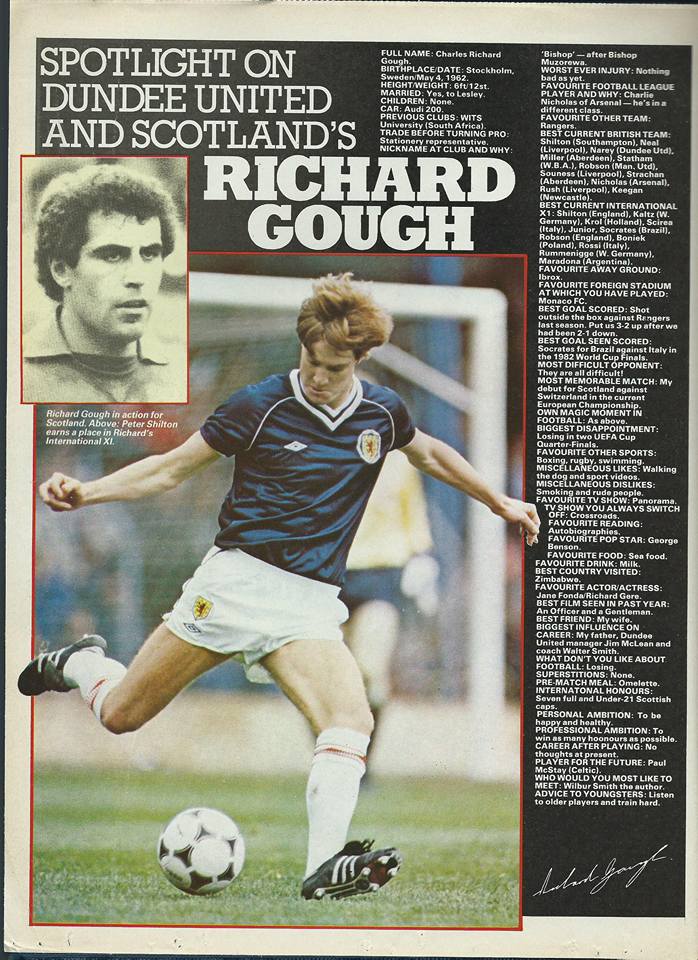
Spotlight on Richard Gough

17681_1629806233923415_7356742671447453153_n

When Match magazine launched in the late ‘70’s as a rival to the all-conquering Shoot, they decided that they too should have a formatted interview with players but they couldn’t call it Focus On. So those crafty guys at Match came up with Spotlight On. Like it’s Shoot article, it had some of the usual questions Favourite food, TV Show, Pop star and the obligatory use of Miscellaneous Like and Dislikes. Has the word Miscellaneous ever been used elsewhere in the history of mankind?
So here we have a young Richard Gough still playing with Dundee United and only having won 7 caps, the last three of which would have been in the 1983 tour of Canada. In total Richard would win 61 caps of which, 26 were won as a United player. He would go on to win 8 with Tottenham and then 27 with Rangers. If you had read this in 1983, you might have known he was heading to Ibrox at some point. Favourite Other Team – Rangers, Favourite Away Ground – Ibrox, Biggest Influence on Career – My father, Jim McLean and coach Walter Smith.
Some of his other answers are quite interesting too. Favourite Football League player and Why: Charlie Nicholas of Arsenal – he’s in a different class. His best current British team had a scattering of Scots including David Narey, Willie Miller, Graeme Souness, Gordon Strachan and Charlie Nicholas. His player for the future is Celtic’s Paul McStay.
Most memorable Match was : My debut for Scotland against Switzerland in the current European Championship. Funny that, years later one of his most memorable moments is that handball against Switzerland when he was sent off for doing that “instinctive” thing of catching the ball as it apparently bounced off of a sprinkler. 30 odd years of kicking and heading a ball and his instinct was to catch it!
Favourite TV programme was Panorama, must have been all that South African coverage. Favourite Pop Star is George Benson but at least his favourite food is not Steak; it’s Sea Food.

David Stuart

First posted on Facebook June 16th, 2015

Blog at WordPress.com.

Up ↑