Search

The Scotland Epistles Football Magazine

Scotland Football Fanzine

Category

Uncategorized

Happy Birthday Brian McClair

scan00108


Brian McClair will be 52 on December 8th. Brian belongs to that great list of really good Scottish forwards who did well in England and eh, couldn’t find the back of the pokey on the International front. His club record stands at just over 500 League games with just over 200 goals in stints with Motherwell, Celtic and Manchester United before a final turn at Fir Park. If that ratio were applied to his International record he would have scored 12 goals instead of the two he did and even one of those was a deflected.

Brian was first capped by Andy Roxburgh in November 1986 against Luxembourg in a Euro Qualifier at Hampden. Although he was the only player making his debut that night, in the starting eleven Pat Nevin and Murdo MacLeod were both making only their third appearances. Ally McCoist would come on in the second half for Murdo for only his second cap.

Scotland won comfortably with two goals from Davie Cooper and a third by Mo Johnston.

Brian would be given a start in Scotland’s next game against the Republic of Ireland also at Hampden in February ‘87. However, that well known Irishman Mark Lawrenson scored the only goal to dent Scotland’s hopes of qualifying for the finals, having already drawn nil nil with both Bulgaria at Hampden and the Republic in Dublin.

Brian got lucky and missed the trip to feckin’ Belgium as the Scots were pounded 4-1.

However, he was back in the starting line-up for the Rous Cup in May which saw us draw nil nil once again with England at Hampden and two nil to Brazil a few days later, where Brian was on the subs bench replacing Jim McInally in the second half. This would be Brian’s last cap as a Celtic player as he signed for Manchester United in the summer of 1987 for £850,000. Brain would eventually play over 470 games for United, scoring 127 goals in total.

However, for Scotland nought; for a while anyway.

scan00048

Cap 5 came against Bulgaria in our penultimate qualifier in Sofia which saw Gary MacKay score the goal that put the Republic through to their first Euro Finals. Once again, Brian was again fortunate to miss the embarrassing nothing each draw in Luxembourg a month later with Everton’s Graeme Sharp drawing another blank there.

A one all friendly in Malta in March ’88 saw Sharp break his duck and also play in his last Scotland game. Ho Hum.

McClair had come on as a sub in the second half for McCoist and would do so again a month later as Scotland ground out another blank draw, this time at the Bernabeu against Spain.

Brian had a great first season at Old Trafford and returned to the starting line-up for our first game of the 1990 World Cup Qualifying campaign in September 1988. Brian would play in the first few games of our qualifiers as Scotland beat Norway 2-1 in Bergen with goals from Paul McStay and Maurice Johnston. A one all draw with Yugoslavia at Hampden with Johnston again being the scorer followed in October.

An oddly timed trip to Perugia in December 22nd for a wee friendly. WTF? We lost two nil; not sure if we gifted the goals or not.

Back to World Cup action and that nerve sapping game in Cyprus where Richard Gough digs us out a hole with a goal, six minutes into injury time. Of course that was followed in March ’89 by the incredible night we defeated France two nil at Hampden with Mo Johnston providing the goals. McClair would come on for McCoist late in the second half for his 12th cap.

Six months later and Brian plays a bit part in our last qualifier a one all draw with Norway at Hampden in November ’89 coming on late in the game as he does in March ’90 in Scotland’s one nil defeat of Argentina at Hampden with Stewart McKimmie providing the Goalden moment.

Brian would not feature again until after Italia ’90 and despite playing in five of the qualifiers he never makes the final 22 for the World Cup with players like Gordon Durie, Robert Fleck and SuperDud Alan McInally getting the nod ahead of him.

Winter 1990 and McClair became involved in what was to be Scotland’s first successful Euro campaign as he started the second game in Sofia, Bulgaria once more as the Scots drew one each with Ally McCoist scoring early in the match.

March ’91 and it’s Bulgaria at home with the same score line as before with John Collins scoring late in the game (83rd minute) to put Scotland in the lead with Kostadinov spoiling a night of celebration with a goal in the 89th minute. Bummer.

We faced the might of San Marino next in Serraville but once more McClair failed to find the net although thankfully Gordon Strachan with a penalty and Gordon Durie both scored second half goals to save our blushes, however this was after McClair was replaced by Pat Nevin minutes beforehand.

A two each draw in Berne against Switzerland with goals from Durie and McCoist and McClair coming on as a sub once more late in the game followed in September ’91.  McClair once more started as Scotland lost to Romania one nil in Bucharest in their penultimate qualifying game. Mike Galloway of Celtic was to make his one and only Scotland appearance in this game.

13th November, 1991 and a victory against San Marino would see us through to the Finals for the first time as one of only 8 (Yes . . . 8!) qualifiers. Unfortunately, for McClair he wasn’t involved but an early goal from Paul McStay settled Scottish nerves and two more strikes by Gordon Durie and Richard Gough before half time had us dancing in the aisles of Mount Flo. McCoist would add another after half time.

Then came those Finals Warm up friendlies with McClair playing in a home win against Northern Ireland and wins across the Atlantic as we beat USA and then Canada before a nil nil draw with Norway in Oslo.

McClair would not only get a place in the Squad this time round but would start in all three games of Euro ’92 in Sweden. Scotland gave a good account of themselves against both Netherlands and Germany but still lost the games, 1-0 and 2-0 respectively.

Game 26 and finally Brian hits the net in the last game of our maiden Euro Finals. Scotland were playing Russia, USSR or rather CIS as they were called for a week or two back then for third spot in our group. Once again it was Paul McStay that gave Scotland the early lead in six minutes and in a further ten minutes McClair plays a neat one two and then shoots, hitting a Russian defender square on the chest that spins off him and past the despairing arms of Dmitri Kharin in goals. A Gary McAllister penalty in 83rd gave Scotland a very credible 3-0 win.

World Cup Qualifiers followed but an opening defeat to Switzerland in Berne was a bad start with Scotland going down 3-1 with McCoist scoring for Scotland and Richard Gough being sent off for that “instinctive” handball late in the game. A substitute appearance followed in non-score draw at Ibrox against Portugal in October ’92.

Brian was left out of the team for a while but following a 5-0 defeat to Portugal in Lisbon, Roxburgh had a wee clear out of Rangers players; Goram, Gough, McPherson, McCall and McCoist were all left out (of course, McCoist’s broken leg might have had something to do with it) and so he was back in the fold starting in the three nil victory against Estonia with Kevin Gallacher, John Collins and Scott Booth all netting in Tallinn.

Brian’s last game would come in June 1993 up at Pittodrie and would also be against Estonia; it would also feature that collector’s item; a Brian McClair goal as he gave us the lead in 18 minutes followed by a double by Pat Nevin as the Scots won 3-1.

So that was it for Brian, although he would still feature for Manchester United for another five season, no more caps were forthcoming.

Recently he has returned to Scotland and is now SFA’s National Performance Director and hopefully he will aid us in turning out players as skilful and intelligent as he was on the pitch and hopefully with more goals for the national team.

Happy Birthday Brian.


David Stuart
DECEMBER 75, 79, 88, 94 – OH WHAT A NIGHT….

12316193_1684444215126283_4353291537241381063_n

I tend to consider the month of December to be an unusual time to play an international match so I was surprised to discover that since 1945 Scotland are actually into double figures for yuletide fixtures. Indeed at one point I thought I’d make this article into a Scotland match advent calendar, EG

1st December [1971] – Netherlands 2 Scotland[Friendly];

2nd December [1987] – Luxembourg 0 Scotland 0 [Euro Qualifier];

7th December[1965] – Italy 3 Scotland 0 [World Cup Qualifier];

13th December [1983] – Northern Ireland 2 Scotland 0 [Home International]…….but who wants the advent calendar from hell?

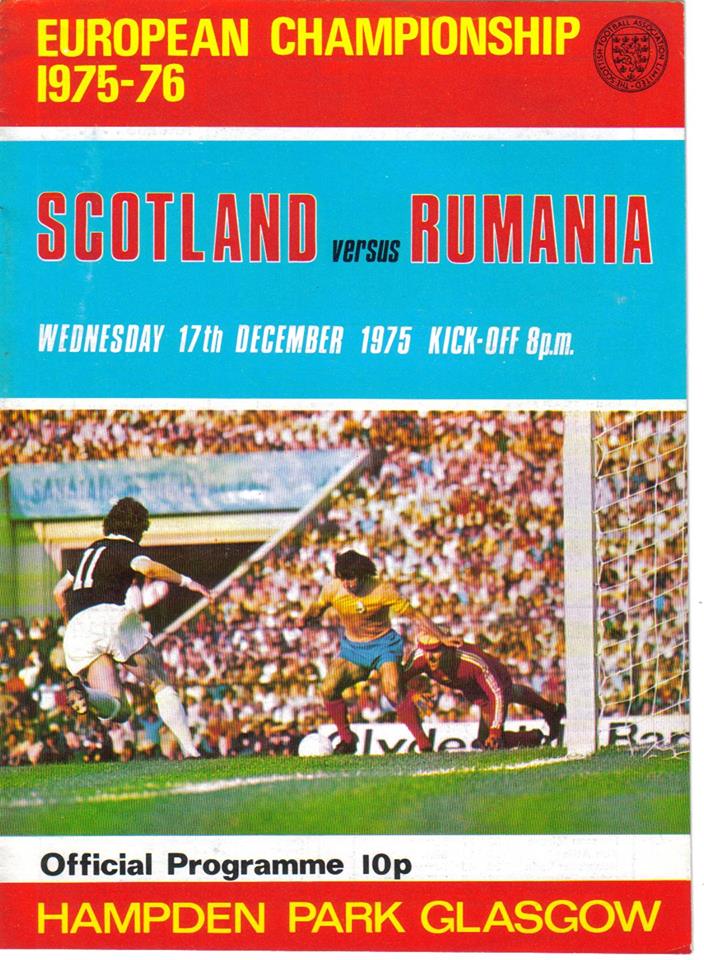
So let’s restrict the pain shall we to the week before Christmas.17 December 1975 – Scotland 1 Romania 1[Euro Qualifier] – I was one of only 11,375 freezing-cold supporters at Hampden that night for the proverbial ‘dead-rubber’ as Spain had already qualified from our group which also included Denmark.

Against the Romanians, Hearts goalkeeper Jim Cruickshank won his sixth and final cap, Andy Gray, then of Aston Villa made his full international debut, Ayr United’s Johnny Doyle won his only cap whilst Manchester United’s Martin Buchan won his 20th cap and skippered the team.

Bruce Rioch gave Scotland the lead after 39 minutes – a superb free-kick from the edge of the box but substitute Zoltan Crisan equalised in the 74th minute and as the temperature plummeted I remember wishing that boys were allowed to wear tights. Anyway, I think I dogged school the next day in disgust – either that or I had a slight chill….

18 December 1994- Greece 1 Scotland 0 [Euro Qualifier] – There were only 20,000 in the Olympic Stadium, Athens to see Greece take the points thanks to an 18th minute penalty conversion by Efstratios Apostolakis. However as Scotland manager Craig Brown famously said [allegedly] ” We won more corners than them!” Stuart McCall won his 30th cap that evening whilst Gary McAllister was the team captain. Goalkeeper Andy Goram [I’m not sure which one though] started the game but was replaced by Jim Leighton after 77 minutes – I presume it was due to injury. Alls well that ends well however, as ultimately Scotland finished ahead of Greece,Finland, The Faroes and San Marino [though behind Russia] to make it to the finals of Euro 96. Hurrah!

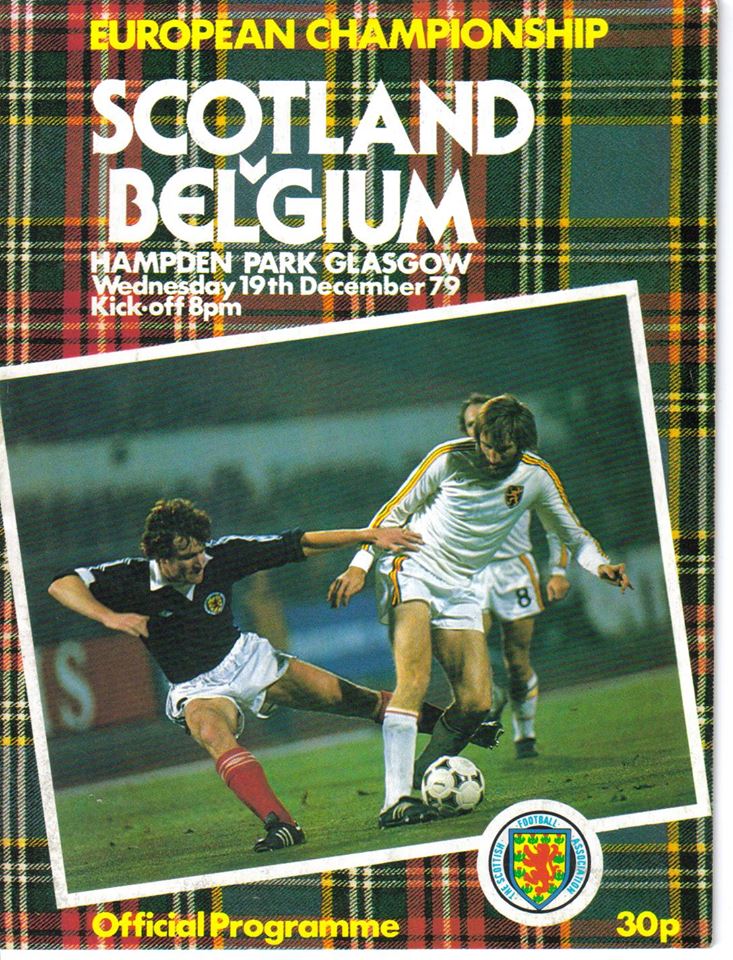
19 December 1979 – Scotland 1 Belgium 3 [Euro Qualifier] -The game was originally scheduled to take place on 7th February but had to be postponed due to a snow-covered Mount Florida.

11037046_1684444255126279_6475151013150904901_n

Unfortunately come December Scotland were already ‘out’ of the competition, however our old friends Belgium had to win the game to keep their qualification hopes alive. In front of a crowd of 25,389 Tintin’s boys did the business, indeed they managed to beat Alan Rough three times in the first half hour before Notts Forest’s John Robertson pulled one back in the second half. Eamonn Bannon made his debut that night but it would be unfair to blame him especially as we had a back four of Danny McGrain, Gordon McQueen, Kenny Burns and Sandy Jardine.

Maybe Belgium were just a very good team – well ultimately they went on to reach the final of Euro 80 where they lost 2-1 to West Germany.22 December 1988 – Italy 2 Scotland 0 [Friendly] – To many people [well me and my mates anyway] this game had ‘Pre-Christmas junket’ written all over it although allegedly it was to help with our preparations for visiting Cyprus the following February on World Cup business. Anyway, in Perugia, about 100 miles north of Rome, Andy ‘I’m Spartacus’ Roxburgh and his team of gladiators came a cropper whilst a debut cap was given to Rangers’ Ian Ferguson – the Tony Curtis of his day.

I suppose the main thing was that we did beat Cyprus which enabled us to return to Italy in the summer of 1990. Hurrah again.Anyway, season’s greetings to you all, now if you’ll excuse me, I’m away to roast my chestnuts on an open fire. Ye cannae whack it….

Robert Marshall

Happy Birthday Ian Ure

IAN URE and Jim Baxter prior to their victory over England at Wembley in 1963. Baxter scored twice in a 2-1 victory for the Scots.


Ian Ure will be 76 on December 7th and Colin Hendry will also celebrate his 50th birthday then. Both players were well known for their striking blonde hair and both started out at Dundee but for Ure, Dundee would perhaps be seen as the pinnacle of his career whereas for Hendry it’s more where he served his apprenticeship before going on to greater things.

Their Scotland careers were also quite contrasting, Ure would win eleven caps and all by the time he was 27, Hendry would not be capped by Scotland until the age of 27 winning 51 caps in total.

Ian Ure was first capped by Scotland in November, 1961 as a Dundee player against Wales at Hampden with Celtic’s Billy McNeill dropping out; also making his debut that day was his fellow Dens Parker Alex Hamilton. Both would play a major part in Dundee winning the 1961-62 championship as well as their run all the way to the European Cup Semi-Finals, the following season. Scotland would win 2-0 with both goals from Ian St. John.

Three weeks later and Ure retained his place for the vital World Cup play-off against Czechoslovakia. Due to injuries Scotland would field some inexperienced players with Hugh Robertson also of Dundee making his only Scotland appearance and goalkeeper Eddie Connachan also winning the first of his two caps.

Although St. John was to score two goals in the Heysel Stadion, Brussels; it was to be another night of misery for Scotland in Belgium as the Czechs scored a late goal to take the game into extra time. Two more Czech goals in the extra period and Scotland had failed to reach the World Cup Finals in Chile. As for the Czechs they went all the way to the final before being beaten 3-1 by Brazil.

Ure would be dropped for the next two games in favour of McNeill but would be in the starting line-up to face Wales once more, this time at Ninian Park, Cardiff in October, 1962. Scotland won 3-2 with a penalty from Eric Caldow with Denis Law and Willie Henderson scoring the others.

A month later and a crushing defeat of Northern Ireland at Hampden saw the Scots hit five to a solitary goal by the Irish. Denis Law scored four of those goals with Henderson getting the other.

April 6th, 1963 saw Ian win cap number five as the Scots beat the Auld Enemy at Wembley 2-1 with a double from Jim Baxter. This game is mainly remembered for the Scots going down to ten men early in the game after a leg breaking tackle on Eric Caldow by England’s Bobby Smith.

The drama was to continue a month later as Scotland faced Austria in a “friendly” at Hampden. Scotland were 4-1 in front when in the 79th minute referee James Finney abandoned the game as he stated “I felt that I had to abandon the match or somebody would have been seriously hurt”. By this point, two Austrians had been sent off and a few scuffles were breaking out between players with Denis Law having helped himself to a couple of goals, among those handing out a punch or two.

Denis would score a hat-trick on the 4th June, 1963 against in Bergen but unfortunately and at the time rather embarrassingly the part-timers of Norway scored 4 to give them a famous win.  This was followed by another unexpected defeat to the Republic of Ireland at Dalymount Park, Dublin five days later with Noel Cantwell scoring the only goal.

The prospect of playing Spain in the Bernabeu four days later was not something the Scots were looking forward to. With Billy McNeill, Frank McLintock, (then of Leicester City) and Ure all starting, it was clear Scotland were out to defend. That plan went out the window as the Spanish went into the lead after eight minutes. However, in a blistering 17 minute spell midway through the first half Scotland scored four goals through Law, David Gibson of Leicester, club team mate McLintock and Davie Wilson of Rangers.

The game ended 6-2 to Scotland; Henderson and St. John added goals in the second half. By the time of his next International against Northern Ireland at Windsor Park in October 1963, Ian was an Arsenal player. Ian was transferred for £62,500, which was a lot of money at the time for a defender. He would miss only one game in his first season at Arsenal but injuries would soon play their part in retaining his place in the team. Ure’s time at Highbury is not looked upon too kindly by Arsenal fans even though he would play just over two hundred games for them. A mistake in the 1969 League Cup Final seems to be unforgiveable in the eyes of most of the Gunners fans at the time.

Scotland would be beaten by Ireland by two goals to one with St. John being the lone Scot to score that day. However, the Scots did get their revenge on Norway on November 7th as they beat them 6-1 at Hampden with Law hitting four and Dave Mackay the other two.

This would prove to be Ian’s last game for four years but another one of his ex-Dundee team mates was to make his international debut that night, Alan Gilzean who would go on to win 22 caps with Scotland and would flourish at Tottenham Hotspur over the next few years.

Although, Ure would continue to make over 20 appearances per season at Arsenal, he was becoming second choice to Frank McLintock and Terry Neill.

In October 1967 he returned to the national side for one more game; a 1-0 defeat to Northern Ireland in Belfast, which would effectively seal Scotland’s fate in their attempt to reach the play-off rounds of the European Nations Cup as England would only need a point in the final qualifier / Home Internationals to go through. Scotland would draw one each at Hampden in what was effectively the play off in February 1968.

As to Ian he would move to Manchester United for a couple of seasons but by then knee injuries meant he was never the same player again.                Happy Birthday to Ian and also to Colin Hendry and all the best for the coming year.

David Stuart

A Christmas Offer

banbury-santa

Okay I know I’m probably pushing it a wee bit too far with this one but as you know we have provided some amount of material this year and probably will continue to do so until they take this keyboard away from “my Cold, Dead, Hands” but of course there’s a magazine to sell too.
I know it’s only a week or so ago I wrote about the number 69 and here I am pleading again for people to buy it. I will do a follow up to 69 soon but at the moment it will only be called 67!
Anyway, here’s the plan. First of all, around this time we seem to end up with lots of spare Christmas cards and Stamps. Well, why don’t you put the stamps to use? Send me 6 first class stamps and I will send you a copy of issue 3 or even only 5 and I can send issue 1 or 2 instead. I know it sounds a bit strange but if you don’t have Paypal it’s not easy to buy online when you can’t use a debit card.
The second offer is to think of giving issue 1-3 as a present this year to a deserving Scotland fan who maybe hasn’t latched on to the magazines yet. You can buy them on eBay for a total of £7 and £1.60 postage but if you send a payment to my email address via Paypal and make it a family and friend payment then the costs incurred via EBay and PayPal are reduced so you can buy for only £8 in total.
Please give this a thought and thanks for your support throughout the year. Payments via Paypal can be made to davstu11@hotmail.co.uk. You can also get issue 3 for £4 including post and packing this way and £3 each for issue 1 and 2.

If you are going to send stamps or a Postal Order or cheque (Prices same as quoted). Then send to this address David Stuart, 117 Curtis Avenue, Glasgow G44 4NN. Contact me also on my email if you live abroad and want some issues that includes my brother John Stuart!

David Stuart

Happy Birthday Arthur Duncan.

Scan0003


Arthur Duncan will be 68 on December 5th. Arthur is best known as a Hibernian player where he currently holds the record for most League Appearances with 446 over a fifteen year period from 1969-84. Arthur also played for Partick Thistle prior to moving to Hibs for four years and finished his career at Meadowbank Thistle.

Arthur was known as a speedy left winger and was an intricate part of Turnbull’s Tornadoes. It was ex-Hibs legend Willie Ormond in his time as Scotland manager that decided to give Arthur his chance on the International stage. Arthur would play only six times for Scotland and they all came in 1975.

The first five of Arthur’s appearances would come in a three week spell staring on May 13th 1975 at Hampden culminating on June 1st in Bucharest.

His debut came in the 77th minute of a friendly v Portugal coming on for Bruce Rioch who was also making his first appearance. Bruce of course would go on to make 24 appearances overall and would captain his country on ten occasions with a healthy return of six goals too. Making his final appearance that night was another great Scottish winger; Charlie Cooke of Chelsea bowing out after sixteen caps for his national side.

Scotland won 1-0 with Artur scoring the goal; that is Artur of Portugal not Arthur of Scotland.

17th May and it was the start of the Home Internationals and a start for Duncan down at Ninian Park, Cardiff. Scotland found themselves 2-0 down to Wales following a seven minute blitz in the first half with John Toshack and Brian Flynn providing the goals. However, the Scots were not to be denied and Colin Jackson pulled one back early in the second half and then Arthur ran the ball down the line before cutting in and crossing through the middle for Rioch to hit one of his howitzer’s into the net. 2-2 it finished.

20th May and it was back to Hampden to play Northern Ireland. The Scots romped home in this 3-0 with goals from Ted MacDougall, Kenny Dalglish and Derek Parlane. Shouts of Bring on the English were chanted throughout the match. Unfortunately, four days later they did and it was the Scots that were humbled five one. Although, for Arthur it was only 61 minutes of misery leaving when the score was only 3-1 being replaced by Tommy Hutchison. Messrs. Dalglish, McQueen, McGrain and Rioch all played that day but they would get their revenge by taking part in two victories over England in 1976 and ’77.

169472-scotland-captain-sandy-jardine-centre-introduces-team-mate-arthur-duncan-right-to-british-polici

A disappointing Euro campaign continued (having already lost to Spain at home) in Rumania with Scotland drawing one each in a game that saw Willie Miller make his Scotland debut along with Jim Brown of Sheffield United in goal in his only Scotland appearance after the failure of Stewart Kennedy at Wembley the week previous. Gordon McQueen equalised for Scotland in the 89th minute.

After that mad dash of five games in three weeks; Arthur would play in Scotland’s next fixture in Copenhagen as the Scots scraped by with a one nil win with Joe Harper providing the only goal in September ‘75. This game was noted for the bar brawl that led to bans for Billy Bremner, Arthur Graham, Joe Harper, Pat McCluskey and Willie Young.

You would think with a squad losing five players Arthur might have kept his place but he and Tommy Hutchison never played again for Scotland after that night.

So Happy Birthday Arthur and all the best.


David Stuart

FIFA 1974


$_35

With Christmas coming up I was thinking about some of the toys we used to get as youngsters. It’s alright for all you young guys, who can’t wait for the latest FIFA game to play their heroes but back in the day you didn’t have a lot of choice of football games and they weren’t that much fun either.

At the bottom end of the market was Blow Football, two big straws, a ball and two nets . . . boy did it blow. It was alright if you were playing some common or garden friend but if you came up against someone who played the bagpipes, you just ended up with red cheeks and heavier defeats than Airdrie. Of course coming from Milton, there wasn’t too many pipers about although I do believe a lot people there now enjoy a wee bit of blow from a pipe.

Generally though, you would open up the packet, play for about two minutes, get bored and then start using the straws as peashooters and eventually fall out with your mate cos’ he cracked you one in the eye and end up wrecking your bedroom fighting each other. Not good for football practice but good for survival skills in the hooligan dominated 70’s.

You can still get Blow Football but two straws out of McDonalds and a crumpled of piece of paper will do just as well.

Of course we had other not so great games in the 70’s; Casdon Soccer was another. A table top game which had etch a sketch like controllers that turned players who had a big club foot that hit the ball. All the players were stationary except for the swivel movement. If you were really lucky you had the Bobby Charlton endorsed set or the latterly the Kenny Dalglish . . . well not lucky, it just meant you had a picture of Bobby or Kenny on the front but the same crappy game inside.

th (1)

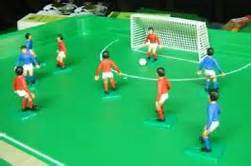
Then there was Super Striker, a five a-side game that was perhaps a step up, but still not exciting. I’m not sure if I ever played it much. Compared to Subbuteo, the players were pretty big but to kick you pressed their head and then they kicked. It was a bit boring as you moved the players to the ball and then kicked it and whatever player it ended up nearest, played next. With real diving goalkeepers too. Aye right if you could swivel it right.

Of course money was tight in the Stuart household, so I got the slightly downgraded Barras version, where you pulled the lever on the player’s leg. I can’t for the life of me remember what it was called, but again after a few games, the excitement dulled considerably. The players all came plain colour and you could choose to paint them but I was too lazy for that. Just ask the wife she does all the painting and decorating in ma hoose. (One email to that fellow sad sad man Robert Marshall and it turns out it was called Big League)

What about table football or Fussball as our European cousins like to call it?  Well in the Seventies the only thing built to last was rock music; other than that most of it was throwaway tat. So Table Football wasn’t that great as it was quite flimsily built, especially if you played with your big brother who insisted that he was allowed to tilt the table whenever he wanted.

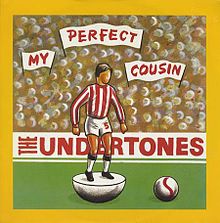
“He always beat me at Subbuteo,

Cos he flicked to kick and I didn’t know.”

The Undertones from ‘My Perfect Cousin’

220px-Myperfectcous

Subbuteo was king in the 70’s, of football games. The best thing was you could be your own team, for most of the other games you were either the red or the blue team.

Even though Subbuteo was still the best, it was still a pain in the arse to play. First there was that ‘grass’ cloth carpet, if you didn’t have a table to play on then it was the floor. It took ages to make room and flatten it out with your hands and then if you had a dog it was worse trying to get hairs off or trying to keep the dog from standing on it.

Once you’re set up, it’s Game on. I flicked to kick like a true aficionado, so quite quickly would get a couple of goals to the good and then it would happen.

“Aw sorry, David I just kneeled on one of your players”

“That was Joe Jordan ya bastard!”

Before you know it, you’re fighting on the carpet and not only has Jordan been obliterated, but Dalglish’s headless, Jardine’s legs have been snapped, Billy Bremner’s in a bad way and McGrain will no longer make those runs up the wings but Big Jim Holton is still standing imperiouly daring anyone to take him on. David Harvey just stood there with his arms raised at the horror of it all. Match abandoned.

OLYMPUS DIGITAL CAMERA
Sandy Jardine and Danny McGrain struck down in their prime.

You pack away the team and turn to your mate and say. “Let’s play fitba’ instead, it’s better than this crap”. Sad thing is kids don’t say that as much anymore as they prefer to play the game on computer.

(This was originally published in the Partick Thistle fanzine S.I.T.B., but some of the names have been changed to protect the innocent.)


David Stuart

PS. On the facebook page Ian Stewart offered up this game.

12347989_561111300703996_9051510263582690114_n

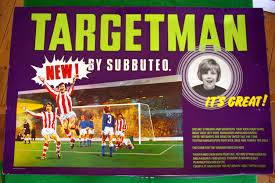
It seemed as if Subbuteo were trying to build on the success of their normal game by introducing Targetman.
You had two 5 a side teams one in blue tops white shorts the other in red and white stripes a la Everton v Southampton .
If my memory serves me right you pulled back the players legs which had a spring then let it go to kick the ball.
The pitch was enclosed so you batter the ball off the walls like you can in 5 a side.
I tried vainly to get my pals to play regularly but was fighting a losing battle and the prospect of setting up a Targetman league playing my sister constantly was unappealing (same opponent over and over like a modern day SPL).
Add to that the lack of different teams to buy, the usual Subbuteo trait of players breaking down and having to be glued in order to pass a fitness test Targetman sank faster than Monica Lewinsky at a Presidents ball.
After more than a year of not seeing the light of day Targetman was admonished from the Stewart household by my mother into the custody of “some weans who might be gled o it”
I embraced the beauty of “flick to kick ” and never looked back.
For all its failures though it was still better than the Bobby Charlton/Kenny Dalglish game


Happy Birthday Simon Donnelly

Simon Donnelly
14 Oct 1998: Simon Donnelly of Scotland trots forward during the European Championship qualifier against the Faroe Islands at Pittodrie in Aberdeen, Scotland. Mandatory Credit: Mark Thompson /Allsport


Simon Donnelly is 41 on December 1st and had one of those blink and you missed it Scotland careers. Having made thirteen appearances for the Scotland under 21 team Simon graduated to the first team in May 1997. He came on for the last ten minutes replacing Kevin Gallacher in a friendly with Wales down at Rugby Park unfortunately John Hartson scored the only goal of the game for Wales that night. Also making his debut that night was Brian McAllister of Wimbledon who played 3 games for Scotland in total and who incidentally turned 45 on November 30th.

Although Simon and Brian would gain very few caps between them, the other three debutees that night would garner 164 caps between them. David Weir reached 69, Christian Dailly, 67 and Neil Sullivan a mere 28.

Another friendly a month later in the Ta’Qali Stadium in Valetta, Malta saw Simon replace his fellow Celt John Collins for the final 6 minutes of the game. Scotland won 3-0 with Darren Jackson bagging a double with Dailly scoring the opener.

Cap number three came in October ’97 as Simon once again was given scant minutes to prove himself replacing Gordon Durie with again 6 minutes to play. This was in a World Cup Qualifier against Latvia at Celtic Park that Scotland won 2-0 with Gallacher and Durie scoring the goals.

A month later and Simon got to taste the atmosphere of Stade Geoffroy Guichard, Saint-Etienne in a friendly against France for all of seven minutes, coming on for Gallacher once more. Scotland lost 2-1 with Durie scoring the Scotland goal. Scotland would return to that stadium seven months later and be pumped by Morocco in our last game of the 1998 World Cup.

In a World Cup year there are always friendlies and 1998 was no exception as Simon would get a whole 26 minutes in a 1-0 defeat to Denmark at ibrox in March. 24 minutes against Finland in a 1-1 draw at Easter Road in April and then over to the USA to play Colombia at the Giants Stadium in East Rutherford in May. Scotland drew 2-2 with John Collins and Craig Burley netting for the Scots. Simon got a full 39 minutes for that one. This was followed by a game against the US in the R.F.K. Stadium in Washington which ended in a nil nil draw and Simon getting a lowly eight minutes.

So not the most prestigious start to his Scotland career, however, he had still impressed enough for Craig Brown to give him one of the Squad spots for the World Cup in France, although for Simon there would be no game time in the tournament.

Simon would once more come on as a sub in a Euro Qualifier against Estonia on October 10th at Tynecastle but his fellow sub Billy Dodds would make more of an impact as he equalised in the 70th minute to make it one each. However, a few minutes later Estonia would take the lead once more. Simon would then take on one the full backs and put over a cross from the left wing which the Estonian Centre Half put past his own goalkeeper in the 77th minute. With a few minutes remaining Billy Dodds would grab a vital winner.

Simon in his first nine caps played a total of 129 minutes and finally was given a starting place and a full ninety minutes four days later at Pittodrie against the Faroe Islands. Scotland won 2-1 with Craig Burley and Billy Dodds scoring the goals and Smirnov hitting a penalty late in the game to give us all a nervy final few minutes.

And for Simon that was that. It might not seem much but he did manage to play in ten games against ten different opponents and even more remarkably in ten different stadiums; even more bizarrely six of which were in Scotland without once playing at the National Stadium with games at Rugby Park, Celtic Park, Ibrox, Easter Road, Tynecastle and finally Pittodrie.

Happy Birthday Simon.

11141768_1639200322984006_4713053809168100637_n


David Stuart

SAINT ANDREW’S DAY

12316398_1682087178695320_186109348167470774_n

I’m not religious but I’ve always been happy to celebrate Saint Andrew’s day especially as it doesn’t involve having to buy someone a present. Saint Andrew is also the patron saint of Poland, Romania, Ukraine and Russia just in case you are looking for a team [away from these shores of ours] to support at next year’s Euros. Just for the ecumenical record then, only Scotland and Greece have recently disappointed the man who was one of Jesus’ original squad of twelve.

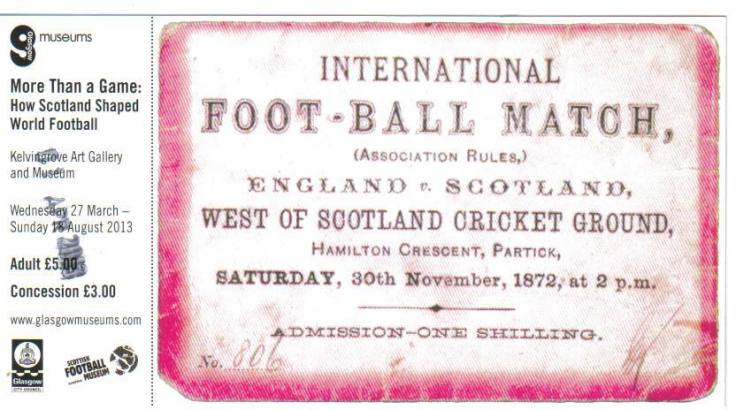
Of course it was on Saint Andrew’s day in 1872 that the world’s first international football match took place when Scotland played England at the West of Scotland Cricket Ground in the Partick area of Glasgow. The game finished goal-less, thanks in part to the heroics of the Scotland goalie and captain Robert Gardner.

From the outset Scotland wore blue jerseys with a lion on it – there was no room for pink in Partick in those days. Apparently a photographer was arranged but he left without taking any pictures because the players would not guarantee to buy any. A year later, a composite team picture was never printed because several of the England players were pulling funny faces. Those Victorian boys, eh? What japesters…
[Source:Scotland The Team by Andrew Ward].

11041264_1682087235361981_6534601996105402199_n

There have now been over a hundred Scotland-England matches but there has only been a goal-less draw on one other occasion – the concluding game of the British Championship at Hampden Park in April 1970. The Scottish goalie that day was Hearts’ Jim Cruickshank who, as well as looking like a Victorian Gentleman at the time, kept clean-sheets in two of his five other caps. It’s worth remembering that the English forwards in 1970 were Jeff Astle, Martin Peters and Geoff Hurst – architect of the two-goal hattrick.

So raise a glass if you will, to Saint Andrew, international football and the memory of players like Gentleman Jim.

Robert Marshal

Happy Birthday Andy Gray.


Scan0003

Andy Gray will turn 60 on November 30th. It’s fair to say that although Andy played 20 times for Scotland he never really had that period where you could say he was an established first choice striker for Scotland. Of course, anyone who played at the same time as Kenny Dalglish would always be second fiddle as such and there’s was quite a lot of competition for that place such as Joe Jordan, Derek Johnstone, Alan Brazil, Willie Pettigrew and Steve Archibald among others in Andy’s time as an internationalist.

Andy had won three caps at Under-23 level as a Dundee United player but by October, 1975 he had moved to Aston Villa. His final appearance at Under-23 level saw him score three goals against Denmark in a Euro Qualifier and the following month he was to make his first team bow. This time in a first team Qualifier against Romania at Hampden. Scotland were to draw one each with Bruce Rioch scoring the Scots goal. Also, making his one and only appearance in a Scotland shirt was Ayr United’s Johnny Doyle.

In April, ’76 he was in a forward line that included Dalglish, Derek Johnstone, Andy and making his debut Willie Pettigrew against Switzerland at Hampden. Willie opened the scoring after two minutes but despite the threat Scotland had upfront no more goals were to follow for either side. Willie Ormond had put out an almost experimental side with Alan Rough, Frank Gray also making their first starts, however making their first and last appearances for Scotland that night were Tommy Craig of Newcastle, Rangers players’ Alex MacDonald and Bobby McKean as well as Des Bremner of Hibs.

Cap number three in September 1976 saw Andy score his first two goals for Scotland as they routed Finland 6-0 in a friendly at Hampden. Also on the scoresheet were Don Masson, Bruce Rioch, Kenny Dalglish and Eddie Gray. Andy retained his place for Scotland’s first 1978 World Cup Qualifier in October, 1976 against Czechoslovakia in Prague. In an attacking minded team that night Scotland went with a front three of Jordan, Dalglish and Gray. Needless to say Scotland might have done better had Andy not been sent off along with Czech player Anton Ondrus in the 43rd minute. The Czechs obviously adapted quicker to the ten man game as they scored in the 46th and 48th minute to win the game two nil.

Ally MacLeod would come in as Scotland Manager a few months and despite being the top goalscorer in the English First Division for season 1976 – ’77 and in the following year scoring 29 goals and picking up both the English Player and Young Player of the Year, Andy was never picked by MacLeod prior to the ’78 World Cup and as is well known never made into the Squad for Argentina.

However, Andy returned to the fold for the first Post-Argentine Debacle game against Austria in Vienna for a Euro Qualifier. Scotland were three down by the 64th minute but goals by Gordon McQueen and Andy put a more respectable sheen on the game but it was enough for MacLeod to see the writing on the wall as he bowed out as Scotland Manager.

Andy probably thought with Jock Stein coming in he would have the chance to establish himself and indeed Andy started in Jock’s first game in charge in October, 1978 as Scotland squeezed out a 3-2 win in front of an expectant crowd of 65,372 at Hampden. Kenny Dalglish hit a double with an 87th minute penalty from Archie Gemmill claiming victory.

However, Jock seemed to prefer Joe Jordan alongside Dalglish for the next few games and it was not until March, 1980 that Andy was back in the line-up. Andy had joined Wolves in September, 1979 for a then English record of £1.5m. Andy was to score in a rare Scotland win for the time as they beat Portugal 4-1 in the final game of a poor European campaign in front of a paltry crowd of 20,233. Kenny Dalglish, debutant Steve Archibald and another Archie Gemmill penalty provided the other goals.

Andy’s 8th appearance would be a couple of months later a she came on as a late sub at Wembley in the Home International against England, which the Scots were to lose 2-0.

Andy would then get his best run in a Scotland shirt as he appeared for four consecutive World Cup Qualifiers starting in September 1980 as Scotland beat Sweden 1-0 in Stockholm with Gordon Strachan producing a slice of magic to provide the sole goal.  A non-score draw with Portugal at Hampden followed a month later with a trip to Tel Aviv in February ’81 next on the list. Scotland won one nil with Kenny Dalglish scoring in the 54th minute. Gray would come on for Dalglish fifteen minutes later as Scotland ground out an important two points. This was the only defeat the Israeli’s conceded at home and went a long way to secure Scotland‘s qualification. Andy would be recalled to start as Scotland would play out a nervous one each draw with Northern Ireland a month later at Hampden with John Wark scoring in the 75th minute to equalise after Hamilton had put the Irish in front five minutes earlier.

With four games and no goals produced, Jock Stein must have felt it was time for someone else to be given a chance with Joe Jordan once more being reinstated in the Scotland line up. In September ’81, Andy came on as a sub for Dalglish in 70th minute in another qualifier against Sweden at Hampden. Joe Jordan had given Scotland an early lead and Andy gained Scotland a penalty with a most dramatic dive in the 83rd minute, which John Robertson put away with his usual aplomb. Andy again made a subs appearance in another nervy night for Scotland, this time in Belfast when he came on for Gordon Strachan in the 70th minute. The game ended 0-0, which was enough to see Scotland qualify for the World Cup in Spain.

Again, Andy would see a World Cup Finals come and go without his presence and probably felt a bit more aggrieved having played in 6 of the 8 qualifiers with Alan Brazil, Steve Archibald, Joe Jordan and Paul Sturrock all getting the shout ahead of him.

However, Andy was recalled to the squad for the May, 1983 Home Internationals playing the full ninety minutes in all three games with Kenny Dalglish missing out; as Scotland drew nil nil with Northern Ireland at Hampden, then scoring one of the goals as the Scots beat Wales 2-0 at Ninian Park, Cardiff with Alan Brazil producing the other. In the final game once more the Scots went down 2-0 to England at Wembley.

Andy also joined the squad for the team’s tour of Canada that summer with three games against the Canadians. Andy was a sub in the second game in Edmonton, as Scotland won 3-0 with Charlie Nicholas, Richard Gough and Graeme Souness providing the goals. Scotland had already won the first game 2-0 in Vancouver; Andy scored both goals in Toronto’s Varsity Stadium as they won with the same result to end their tour.

Despite those goals, Andy once more found himself in the International wilderness with the emergence of the likes of Mo Johnston and indeed he would be called up for the squad once more for what was to prove to be Jock Stein’s penultimate game in charge.

Andy was by now an Everton player and was picked to play in what would prove to be a vital World Cup game against Iceland in Reykjavik. Scotland won by virtue of a Jim Bett goal that took a long time in coming as the Scots finally broke down the stubborn Icelandic defence in the 86th minute.

Andy would be part of the squad for that fateful night in Cardiff when Jock Stein lost his life.

Andy was never to play for Scotland after this. So here’s to Andy who like a lot of Scotland strikers over the year perhaps should have scored more goals for his country but one thing’s for certain there would be few who would have been more committed or as brave as Andrew Mullen Gray, when it came to playing for Scotland as Andy didn’t really know how to play any other way.


David Stuart

Blog at WordPress.com.

Up ↑